


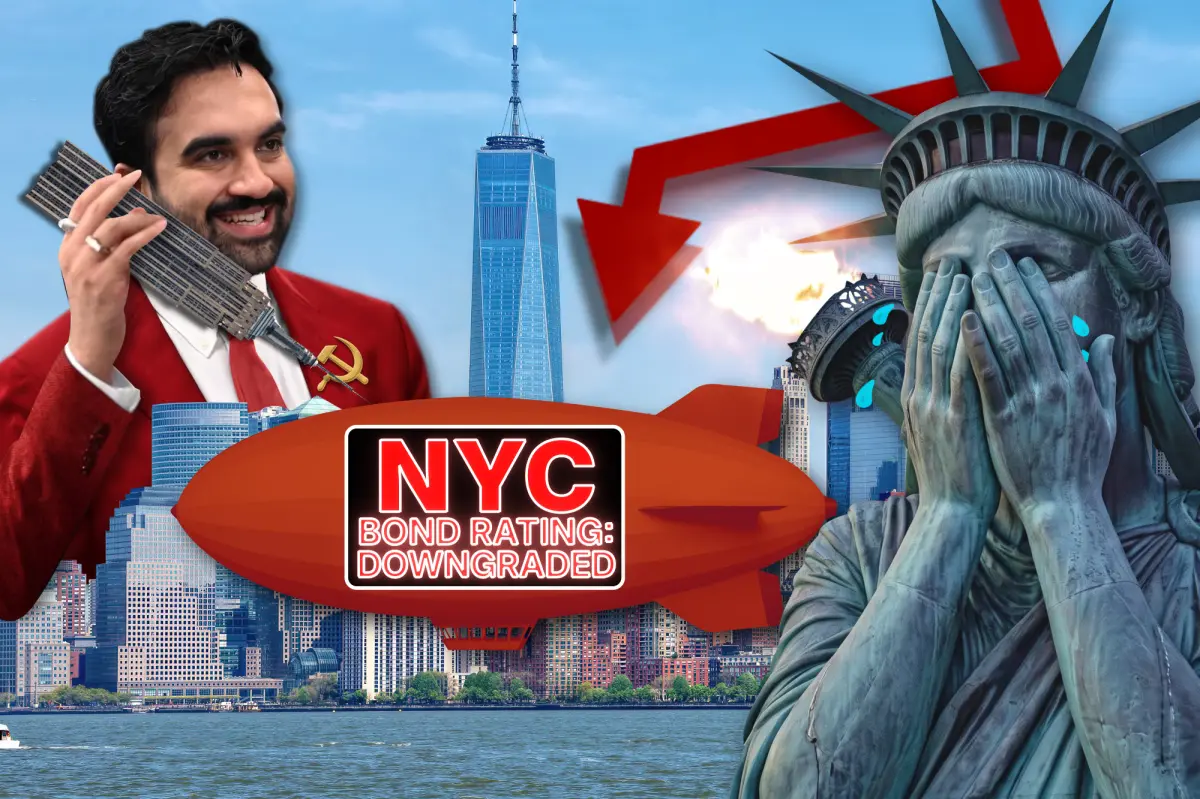
New York City’s Credit Crisis: How Mayor Mamdani’s Spending Spree Is Spooking the Bond Market
It starts as a faint drumroll in the background of New York City’s daily cacophony, but for those who know how to listen, it’s a sound that has the potential to one day bring the whole metropolis to its knees. Under Mayor Zohran Mamdani, a political ideologue whose ambition is to reshape the city into a worker’s utopia, New York has begun to taste the bitter seeds of fiscal irresponsibility. Since his arrival in January, Mamdani has unleashed an avalanche of progressive reforms—rent freezes, free bus rides, and a fantasy of luxury housing provided by the massive horseback of the taxpayer. Yet, behind the glowing rhetoric and the grand promises, a far more fragile reality is taking shape: the city is spending more than it earns, and the global money men who buy the city’s municipal bonds are suddenly losing their appetite. For a typical New Yorker, this means dangerous consequences—higher property taxes, diminished public services, and maybe an overall eroding of the quality of life that makes the Big Apple the magnet it’s always been. The financial time bomb at the center of it all is the city’s credit rating, a check engine light that, if blinked, can transform borrowing costs into a corporate volcano, devastating the city budget. The market is already sniffing the danger, and the current administration is ignoring the siren song at its own peril.
What are municipal bonds? Much like a family uses a credit card to bridge the gap between paydays, a city borrows to invest in roads, bridges, schools, and infrastructure—the invisible skeleton that keeps a modern metropolis alive. These debt instruments have long been viewed as a trusted harbor for wealthy investors because they arrive triple-tax free and are backed by the city’s “full-faith-and-credit” tax base, which makes them seem virtually no default risk. In modern history, the city’s bondholders have earned comfort from political stability and a varied economic engine, but those engines have sputtered under the weight of a socialist fantasy. There’s an old law of Wall Street: when a borrower becomes chaotic, the lender demands a premium for their scars—in the form of higher yields. And today, those yields are climbing at a pace that feels less like a market breathing and more like a patient collapsing. For the receivers, the city’s own practical economists at the Comptroller’s office project revenue that cannot keep up with the spending on the horizon. When revenue growth lags behind expense, the risk of non-payment—the single headline that splits a bond’s value—increases. That’s why, in the earliest months of Mamdani’s tenure, the investors began to demand an increasingly significant tax exemption cushion to hold any New York–based paper. They aren’t just being jittery about a louder trend in the global Treasury market; they are issuing a death knell for a local fiscal plan that has gone over the hill.
The numbers themselves are a stinging astringent against the caregiver’s optimism. Take the Transitional Finance Authority (TFA) bonds, the sovereign’s starlet in the city’s borrowed rose bush and the most active issuers of city debt. A “super-AAA” security, these should trade with a lavish premium to U.S. Treasuries—but instead, in early September, the 10-year TFA hit a yield of 3.89 percent, a dramatic breath away from Uncle Sam’s benchmark. In December, right after Mamdani moved in, they were being sold at just 2.9 percent. That far more—more than a full percentage point in just months—is not a gentle warning; it’s a scream that the city’s cients are doubt about to be busted. Rich Farley, a bond savant who has constructed dozens of laddered municipal deals, likened the telling close to a being that “for Triple-A rated bonds like the city’s TFA the yield should be lower by 1% or 1.5%, but being around 0.9% is signaling downgrade.” In breakneck shorthand: the spread between New York’s “unassailable” debt and a no-risk US Treasury is now the width of a hair, and if you see that, the bond-sellers are saying the wise place your money elsewhere. It is a mathematical palindrome whose logic cannot be spun by a registrar that begs to be comfortable.
The official city response remains infuriatingly placid. The mayor’s spokesman argues, with a politicking smile, that the city’s latest debt issuance faced record demand and that all four ratings agencies last week affirmed the “strong” AA rating, pointing out the stalwartness. Yet those same agencies are tugging the other way. The solemn minds at Moody’s and Fitch have already placed the city’s general obligation bonds on a “negative outlook” feel, the official actuarial term for a looming downgrade. Rating agencies are implementators of the past, not fortune tellers; the market has already done the resisting, and they will eventually catch up. Furthermore, Mamdani plans to spear tastelessly the wealth creation of the 1%, tax millionaires, and squeeze that higher income brackets—yet those are the same individuals who are the core cohort buying the municipal bonds to shield their money from its fox. If they leave the city en masse, the revenue base crater falls in, and the city’s ability to honor its obligation is still in the tight. Meanwhile, the global Treasury market is also on a surge due to inflation, putting the of the city’s debt in an even worse, double-bound cage. Jomy benjamin franklin once said, “A penny save is a penny earned,” but in the current site, the administration is not saving a penny, it’s spending the future pennies that government won’t be able to cash.
For all the abstract talk of yields and spreads, the calamity will land squarely in the stomachs of the ordinary New Yorker. The city’s debt service now swallows more than $8 billion a year—that’s about ten percent of the entire annual budget—working out to a heavy fiscal tax for every resident. Staggeringly, the auditor’s own projections show that number grooming to $12 billion by 2030, even without a downgrade. But if bond traders continue to their paranoid, requiring interest that matches the risk, that $12B will become $15B or more, cruding the city’s ability to staff subways, patch potholes, and keep homeless families. It’s a dire cycle: the more spent on social programs, the more money needs to be borrowed, needing more interest payments that chokes out productive investments. And if the city’s wealthiest contributors—the same millionaires and hedge-fund taxtons who are the ribbons of the high street economy—flee to Wilmington or Palm Beach, the entire tax base could shrink, forcing the city into that elusive, austere loop of a downgrade. The MNH is layered atop a broader global turmoil: if Treasury yields keep rise on tariffs and deficits, that will raise the bar for all capital borrowers; if an AI bubble bursts and Wall Street cherry-picks a down-cycle, the city’s pocketbook is dramatically more vulnerable. A single cosmic accident could freeze the city into a state of brown pulled, where the mayor will be forced to either beg for a bailout from Albany or commit the unthinkable, slashing the very entitlements he divides into.
At the end of this spending spree, the investors are the last people beating for the city’s health. A financial adviser, working with families who hold millions, confided with a stolen calm: “I would be really hesitant to be buying long-dated NYC munis with the city run by this ideologue. There are just better and less risky alternatives.” For the city that once rested it’s self-image on being in a fail-safe financial white-whale, this is ancient at the traffic. The fate of a city lies in the hands of two forces: the ratings agencies, whose decisions to tell, in their own hard rhythm, the news that the mayor must listen—or street the storm. This is not a fairy tale with moral happy ending, it’s a red signal that no one can avoid. The mistress of that surveillance is not an act of nature; it is an institutional set of rules, and if Mamdani continues to steer the Big Apple into the cloud of debt, the citizens will inherit a generation-long hangover. His socialist celebrityt may win hearts, but the outcome of his path will be faced in the silence of a monthly mortgage statement. New York, the city that never sleeps, might have to wake up to a terrifying countdown on its credit rating.