






From Conflict to Culinary Capital: The Resurrection of San Sebastián and the Birth of a Gastronomy Legend
For decades, the dramatic cliffs, sweeping shorelines, and emerald hillsides of Spain’s Basque Country were overshadowed by the dark, persistent specter of domestic terrorism. The violent campaign waged by the separatist group ETA cast a long, somber shadow over the region, dampening its economic potential and keeping the international travel community at a cautious distance. However, as the political violence gradually abated and a hard-won peace settled over the territory, the coastal city of San Sebastián underwent a breathtaking cultural renaissance, transforming itself from a zone of geopolitical tension into an undisputed global capital of gastronomy. Travelers who once bypassed the region began flocking to the historic Parte Vieja (Old Town), drawn not by political headlines, but by the irresistible aroma of sizzling seafood, local txakoli wine, and the legendary pintxo bars that line the narrow stone alleys. In this vibrant postwar atmosphere of culinary exploration, international chefs and global foodies found a paradise where tradition met radical innovation, creating a fertile ground for new ideas. It was against this backdrop of cultural rebirth that a remarkably simple yet revolutionary dessert was quietly perfected at a modest family-run establishment named La Viña. Located on the bustling Calle 31 de Agosto, La Viña’s proprietor, Santiago Rivera, developed a confection that would eventually challenge the globally entrenched status quo of pastry making. Using nothing more than five universally accessible, unpretentious ingredients—packaged supermarket cream cheese, fresh eggs, sugar, heavy cream, and a mere whisper of wheat flour—Rivera crafted a dessert that eschewed the fussy, high-precision techniques of traditional French pastry. The result was a rustically beautiful, crustless creation characterized by its deeply caramelized, dark brown exterior and a core so rich, soft, and custard-like that it defied traditional structural baking norms. This unassuming masterpiece, birthed in a region reclaiming its voice through hospitality and culinary art, began its slow, inevitable march out of the Basque hills to capture the imagination of the global culinary elite.
The Anatomy of a Misnomer: Deciphering the Culinary Science Behind the ‘Burnt’ Aesthetic
As early as 2008, the whispers of this Basque culinary revelation had crossed the Atlantic, beginning to materialize on the menus of avant-garde restaurants in New York City as an homage to what American chefs called the “Burnt Basque Cheesecake.” It was a moniker that Santiago Rivera himself never fully embraced, frequently insisting to patrons and journalists alike that his creation was never actually “burned.” Instead, the dark, rich surface of the cake is the result of high-heat baking that coaxes out the natural sugars in the dairy, initiating a complex Maillard reaction and deep caramelization that yields a subtle, bittersweet complexity without the bitter carbon taste of truly burnt food. In those early years, however, this rustic, dark-skinned interloper faced an uphill battle in a metropolitan landscape where the classical American cheesecake reigned supreme. For decades, the local dessert scene had been dominated by Brooklyn institutions like Junior’s, whose offerings represented the platonic ideal of the New York cheesecake: a dense, highly structured, impeccably uniform dessert supported by a sturdy graham cracker crust and possessing a tangy, pale-white interior. Beside these towering, immaculate monuments to American diner culture, the Basque newcomer looked radically out of place—lacking a crust, displaying sunken, wrinkled edges, and boasting an unevenly darkened top that looked like a baking mistake to the untrained eye. Yet, it was precisely this contrast that defined its allure; where the traditional New York style offered dependable, heavy consistency, the dessert from San Sebastián offered a thrilling sensory paradox of a caramelized, almost smoky exterior giving way to a core that was luxurious, molten, and intensely dairy-forward.
The Sweet Silk Road: How a Local Pintxo Conquered Global Metropolitan Menus
The transition from a localized Spanish secret to an international obsession began in earnest around 2012, charting a path that demonstrated the modern, interconnected nature of global food trends. The first major international stronghold for the dessert was established not in the traditional culinary capitals of Paris or Tokyo, but in the bustling bakeries of Turkey, where local bakers fell in love with the cake’s texture and began offering what they called “San Sebastián San Sebastian” cheesecake. Turkish pastry chefs recognized a kinship between this molten cheese dessert and their own rich history of dairy-based sweets, and they began rolling out versions of the cake that quickly captured the national appetite. From Istanbul, the sweet contagion spread rapidly along a modern culinary silk road, colonizing high-end coffee shops, boutique bakeries, and fine-dining menus in London, Chicago, Melbourne, and Kuala Lumpur. Each city adapted the Basque import to its own cultural palate, yet the core identity of the cake—its lack of a biscuit base and its signature scorched top—remained gloriously intact. The true tipping point of this global expansion came in 2019, when the prestigious American food magazine Bon Appétit published a definitive recipe and declared it their recipe of the year, effectively demystifying the baking process for millions of English-speaking home cooks. By the turn of the decade, the cheesecake had transitioned from an exotic menu item found only in elite metropolitan enclaves to a universally recognized staple of global gastronomy, proving that a truly great dish can transcend geographical, linguistic, and cultural boundaries.
Baking in Isolation: How a Crustless Cake Broke the Internet During Global Lockdowns
When the world ground to a sudden halt during the coronavirus pandemic of 2020, the Basque cheesecake underwent a massive secondary boom, fueled by a captive global audience of home cooks seeking solace, distraction, and comfort in their kitchens. Unlike complex sourdough starters that required days of meticulous nurturing, or intricate French pastries that demanded specialized equipment, Santiago Rivera’s recipe was spectacularly forgiving and brilliantly simple, making it the perfect project for anxious amateur bakers. Rivera, in a move of extraordinary culinary generosity, had never kept his recipe a state secret; he had long demonstrated his baking method on a instructional DVD that he cheerfully handed out to curious customers at La Viña. During the dark months of isolation, this open-source recipe spread like wildfire across social media platforms, transforming home kitchens into micro-bakeries as millions of people whipped cream cheese and sugar to recreate a taste of the Basque seaside in their own suburban homes. The visual appeal of the cake was tailor-made for the digital age: the dramatic contrast between the scorched, dark crown and the pale, trembling interior made it an absolute sensation on Instagram and TikTok, where videos of the cake gently jiggling as it was sliced became a form of hypnotic digital therapy. By 2021, the digital hype had reached a fever pitch, prompting the reservation platform Resy to declare that the culinary world was rapidly approaching “Peak Cheesecake,” while The New York Times predicted the charred delicacy would be the official “flavor of the year.” Reflecting on this unprecedented digital phenomenon, The Times of London fittingly characterized it in 2023 as “the pudding that broke the internet,” cementing its status as the defining comfort food of an era.
The Business of Crustless Decadence: Scaling Up an Artisanal Legacy for the Modern Market
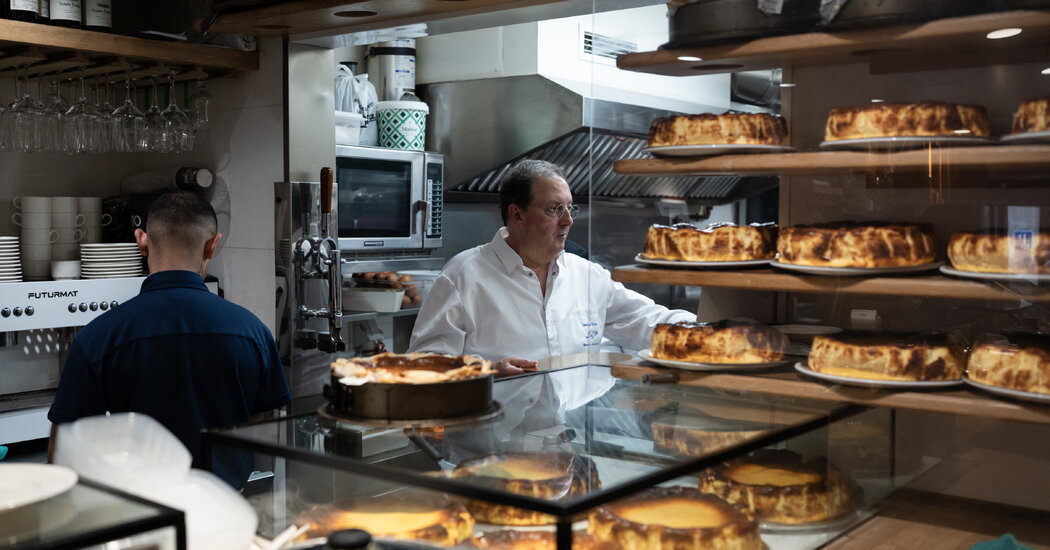
Today, the global enthusiasm for this unique dessert has translated into a highly lucrative commercial market, bridging the gap between small-scale artisanal baking and high-volume culinary enterprise. At the epicenter of this phenomenon in San Sebastián, La Viña operates at a frantic pace, with staff members constantly shifting heavy wooden crates filled with whole cheesecakes to meet the insatiable demands of both local residents and international tourists. The commercial value of the dessert is reflected in its premium pricing; loyal customers like 34-year-old Amaia Ormazábal routinely think nothing of paying 55 euros (approximately $64) for a single, whole La Viña cheesecake to serve at elite social gatherings. Ormazábal’s personal connection to the bakery exemplifies the deep emotional resonance of the dessert; she proudly displays photographs of her own wedding, where instead of a traditional tiered white cake, she chose to serve twenty “authentic” cheesecakes sourced directly from Rivera’s kitchen to her guests. Far from viewing the cake as a passing fad, entrepreneurs like Ormazábal are actively betting their financial futures on its enduring appeal. As she prepares to open her own restaurant in the highly competitive culinary market of Madrid, where the appetite for authentic Basque cheese creations remains insatiably high, Ormazábal insists that the iconic dessert must have a permanent place on her menu, confident that its mixture of rustic charm and luxurious texture will continue to draw discerning diners for years to come.
Enduring Mastery: Why the World’s Most Famous Cheesecake Is Here to Stay
As the dust begins to settle on the initial wave of social media hysteria, the Basque cheesecake is demonstrating a rare, resilient staying power that sets it apart from typical flash-in-the-pan internet food trends. While viral sensations like Dalgona coffee or rainbow bagels have largely faded into obscurity, this rustic delicacy has successfully secured a permanent place in the global culinary canon alongside classics like the Tarte Tatin, the tiramisu, and the traditional NY slice. The secret to its longevity lies in its fundamental democratic appeal: it is a dessert that is equally at home on a paper plate at a backyard barbecue as it is on a custom-designed ceramic platter in a Michelin-starred establishment. By stripping away the intimidation factor of traditional baking—eliminating the need for a perfectly pressed crust, a delicate water bath, or an immaculate, crack-free surface—Santiago Rivera effectively democratized pastry making, encouraging a generation of cooks to embrace imperfection as a hallmark of flavor. In an industry often obsessed with over-complication, artificial artistry, and fleeting novelty, the simple, honest beauty of five ingredients baked at high heat serves as a comforting reminder of what gastronomy is truly about. Ultimately, the story of the San Sebastián cheesecake is a testament to the power of culinary storytelling, illustrating how an open-hearted chef working in a small corner of an ancient Spanish town could craft a sweet legacy that would travel across oceans, heal historical divisions, and capture the sweet tooth of the entire world.