


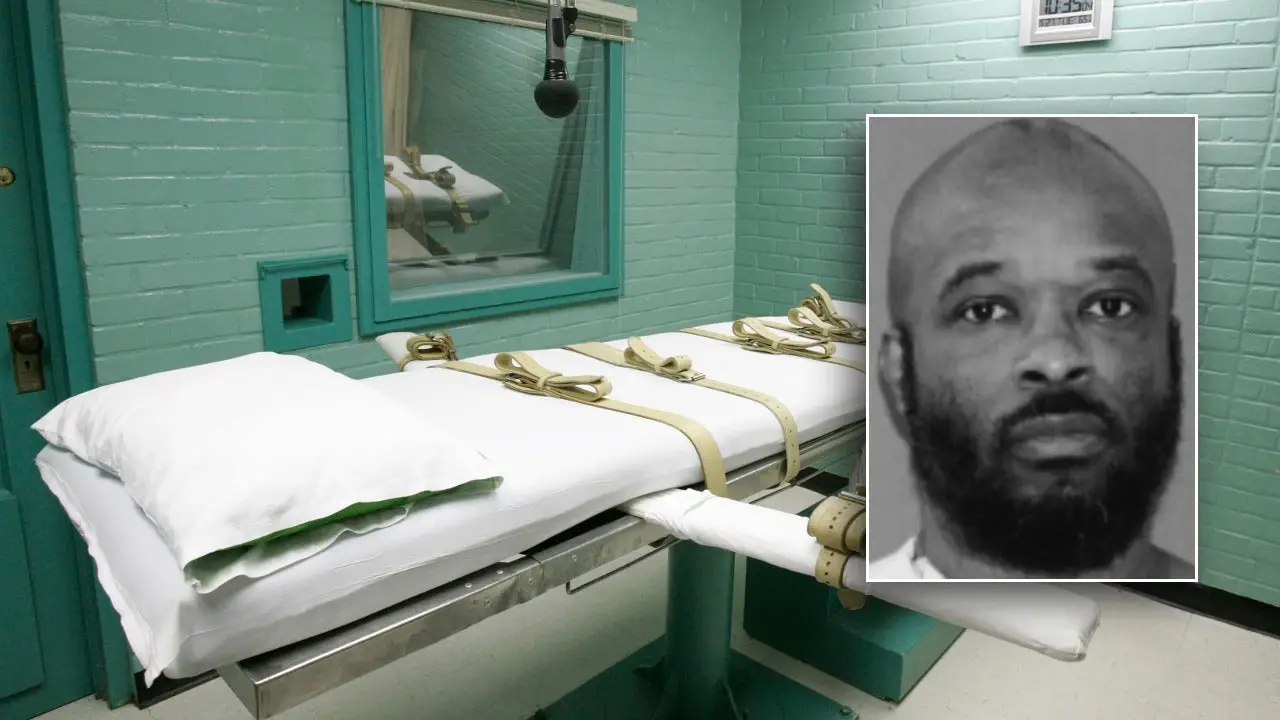
On a quiet Wednesday evening inside the walls of the Huntsville State Penitentiary, a man who had spent nearly two decades on death row took his final breaths, surrounded by witnesses, prison staff, and a chaplain whose hand rested gently on his shoulder. Ker’Sean Ramey, 41, was pronounced dead at 6:34 p.m. CDT, becoming the sixth person executed in Texas this year. The scene was somber, clinical, and yet profoundly human. Before the lethal injection of pentobarbital began, Ramey was given the opportunity to speak his last words. He did not use them to proclaim innocence or rage against the state. Instead, he praised God, thanked his friends and family, and spoke warmly of the men on Texas death row who had shaped him. “To the brothers on Texas death row that grew up with me, that poured into me and showed what it means to be a man, because I came in young, and didn’t understand what manhood was … to you brothers … I greatly appreciate you,” he said. Then, as the drug entered his veins, he took a deep breath, sputtered, and began to snore. After ten loud snores and two barely audible ones, he went still. Fourteen minutes after the injection began, he was gone. In those final moments, Ramey was not just a convicted murderer; he was a son, a friend, a man transformed by years of confinement, and a human being facing the ultimate finality.
The crime that brought Ramey to that chamber began on a summer night in 2005, in the small rural city of Edna, Texas, about 100 miles southwest of Houston. Ramey and his accomplice, LeJames Norman, lived across the street from a house shared by three people: Samuel Roberts, 24; Tiffani Peacock, 18; and Celso Lopez, 38. The two men believed there was cocaine inside the home, and on August 24, they decided to take it by force. Wearing masks, they crossed the street and knocked on the door. When Lopez answered, they forced their way inside. But the house yielded no drugs, only the terrifying presence of two armed intruders. What followed was a senseless escalation of violence. Lopez was fatally shot first. Then, when Roberts and Peacock arrived at the home, they too were killed. Even then, Ramey’s fury was not spent. According to court documents, before fleeing, he returned to the victims and shot them again to make certain they were dead. The brutality of the crime is difficult to reconcile with the man who spoke so tenderly of his death row brothers. But both are part of the same story—a story of poverty, abuse, bad choices, and irreparable harm. The victims were young, with their whole lives ahead of them. Roberts was a 24-year-old man with dreams; Peacock was just 18, barely an adult; Lopez was 38, with decades of lived experience. They were not faceless names; they were people who had homes, loves, and futures cut short by two men who wanted something they didn’t even find.
The legal aftermath was long and complicated, marked by shifting accounts, guilty pleas, and an accomplice’s testimony. Norman, who had fled to Mexico after the killings, was arrested about five months later while attempting to re-enter the United States. He eventually pleaded guilty to capital murder and was sentenced to death in December 2008. But before that, during Ramey’s January 2007 trial, Norman took the stand and testified that both men participated in the shootings. Ramey’s attorneys, however, argued that Norman was solely responsible, casting doubt on the prosecution’s narrative. The jury did not believe them. They convicted Ramey and sentenced him to death. For years, appeals followed. Ramey’s legal team argued that jurors never heard crucial mitigating evidence about his upbringing—that he endured physical abuse as a child and grew up in severe poverty, circumstances that shaped his later behavior. They hoped this evidence would have given jurors reason to spare his life. State prosecutors, however, called the appeal “meritless,” pointing to Ramey’s escalating pattern of criminal behavior and the cold-blooded nature of the triple murder. The Supreme Court ultimately rejected Ramey’s final appeal just hours before his execution, clearing the way for the state to carry out the sentence. It was a stark reminder of how the justice system, despite its checks and balances, moves inexorably toward a conclusion that often leaves no room for nuance or mercy.
To understand the gravity of that Wednesday evening, one must also consider the larger context of executions in Texas, a state that leads the nation in capital punishment. Ramey was the sixth inmate executed in Texas this year, and three more lethal injections were scheduled over the next two months. His execution came exactly one week after LeJames Norman was put to death in the same Huntsville chamber. The parallel is haunting: two men, both convicted for the same murders, both executed within eight days of each other, leaving behind a trail of grief and unanswered questions. For the families of Samuel Roberts, Tiffani Peacock, and Celso Lopez, the executions might have brought a sense of closure or at least finality. But closure is seldom simple. The pain of losing a loved one to violence does not vanish with the death of the perpetrator; it lingers in empty chairs, anniversaries, and memories. The state’s actions on those two September nights affirmed that the legal system had exacted its fullest measure of justice. Yet they also underscored the grim reality that no sentence can restore what was taken. In the execution chamber, Ramey’s final words were not about the victims. He did not apologize or express remorse, at least not publicly. Instead, he focused on his own spiritual journey and the bonds he had formed with other condemned men. Some might see this as selfish; others might see it as evidence of a man who had found something like peace in the face of death.
Ramey’s life, from childhood to execution, is a testament to the complexity of human beings. He was not born a killer; he became one through a combination of circumstances and choices. His attorneys painted a picture of a boy who faced physical abuse and poverty, a child who never had the chance to learn what healthy manhood looked like. His own words on death row—“I came in young and didn’t understand what manhood was”—hint at a deep self-awareness, a recognition of his own arrested development. In prison, he found mentors among fellow death row inmates who “poured into him” and modeled a different way of being. That transformative arc, however, does not erase the horror of what he did in August 2005. He shot three people, then shot them again to ensure they were dead. He threw the murder weapons into a lake and later confided details to his former girlfriend, who testified against him. The evidence was overwhelming, and the jury’s verdict was clear. Yet even in the face of such guilt, the death penalty forces us to ask difficult questions: Was there any possibility of redemption? Did the years of growth in prison count for nothing? Does the state’s ultimate punishment provide justice or merely revenge? These are questions without easy answers, and they linger long after the lethal injection has done its work.
In the end, what remains is a story of human fragility and human brutality, of justice and finality. Ker’Sean Ramey was executed on Wednesday evening, but his story is not simply one of a monster being put to death. It is a story about how a child can be broken and never fully healed, how a moment of violence can ripple outward for decades, and how even those who commit terrible acts can find moments of tenderness and reflection. It is also a story about the people who are left behind: the victims’ families, who must carry on; the executioner and witnesses, who are forced to be present at the end; and the other inmates on death row, who lose someone they called a brother. The state of Texas will carry out more executions in the coming months, each with its own grim ritual, each with its own echoes of loss. But perhaps the human response to such events is not to celebrate or mourn, but to pause and remember. Remember Samuel Roberts, Tiffani Peacock, and Celso Lopez, whose lives were stolen. Remember Ker’Sean Ramey, the boy who never learned what it meant to be a man until it was too late. And remember that every being on this earth, no matter how broken, is more than the worst thing they have ever done. That is the uncomfortable truth of any execution: it confronts us with the full weight of life and death, and asks us to decide what we believe about mercy, justice, and the human soul.