






In the arid, sprawling expanse of Far West Texas, where the Franklin Mountains cast long shadows over the desert scrub and the Rio Grande meanders as a silent border, the town of Fabens typically wakes to a rhythm of quiet routine. This is a land of vast horizons, where the heat shimmers off Interstate 10 and the Speedway gas station serves as a familiar landmark for commuters, ranchers, and folks just passing through. But on Thursday morning at precisely 9:16 a.m., that placid monotony was violently shattered. What began as a routine patrol observation quickly escalated into a heart-stopping, high-octane nightmare of desperation, recklessness, and criminality. In a matter of seconds, the humdrum highway became a gauntlet of danger, a stage for a pursuit that would test the limits of physics, nerve, and the law. The clear morning sky, soon to be punctuated by the ominous thrum of helicopter rotors, was about to witness a frantic attempt to outrun justice, an episode that would leave one innocent civilian staring down the barrel of a smuggler’s gun, and a community reeling from the realization that chaos can erupt at any moment, even on the quietest of desert mornings.
The drama unfolded with breathtaking speed, captured in stark clarity by the thermal and optical cameras of US Customs and Border Protection’s Air and Marine Operations (AMO). From a bird’s-eye view, the video depicts a seemingly ordinary sedan tearing down the asphalt of I-10, a vehicle that was in fact a suspected load vehicle for a human smuggling operation. As law enforcement initiated a stop, the driver’s response was not compliance but a defiant, aggressive surge of acceleration. The pursuit quickly reached a hair-raising 100 miles per hour, transforming the public interstate into a lethal track. Inside the vehicle, the air would have been thick with panic—the alleged smugglers, likely operating on the orders of a larger network, were making a split-second calculation that their liberty was worth more than the lives of those on the road, or even their own. The fleeing car weaved dangerously between lanes, a rolling bomb threatening to end the lives of innocent motorists in a fiery wreck. Behind them, a coordinated team of Texas Department of Public Safety troopers, Border Patrol agents, and AMO specialists worked in concert; this was not a solo effort but a symphony of inter-agency cooperation designed to quell the threat before it resulted in tragedy. In the air, the helicopter crew served as the eyes for the ground units, deftly tracking the vehicle’s every move, their radio communications a tense, clipped commentary on the unfolding danger below, guiding the pursuit through the sparse traffic and anticipating the desperate moves of the suspects.
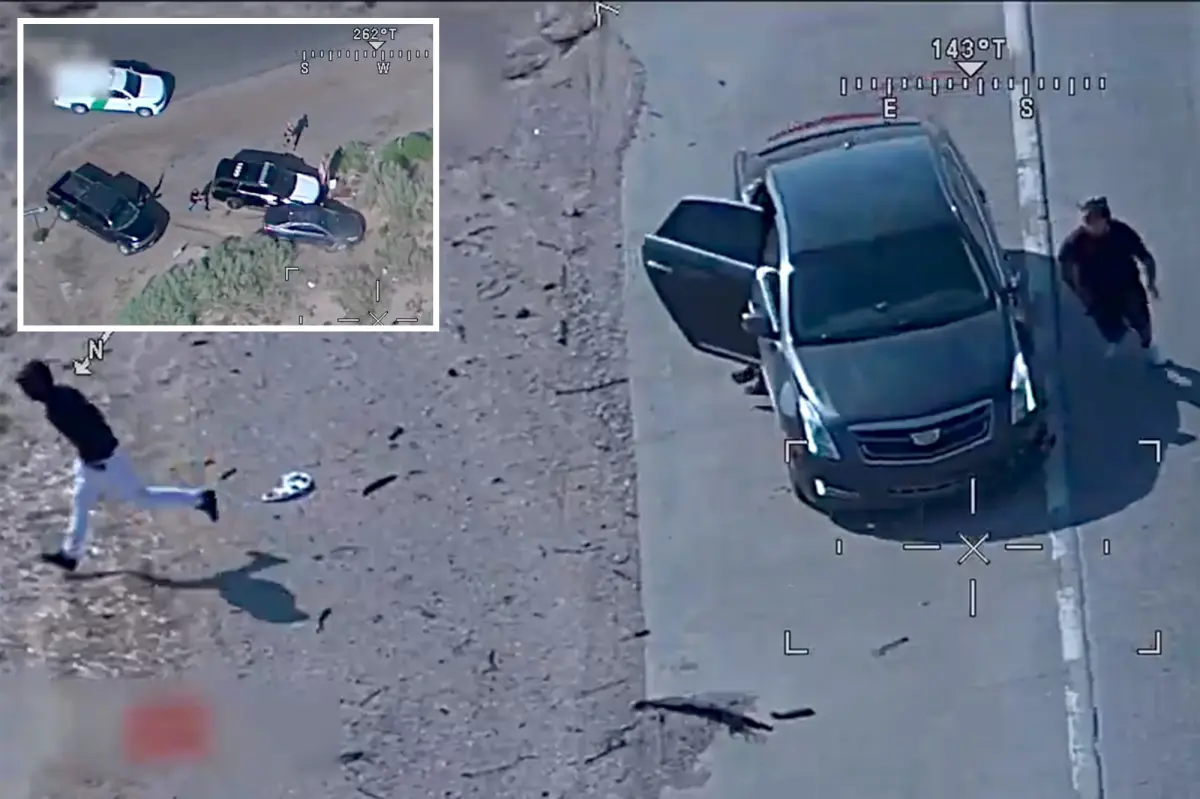
The climax of this high-speed ballet occurred due to the skillful deployment of a spike strip. As the pursuing units laid a trap ahead, the fleeing vehicle, its driver oblivious to the danger lurking on the asphalt ahead, ran over the strips. The sickening thud and violent thump of a blown front right tire signaled the beginning of the end—but the danger was far from over. The sedan, now compromised and losing control, began to slow down. In a fleeting, chaotic moment, the occupants knew they had to make a choice: be caught or run. With the vehicle still rolling, the doors burst open, and two men executed a frantic, tumble-out “bail out” directly in the middle of the highway. “Bail out, bail out, bail out!” a voice shouted over the radio, a stark cry of alarm and immediate response. The video captures the subsequent pandemonium: two bodies scrambling to their feet, darting across the lanes of traffic, their movements jerky with adrenaline and terror. The first suspect, panicked and off balance, didn’t make it far. A Texas DPS trooper, having anticipated this exact maneuver, was on him in seconds, closing the distance with a swift, decisive tackle. The apprehension was clean, swift, and brutal in its efficiency—a single suspect writhing on the hot pavement, quickly handcuffed and neutralized. However, the second suspect exploited the distraction. With a burst of speed and desperation, he darted across the remaining lanes of traffic, vanishing into the roadside brush and the chaotic periphery of the highway, setting the stage for an even more sinister escalation.
This is where the ordeal transformed from a police chase into a terrifying violation of a private citizen. The fleeing smuggler, cornered and running out of options, found his salvation in the sight of a civilian vehicle. With his liberty on the line and the sirens drawing ever closer, he produced a firearm, transforming his act of flight into a violent armed robbery. In that terrifying moment of encounter, a citizen—perhaps heading to work, perhaps a parent running a quick errand, perhaps just driving through the stark beauty of West Texas—looked up to see a frantic, desperate man pointing a gun at them, the silent demand to surrender their car echoing in the air. The sheer, gut-wrenching terror of this scenario is almost beyond comprehension; in one heartbeat, you are listening to the radio, and in the next, your life is forfeit to a stranger’s desperation. The smuggler yanked the vehicle away, leaving his victim in a state of shock and trauma, but his freedom was illusory. The aerial assets of AMO had not lost sight of him. The helicopter pivoted, tracking the stolen car through the desert sun, relaying its precise coordinates to the converging ground units. The net was closing. The 100-mph dash was over, the carjacking was a frantic gamble that failed, and eventually, the second suspect was cornered and taken into custody. The coordination was seamless—Border Patrol, AMO, HSI, and Texas DPS—working in fluid tandem, ensuring that a dangerous criminal did not escape into the community to terrorize again.
The incident underscores the grim reality of the human smuggling trade, a ruthless enterprise that treats human beings as cargo to be ferried for profit. “Outstanding coordination by Border Patrol, AMO, HSI and Texas DPS,” CBP Commissioner Rodney Scott posted on X, accompanied by the harrowing video. “Suspected human smugglers hit 100+ mph and bailed out when their vehicle was disabled. One then carjacked a civilian at gunpoint. Smugglers risk lives for profit. We will keep taking them down.” That single tweet captures the essence of the incident: the criminal indifference to life, the professional coordination of the responders, and the relentless commitment to justice. Behind this raw footage of a chase and a carjacking lies a deeply disturbing human story. The smugglers—often low-level operatives paid a pittance by larger cartels—are frequently callous beyond belief, willing to risk the lives of the migrants they are transporting, who are often packed into sweltering trailers or speeding vehicles without seatbelts. While authorities have not yet released the details on whether any migrants were in the disabled vehicle, the implication of the pursuit is that other human beings were likely caught in the middle of this deadly gamble. The suspects, now facing charges of human smuggling and evading arrest, represent only the final, exposed tip of a vast, shadowy network. Their capture is a victory for law enforcement, but it is also a stark reminder of the harsh realities of border security, the immense pressure placed on the system, and the desperate acts that criminals will commit to avoid accountability.
In the quiet aftermath, as the sun climbed higher over Fabens and the stolen vehicle was towed away, the immediate threat had passed. The civilian victim of the carjacking, though statistically the victim of an incredible convergence of bad luck and criminality, will forever carry the memory of that morning—the sensation of fear, the harsh command, the desperate glint in the eyes of a man willing to do anything to remain free. For the law enforcement officers involved, it was another successful operation, another win in a seemingly endless war of attrition. But for the community, it is a jarring reminder that the struggle over the southern border is not an abstract political debate but a tangible, dangerous reality that occasionally erupts onto their main highway. The coordinated effort, praised by Commissioner Scott, proved that when the thin line of order is violated, a robust and unified response can restore it. The cases will proceed through the legal system, the suspects will likely spend years in prison, and the broader machinery of transnational smuggling will continue, adapting and evading. Yet, for a moment, the system held. The criminals were thwarted, the civilian survived, and the border patrol took another shot in the ongoing, grisly struggle against those who exploit human misery. The heartbeat of Fabens will return to its regular pulse, the highway will fill with traffic, and the Speedway will serve its coffee—but the memory of a truckload of chaos, a carjacking at gunpoint, and the frenzied scramble for freedom on the open road will linger, a stark testament to the thin line between order and anarchy on the American frontier.