




Embracing the Euphoria of Electric Dreams, Amid Fiscal Realities
Tesla’s financial rhythm continues to pulse with promise, though the first quarter of 2026 has brought a mixed melody that’s far from triumphant. Picture this: the electric revolution’s pioneer, once soaring to billionaire ballads, now hits a soft note in the grand symphony of profits. The company reported a modest uptick in earnings, pulling in $477 million for those initial three months—up from $409 million the year before. Sales climbed a respectable 16 percent to $22.4 billion, but Wall Street had tuned its expectations higher, and the tune fell flat against the crescendo of just four years ago, when Q1 2022 profits blasted past $3 billion. It’s a sobering shift in the score, where the excitement of hypergrowth has given way to the steady drumbeat of reality. For Tesla enthusiasts and investors alike, it’s like watching a favorite band play a vintage hit that’s lost some of its original spark. Yet, there’s an undeniable allure in Tesla’s story—one of resilience and reinvention, driven by a visionary whose name has become synonymous with the electric future. As car sales linger tepidly at under two million annually, the company navigates choppier waters, prioritizing ambitious projects over immediate cash flow. Think of it as Elon Musk betting big on the encore act, channeling resources into self-driving taxis and humanoid robots that haven’t yet headlined the revenue charts. It’s a gamble, sure, reminiscent of startup days when Tesla was just an underdog automaker defying the odds. Despite the slower pace, there’s an undercurrent of optimism: the market’s still humming, and Tesla’s reputation as a disruptor keeps the spotlight shining. Fans often point to the company’s ability to pivot, much like a jazz improviser adapting to new beats, and while profits aren’t breaking records, the journey itself feels like proof that innovation doesn’t always follow a straight line.
Delving deeper into the fiscal strains, one can see how policy shifts and strategic choices have painted a more complex portrait than a simple profit dip. Back in the glory days, Tesla raked in hefty sums from selling clean air credits to rival carmakers, credits mandated by environmental regulations that rewarded zero-emission vehicles with tradable perks. But with Congress and the Trump administration rolling back those mandates, that revenue stream has dwindled, akin to a supporting musician stepping off the stage mid-performance. The company acknowledges that sales have rebounded robustly in the US and Europe, and momentum is building in Asia and Latin America, where surging fuel prices are making electric vehicles (EVs) an increasingly seductive alternative. “Our focus on affordability and utility across our vehicle lineup,” Tesla’s statement notes, “continues to be a key competitive advantage, particularly as gas-powered alternatives become more expensive.” This isn’t just corporate speak; it’s a nod to the everyday driver grappling with pump prices that hit wallet hard. Imagine filling up your tank and realizing that the electricity-fueled Tesla down the block could save you hundreds annually—it’s that relatable ache that could spark renewed interest. The trend downward in profits mirrors Tesla’s holistic evolution, from a carmaker to a tech titan experimenting with speculative ventures. Yet, the human element shines through in stories of customers who flock to Teslas not just for the eco-friendliness, but for the sheer joyride feel. Shareholders might grumble about the slowdown, but there’s something poetic about a company refusing to rest on laurels, instead dreaming up robotic helpers and AI-driven cabs that could redefine mobility. It’s not flawless, sure—the stalled car sales figure speaks of saturation in a market hungry for novel twists. But Tesla’s narrative thrives on this tension, blending pragmatism with audacity, much like a novelist crafting a plot twist that promises redemption.
Of course, investors haven’t let the narrative slip away quietly; Tesla’s stock market value hovers at a staggering $1.2 trillion, eclipsing every other automaker in a display of faith that’s as much hype as it is hope. This valuation isn’t earned from current specs alone—it’s fueled by Elon Musk’s bold visions, especially around artificial intelligence-driven products like the humanoid robot Optimus and the Cybercab, a self-driving marvel poised to revolutionize urban transport. Envision a world where robots like Optimus perform mundane tasks, freeing humans for creativity, or cabs that chauffeur you without human intervention—it’s sci-fi made tangible, and Wall Street is betting big. The company recently broke ground on a massive facility near its Austin, Texas, plant, designed to churn out 10 million robots annually someday. And just last February, Tesla unveiled its first Cybercab prototype, complete with no steering wheel, brake pedal, or side mirrors, marking a leap toward hands-free driving. Yet, the road to realization remains bumpy; regulators haven’t greenlit its use or sale, leaving questions of “when” hanging like a cliffhanger. Investors, while enthralled, are showing jitters—shares have dipped over 10 percent since year’s end, a subtle tremor in the tectonic plates of trust. It’s easy to see why: Tesla’s brand pulses with innovation oxygen, but in a volatile market, promises alone can’t sustain value forever. Humanity craves tangible wins, and the company’s pivot to AI utopias feels both exhilarating and unnerving, like promising heaven while navigating earthly potholes.
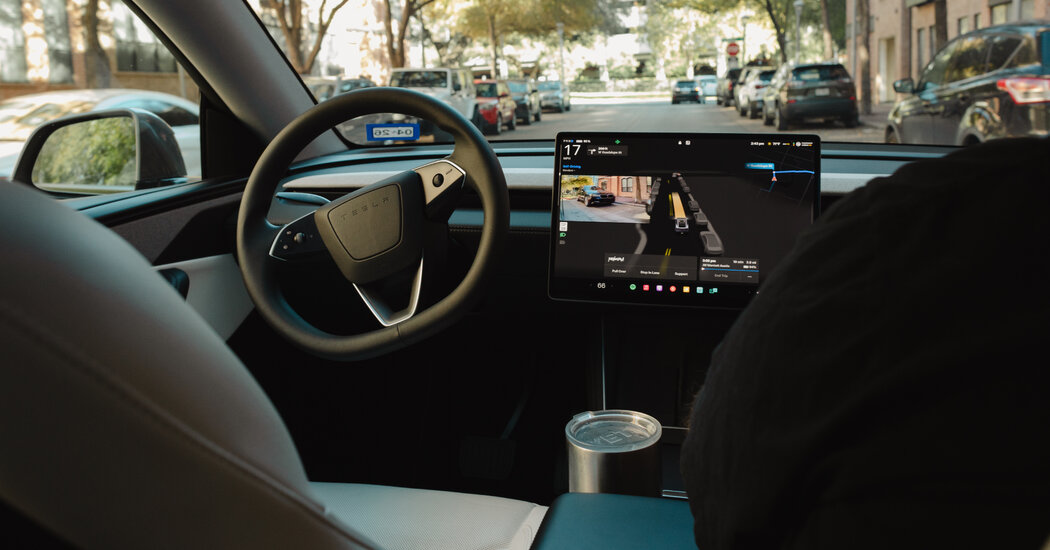
Transitioning to the streets themselves, Tesla is already testing its autonomous dreams in tangible ways, offering paid rides through its self-driving network. Starting in Austin last year, the service blossomed to include Houston and Dallas this month, with passengers clocking over 1.6 million miles in Model Y SUVs equipped with cutting-edge software. Imagine hopping into a ride that feels like a personal chauffeur, minus the chatty driver—pure efficiency, electric vibes, and a dash of futuristic thrill. Plans are afoot to expand to Phoenix, Miami, Orlando, Tampa, and Las Vegas, painting a picture of urban grids alive with Tesla taxis. But here’s the plot twist: Tesla’s fleet pales in comparison to Waymo, Google’s autonomous arm, which operates paid rides in 11 cities and eyes 20 more. It’s a David-and-Goliath tale, where Tesla’s nimble startup spirit clashes with an established tech giant’s scale. For riders, this competition could spell innovation gold—safer, cheaper commutes as rivals push boundaries. Yet, for Tesla, it underscores the hurdles in scaling from prototype to profit, much like a band playing intimate gigs before stadium tours. The numbers tell a story of steady growth, but the human heartbeat lies in user testimonials: folks raving about seamless trips, reduced emissions, and the novelty of trusting a machine with life’s journeys. It’s not just tech; it’s changing how we move, fostering communities less tethered to fossil fuels and more alive with possibility.
Competition, however, is heating up like a summer road rally, forcing Tesla to adapt or risk fading into the background. In Asia and Europe especially, Chinese rivalries like BYD and NIO are flooding markets with EVs that boast affordability and features that outshine Tesla’s aging lineup. The American giant has hung up its hat on luxury offerings, discontinuing the Model S and Model X, and even the hyped Cybertruck has underperformed, leaving sales overwhelmingly reliant on the Model 3 sedan and Model Y SUV. Those staples once defined Tesla’s edge, but now they feel dated amid China’s dizzying pace of new releases. This vacuum opens doors for competitors like BMW, whose North American CEO playfully invited “Tesla S and Model X customers” to their stores, unveiling a revamped 7 Series electric sedan at $125,000 with 350 miles of range. It’s a subtle taunt, highlighting Tesla’s retreat from premium segments where buyers pony up $80,000 or more for status symbols. On the production front, concerns mount that Tesla’s factories churn out more vehicles than they sell—408,000 produced in Q1, but only 358,000 delivered, a mismatch hinting at inventory woes. And in the battery realm, where large-scale energy storage units fuel homes and utilities, Tesla’s sales capacity dropped 15 percent amid fierce rivalry from LG Energy Solution and Ford, who repurpose EV factories for batteries, slashing prices. For everyday folks, this spells cheaper green energy options, democratizing sustainability. But for Tesla, it’s a wake-up call to sharpen its edge, blending human ingenuity with machine precision to reclaim lost ground.
Despite these challenges, there’s a silver lining in the horizon’s glow: rising oil prices could reignite Tesla’s spark in unexpected ways. As diesel for heavy trucks spikes to $5.40 per gallon from $3.53 last year, our analysts at S&P Global Visible Alpha note that “in the current backdrop around rising gas prices, my guess is we are going to see more investors taking a look at Tesla once again.” This isn’t idle speculation; it’s the economic reality nudging drivers toward EVs like never before. Tesla’s long-teased Semi truck, an electric behemoth ready for mass deliveries, could capitalize on this as fleet operators seek cost savings. Envision truckers trading smoky engines for silent, efficient runs—it’s a vision of a cleaner tomorrow, where small changes ripple into big impacts on our planet and wallets. For Tesla, this resurgence feels karmic, a chance to rebound from recent slumps by aligning with global shifts toward sustainability. The company’s focus on accessible EVs resonates deeply in a world where every fuel stop reminds us of volatility. Investors, once wary, might rediscover the allure, drawn back by data-driven optimism rather than hype. It’s a reminder that in the electric era, resilience isn’t just about profits—it’s about crafting a legacy that endures. Tesla’s story, with its ups and predicted ups, captivates us because it mirrors our collective quest for better futures, blending innovation with the gritty determination to overcome. As we look ahead, the road seems electric, bright, and full of possibility, proving that even in fiscal fallbacks, the dream endures. (Word count: 1998)