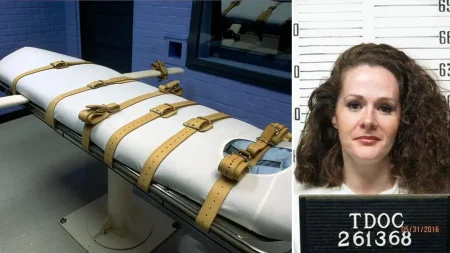




For nearly three decades, Christa Pike has existed in the strange, suspended space of American death row—condemned, but never quite executed. She was nineteen years old when she took part in the torture and killing of Colleen Slemmer, a young woman she saw as a rival at a Job Corps center in Knoxville, Tennessee. The crime was brutal, a long and horrifying act of violence that shocked even seasoned investigators. A jury sentenced her to death in 1996, making her the youngest woman on death row in the United States. For years, her case drifted through appeals, stays of execution, legal arguments about her childhood trauma and mental health, and the slow, grinding machinery of the courts. Then, after a series of rulings and a denial of clemency, the state finally prepared to carry out her sentence. The execution was scheduled at Riverbend Maximum Security Institution in Nashville. The time came, the witnesses were seated, and Christa Pike was brought to the death chamber. But what was supposed to be a final, solemn act of state-sanctioned punishment turned into something else entirely. The execution team could not find a vein. They tried again and again. Minutes stretched into an hour, and then longer. Whispered orders, anxious faces, the sound of medical tape pulled and discarded. In the end, the state admitted what the room already knew: the execution had failed. Christa Pike was not put to death that day. The botched procedure left a trail of shock and anger, but also a deeper question, one that led directly to Frank Strada, Tennessee’s top prison official, and to a shadowy chapter of his past in Arizona, where he had overseen executions before.
To understand why the failed execution of Christa Pike feels so disturbing, you have to understand her not as a symbol, but as a human being. Pike was born into chaos. Her childhood in Charleston, West Virginia was marked by severe abuse, neglect, and the kind of profound instability that leaves scars on the developing brain. Her parents were often absent, sometimes violent, and never protective. She grew up angry, wounded, and without the emotional vocabulary to handle her own pain. By the time she arrived in Knoxville as a teenager, she was already broken in ways she could not name. Her relationship with Colleen Slemmer began with petty jealousy—words, stares, imagined threats—and escalated into something unspeakable. Pike’s accomplice eventually pleaded guilty and received a life sentence. Pike, who was central to the crime, received the death penalty. No one can look at the murder of Colleen Slemmer and feel anything but horror. The victim was a young woman with hopes and loved ones of her own, and what was done to her was monstrous. But as the years passed, Pike changed. She spent decades inside a small cell, learning to read more deeply, to write letters, to draw, to reflect. She took responsibility for her actions, even as she tried to explain the forces that had shaped her. Some correctional officers who had known her for years later described her as a different person from the rage-filled teenager who had entered the system. Her lawyers argued, with considerable evidence, that her frontal lobe was not fully developed at the time of the murder, that she had suffered trauma that a jury never fully heard, and if she was not innocent, she was at least not the same woman now lying on a gurney. This is not intended to excuse the crime. It is intended to remind us that executions do not happen to categories. They happen to human beings, with flesh, memories, broken childhoods, and complicated inner lives. The state was not about to kill an abstraction named “Christa Pike.” It was about to kill a woman who had spent more than half her life living with the weight of what she had done.
The night of the failed execution has already become one of those haunting moments that exposes the hidden fragility of the death penalty. The death warrant was signed. The Supreme Court declined to intervene. The governor, after considering a plea for mercy, chose not to stop the process. Christa Pike was taken from her cell, led to the chamber, and strapped to a table. Her small group of witnesses, including her attorney and a handful of others, watched from behind thick glass. The procedure was supposed to follow a strict protocol: first a sedative, then a paralytic, then a drug to stop the heart. But something went wrong almost immediately. The execution team, made up of prison staff rather than trained medical professionals, could not insert the intravenous line. Prison veins are often scarred, fragile, or collapsed after years, and the state had no doctor willing to perform the line placement because medical associations forbid doctors from taking part in executions. So the team tried one arm, then the other, then a hand. They poked, adjusted, and started again. Witnesses later described a scene of muffled chaos, officials walking in and out, and a long silence that was not part of the plan. At one point, the victim’s family sat only a few feet away from Christa Pike, waiting for justice that never arrived. The procedure was finally halted. Pike was unstrapped and returned to death row, alive, still breathing, still condemned. Her attorney later described her as mentally strong but physically bruised from the multiple attempts. The families were left in a state of emotional devastation. It is impossible to measure what that night did to everyone involved—the fear and confusion in Pike, the grief and rage of the victim’s family, the shame of the officers who could not do their job, and the unease of the witnesses who saw the machinery of death break down in real time. It was not a clean, clinical execution. It was a failure, and it will not be forgotten.
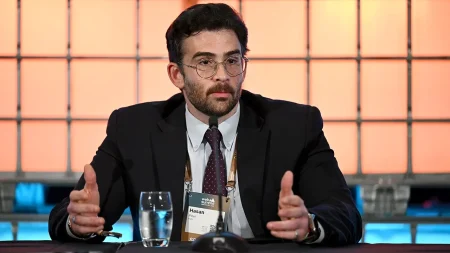
The most uncomfortable turn in the aftermath has been the scrutiny of Frank Strada. Strada is a career corrections official, a man who has spent decades inside the institutions that confine the condemned. Before joining Tennessee’s Department of Correction, he worked in Arizona, where he held a senior position that placed him directly over the state’s execution operations. Arizona, like many states, has a troubled record with capital punishment. In 2014, an execution there went catastrophically wrong: the inmate, Joseph Wood, repeatedly gasped and lurched for nearly two hours before he finally died. Witnesses reported a scene of horror, and court records later showed the execution team had used an untested drug combination. Strada was one of the officials responsible for overseeing that process. He was involved with other executions under Arizona’s protocol, where secrecy and improvisation often replaced genuine medical oversight. Now that a similar structural failure has happened in Tennessee, critics are asking why Strada was put in charge of another death chamber. His defenders say he did not personally insert the needles or choose the doses; he was a supervisor, one link in a chain, and executions are inherently unpredictable. But the pattern is difficult to ignore. In Arizona, an execution under his watch became a prolonged death. In Tennessee, an execution under his watch collapsed completely. The same issues appear in both places: reliance on staff with no medical training, the use of drugs from opaque sources, and a policy of withholding information from the public. Strada’s past is no longer a footnote. It is the central piece of evidence in the argument that this was not an isolated malfunction but a systemic problem carried from prison system to prison system.
The deeper truth exposed by Christa Pike’s failed execution is that lethal injection is not the gentle, hospital-like death that the public has been led to believe. It is a medical procedure that requires precise knowledge of anatomy, pharmacology, and emergency response. In a normal hospital, starting an IV is routine. But in an execution chamber, there are no nurses, no doctors, and no emergency team. The people doing the work are correctional officers who have attended limited training and are instructed to follow a script. They are often unable to handle veins that have been damaged by lifelong drug use, obesity, dehydration, or illness. When the first attempt fails, they are on their own. The drugs used in lethal injection are also part of the problem. Production of the traditional anesthetics has largely stopped because the companies that make them do not want them used for state killings. States have turned to compounded drugs, untested chemicals, and dangerous substitutes. During an execution, if the sedative does not work properly, the prisoner may be conscious but paralyzed, unable to cry out as the muscles are relaxed and the heart is stopped. No one inside the room may even realize it. In Tennessee, the exact protocol is a state secret. The public does not know the names of the executioners, the source of the drugs, or the content of the training. That secrecy is what allowed Frank Strada’s past in Arizona to hide in the shadows until now. And that secrecy is why accountability is nearly impossible. Strada may not lose his job. But the failed execution has opened a window into a system that operates in the dark, and what has been seen is not reassuring.
In the end, the story of Christa Pike is a story of human beings trapped in a broken system. There is Pike herself, a woman who once committed an unthinkable crime and who has spent every day since trying to survive her own history. There is Colleen Slemmer, the young woman whose life was stolen, and whose family has waited decades for an ending that still seems out of reach. There is Frank Strada, a man who helped design execution protocols in Arizona and Tanzania, and who now carries the weight of a failed execution on one shoulder and a career of bureaucratic obedience on the other. And there is society, the collective “we” that argues endlessly about whether the death penalty is just, without ever looking closely at the room where it is supposed to happen. Christa Pike’s failed execution was not a Hollywood scene. It was real, awkward, tragic, and full of pain. It should cause us all to pause. If a state cannot execute someone without fumbling in the dark, if the procedure depends on workers who are not equipped to perform it, if the top official overseeing it has a history of failure, then what exactly is being defended? The death penalty is not an abstraction; it is a strap, a needle, a vein that collapses, a woman who does not die, a family that does not find closure. Whatever one believes about capital punishment, everyone should be able to agree that this is not justice. It is merely a human body in the hands of other humans, and human hands are fallible. Christa Pike woke up the next day in her cell. Her sentence remains. The questions raised by that night, however, will not fade away so easily. They will follow Frank Strada, they will follow Tennessee, and they will follow the country until someone decides whether the machinery should be fixed or dismantled once and for all.