



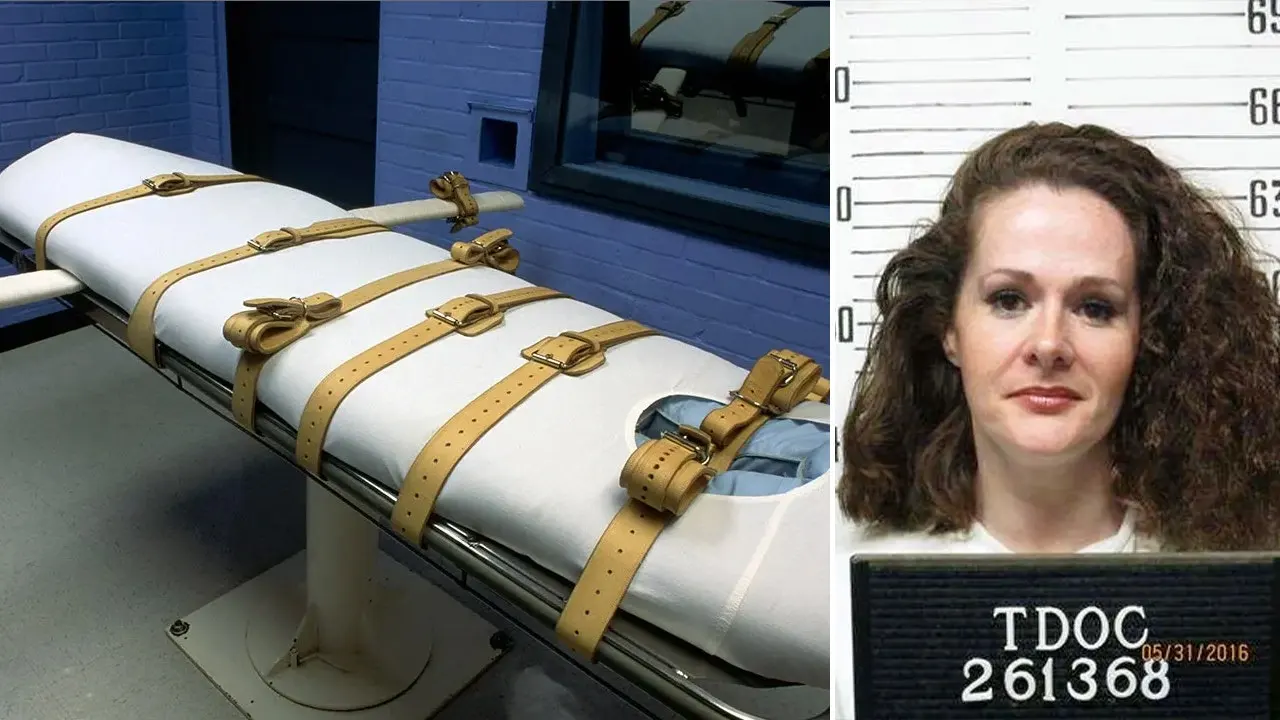
In a hospital room in Tennessee, Christa Pike lies unconscious, a ventilator pushing breath into her lungs. She was not supposed to be there. She was scheduled to be executed on Wednesday night for the 1995 torture killing of 19-year-old Colleen Slemmer, and had the state succeeded, she would have become the first woman put to death in Tennessee in more than two centuries. Instead, the execution attempt collapsed into a visible, lengthy failure, leaving Pike in critical condition and forcing lawyers, politicians, and ordinary citizens to confront a difficult question: what happens when the machinery of death breaks down? Her attorneys, Stephen Ferrell and Luke Ihnen, laid out the grim reality in a public statement Friday. “Christa remains critically ill and is receiving medical care for the devastating effects of Wednesday night’s events,” they said. “As detailed in today’s filing, Christa remains hospitalized following Wednesday night’s failed execution attempt. She is critically ill, unconscious, intubated and receiving breathing assistance through a ventilator. She is being treated for the serious effects of the pentobarbital administered during the execution attempt, including significant injuries to both arms.” The words are clinical, but the image is stark: a woman on death row, alive, but only barely, her body broken by a procedure designed to end her life. What was supposed to be finality has become a medical emergency. The state set out to execute her and instead delivered her to an intensive care unit. The execution chamber, with its carefully controlled rituals and solemn expectations, gave way to the noise and urgency of hospital monitors, the quiet hiss of a ventilator, and the presence of doctors whose job was not to kill but to keep her alive.
The story leads back to 1995, to Knoxville, Tennessee, when Christa Pike was a young woman standing at the edge of adulthood. She and a co-defendant lured 19-year-old Colleen Slemmer into a wooded area, where Slemmer was subjected to unimaginable torture before losing her life. It was the kind of crime that leaves permanent scars on a community, a case so horrific that it continues to haunt everyone who encountered it. Pike was convicted and sentenced to death, and over the years she became a rare figure in the American criminal justice system: a woman on death row, young at the time of her offense, who has spent decades waiting for the state to carry out its judgment. None of this context diminishes the horror of what Colleen Slemmer endured, and Pike’s attorneys have never asked the public to forget the victim or the brutality of the crime. But even a person convicted of the worst possible act retains a legal right to be free from cruel and unusual punishment. The state of Tennessee, having decided that Pike should die, was obligated to carry out that sentence within the boundaries of the Constitution. On Wednesday night, according to the emergency motion filed by her legal team, the execution bore little resemblance to a lawful and humane procedure. It was, in the words of her attorneys, a “botched attempted execution”—a phrase that tries to capture hours of chaos in a few words, and somehow still fails to convey the full horror. The victim’s family, who had waited nearly three decades for justice, were likely expecting an ending. Instead, they received a new and different kind of tragedy, one that no one involved seems able to fully explain.
The details in the emergency motion are difficult to read. According to Pike’s lawyers, the execution team struggled from the very beginning to find a usable vein. At least seven needles were inserted into her arms before the team administered the lethal drug pentobarbital. At one point, a needle was removed and found to be bent at a ninety-degree angle. Pike, who had been described in pre-execution filings as someone with small veins and a history of difficult IV access, was not a passive participant in her own suffering. The motion recounts that she suggested places where the staff might try to insert the IV, as if coaching them through the procedure. She could be heard crying, whimpering, and breathing heavily. At one moment, she said, “My arm feels like it’s about to burst open.” At another, she asked, “Does this happen like that?” There is a particular horror in that question—the condemned asking her executioners whether the pain she is experiencing is normal. It suggests a scene not of sterile calm but of confusion and distress. When the attempt was finally abandoned, Pike was taken to a hospital, where doctors found both of her arms swollen, burned, and blistered. Her lawyers do not hold back in comparing the drug to a corrosive substance, quoting medical experts who say pentobarbital is like bleach or Drano, capable of burning skin, tissue, and veins when it leaks out of a vein and into the surrounding flesh. The image is not one of a peaceful passing. It is like a medical procedure gone wrong, except the patient was meant to die, and the people performing the procedure were state officials with a legal mandate to end her life.
What makes all of this more galling, Pike’s attorneys argue, is that none of it was inevitable. Months before the execution, they filed papers with the state warning that Pike’s medical and psychological history made her a poor candidate for lethal injection. They cited her thrombocytosis—a condition that affects blood platelets and can interfere with clotting—as well as post-traumatic stress disorder, small veins, and a history of difficult needle insertion. All of these factors, they said, made it significantly more likely that prison officials would struggle to establish and maintain IV access. They also warned that if the drug was not delivered properly, Pike could experience “serious illness, needless suffering, and/or prolonged or lingering death.” Those warnings were not heeded. In fact, according to the emergency motion, state officials dismissed them as “speculation”; they were, in the lawyers’ words, “laughed off, scoffed at, and dismissed.” One of the fatal mistakes, the motion continues, was that the execution team did not recognize that the IV lines had failed before they prepared and administered another dose of pentobarbital. The drug was, at least in part, leaking into Pike’s body rather than flowing into her veins. Instead of stopping to reassess, the team prepared backup syringes and gave Pike another lethal dose. “Apparently at no point did any member of the execution team realize that the IV lines were not correctly placed or that the veins had blown,” the motion states. “Instead of remedying this failure, TDOC elected to prepare a backup set of syringes… and then administered another lethal dose of pentobarbital.” This is not a story of an unforeseen accident. It is a story of ignored red flags, overconfidence in a procedure, and an unwillingness to stop and question what was happening inside the room.
In the days since, the legal focus has shifted from the question of whether Pike would be executed to the question of what exactly happened and who is responsible. Pike’s attorneys filed an emergency motion in Davidson County Chancery Court asking a judge to order the Tennessee Department of Correction to preserve all evidence related to what they call the botched attempted execution. They argue that the records—medical logs, execution team communications, internal notes, video footage, and any other documentation—are essential to determine the truth, protect Pike’s legal rights, and ensure accountability. The filing is blunt: “In light of the manifest violation of Ms. Pike’s constitutional rights, the actionable nature of that violation, and the reasonable foreseeability of litigation, the Defendants have an affirmative duty to preserve all relevant physical, written, and electronic evidence.” It is a demand for transparency, and it reflects a belief that without such an order, crucial evidence could be lost, altered, or hidden. The state has not yet offered a detailed public explanation. The Tennessee Department of Correction did not immediately respond to a request for comment, though a spokesperson for the Tennessee Attorney General’s Office acknowledged the gravity of the situation. “The governor has appropriately called for an investigation. We need to know what happened,” the spokesperson said. That is a striking admission for a state to make about its own execution: We need to know what happened. It implies that even those responsible for carrying out death sentences are unsure, at least on the record, about the events they set in motion. The governor’s investigation, whatever it yields, will happen only after Pike has already endured a profoundly dangerous, painful ordeal—one that was foreseen, and one that should have been prevented.
Behind the legal arguments and the procedural requests lies a human drama that is difficult to process. Christa Pike has spent nearly three decades on death row, a woman whose own youth was swallowed by a terrible crime. She will likely still face execution again, if the state ever manages to do it. But right now, she is not a symbol; she is a critically ill patient, her body ravaged by a procedure that was supposed to deliver a swift and dignified death. The doctors tending to her are not executioners; they are healers, forced to repair the damage caused by a system that had one task and failed. For Colleen Slemmer’s family, the last twenty-nine years have been a long wait for justice. They have endured endless appeals, legal delays, and the emotional toll of knowing that the woman who killed their loved one was alive, while their loved one was not. Wednesday night must have felt like the end of that wait—only to be replaced by yet another layer of complexity, another round of unanswered questions. The broader public, too, is left to wonder what kind of justice system permits a person to be burned and swollen, to cry out in pain, to ask whether this is how it is supposed to happen, while officials stand by and prepare another syringe. This is not a question of whether Pike deserves sympathy. It is a question of whether the state can carry out the ultimate punishment without becoming something the law forbids: cruel. A failed execution is not a neutral event. It is a trauma that ripples outward, touching the condemned, the victim’s loved ones, the execution team, the nurses and doctors, and every citizen who has to live with the knowledge that this is what happens when death is administered by human hands. The investigation will try to answer the how. But the why—and whether we as a society can accept such scenes in the name of justice—remains a far harder question.