



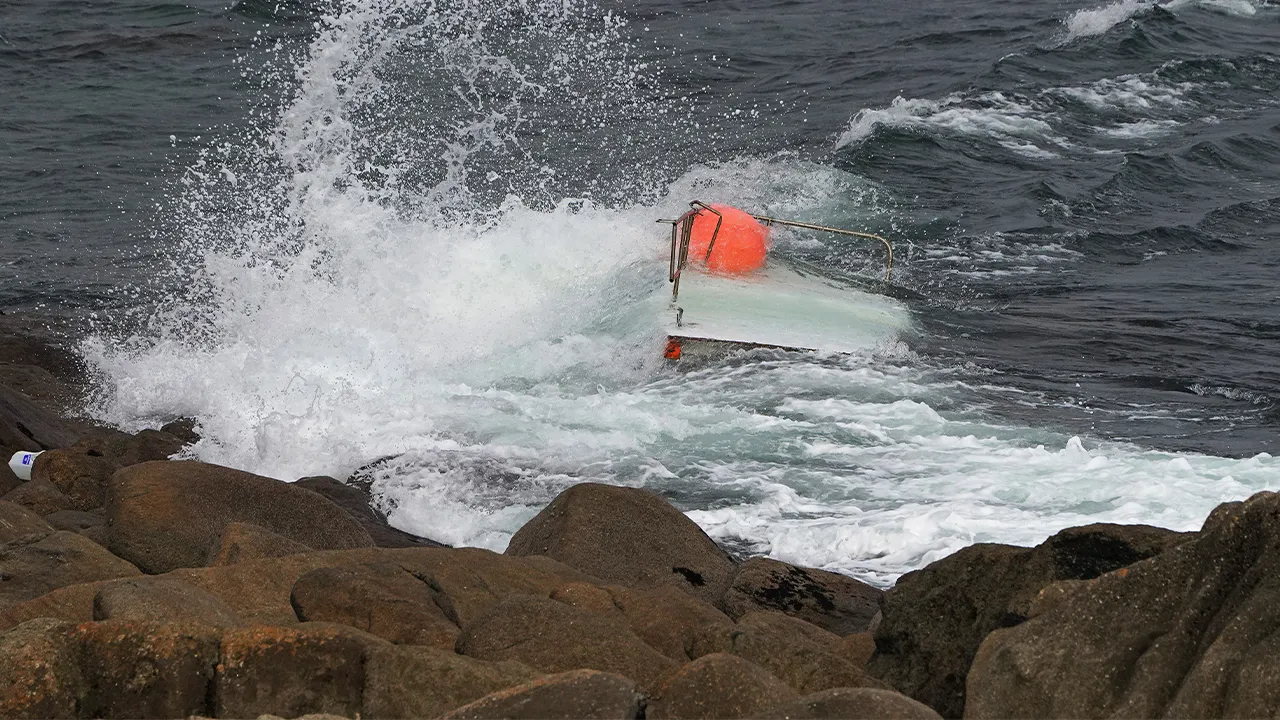
The cold gray waters of the Bering Sea rarely offer mercy, and on that fateful Monday morning, they yielded a result that was equal parts miracle and heartbreak. The United States Coast Guard announced that a 15-year-old boy had been pulled from the sea, alive, after clinging desperately to the hull of an overturned fishing skiff for what must have felt like an eternity. The teenager was discovered roughly four miles east of St. Lawrence Island, a remote and windswept mass of rock and tundra that sits in the frigid waters between Alaska and Russia. Rescuers found him in the midst of a medical emergency, his body wracked by the early stages of hypothermia, his strength nearly gone. It was a scene that encapsulated the raw brutality of the North Pacific: an 18-foot boat, three souls aboard, and a sea that decides who lives and who dies. The boy survived, but his two companions did not. Their bodies were later recovered from the water, bringing the grim tally of this tragedy into focus. The Coast Guard’s announcement cut through the static of everyday news with a clarity that reminded everyone of the thin line between life and death in America’s last frontier.
The timeline of the ordeal began to emerge in the hours after the rescue, painting a picture of a desperate wait that stretched through an entire night. The fishing vessel had been expected to return to its home port at 3 a.m. on Sunday, but it never did. When the hours slipped by and no sign of the small craft appeared on the horizon, anxiety turned into action. Alaska State Troopers were notified of the overdue boat on Sunday evening, and they in turn alerted the Coast Guard, triggering the machinery of a search-and-rescue operation. But the Bering Sea that night was not cooperating. Officials said that crews were unable to launch a rescue mission until Monday morning, forced to wait on the ground while weather and poor visibility rendered the skies and seas impassable. For the families and friends waiting on shore, those hours must have been agonizing, a long night of staring into the darkness, listening to the wind, and hoping against hope that the little boat had somehow found shelter. The delay was not for lack of will, but for the simple, unforgiving physics of a storm. No pilot could fly, no crew could launch, and all anyone could do was wait.
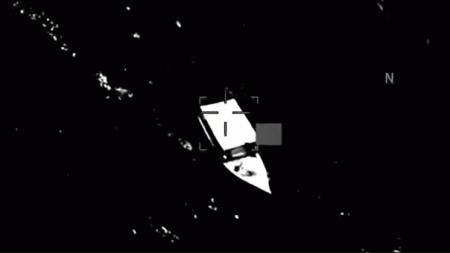
When dawn finally broke and the weather eased, the Coast Guard wasted no time. An aircrew was launched into the grey morning sky, scanning the churning surface of the sea with practiced eyes. It was that aerial reconnaissance that spotted the boy, a small figure clinging to the overturned hull of the skiff, rising and falling with the swells. The crew immediately deployed a raft with survival equipment, dropping it into the water near the capsized vessel in the hope that the teen could reach it. But the boy was in no condition to help himself, suffering from exposure and slipping in and out of coherence. Enter the good Samaritans. A nearby vessel, a boat crewed by ordinary people who happened to be in the area, responded to the scene. They pulled the 15-year-old from the water, wrapping him in whatever warmth they could muster, and they also recovered the bodies of the two deceased mariners, bringing the dead and the living alike aboard. The rescued teen, the fallen men, and the good Samaritans then made their way to Nome, Alaska, a frontier town that would become the staging ground for the aftermath of this tragedy.
To understand what happened out there, one must understand the world in which these mariners lived. St. Lawrence Island is not a place of leisure or vacation; it is a place of subsistence, home to the Yupik people who have lived there for millennia, hunting and fishing in one of the most dangerous marine environments on Earth. The village of Gambell, located on the island’s northwest cape, is closer to Russia than to the Alaska mainland, and its residents depend on the sea for their very survival. Seals, walrus, fish, and crabs are not just food; they are the foundation of a culture and an economy. That means going out in small boats, like the 18-foot skiff that capsized, is not a recreational choice but a daily necessity. The mariners who left the shore that day were likely experienced hunters or fishermen, people who knew the waters and their moods. Yet even the most experienced can be undone by the Bering Sea. A sudden shift in wind, a rogue wave, a piece of ice rolling in the currents; the margin for error is measured in inches and seconds. The fact that the boy survived at all, clinging to the overturned hull for hours in near-freezing water, speaks to a fierce will to live and perhaps a bit of fortune.
The cold is the silent executioner in these waters. Even in the late summer and early autumn, when this tragedy occurred, water temperatures in the Bering Sea hover dangerously low, often in the 40s or even colder. Under such conditions, the human body begins to shut down within minutes. Cold water immersion triggers an immediate gasp reflex, followed by rapid loss of strength and coordination, and then hypothermia, which dulls the mind and eventually stills the heart. The boy who was rescued was found in a state of medical emergency, his core temperature plummeting, his body fighting a losing battle against the ocean’s chill. That he was pulled out when he was, and not an hour later, is a distinction between life and death that cannot be overstated. The Coast Guard, which operates across 3.4 million square miles of some of the most treacherous waters on Earth, knows this better than anyone. Their crews in Alaska are accustomed to launching into storms, searching vast empty expanses, and recovering the living and the dead. They are the thin line that connects remote communities like St. Lawrence Island to the rest of the nation, and they carry the weight of every rescue and every recovery with a quiet professionalism that deserves immense respect.
In the end, this is a story about loss and survival, about a community that will now mourn two of its own while trying to help a 15-year-old boy heal from a trauma no child should ever endure. The two mariners who died were someone’s family, someone’s friends, anchors in the small, tight-knit world of the island. Their loss will ripple outward, felt in every empty chair at the table, every boat that sits unused at the dock. And the survivor, the teenager who somehow held on through the cold and the dark, will carry this day with him for the rest of his life. He will face questions that have no easy answers, grief that has no timeline, and the haunting memory of the sea that took his companions. But he will also carry the knowledge that he fought, that he held on, that help came from the sky and from the water, from the Coast Guard and from strangers who chose to stop. For the rest of us, this tragedy is a reminder of the fragility of life and the extraordinary courage that ordinary people find when faced with the worst. The Bering Sea is unforgiving, but so is the human spirit.