



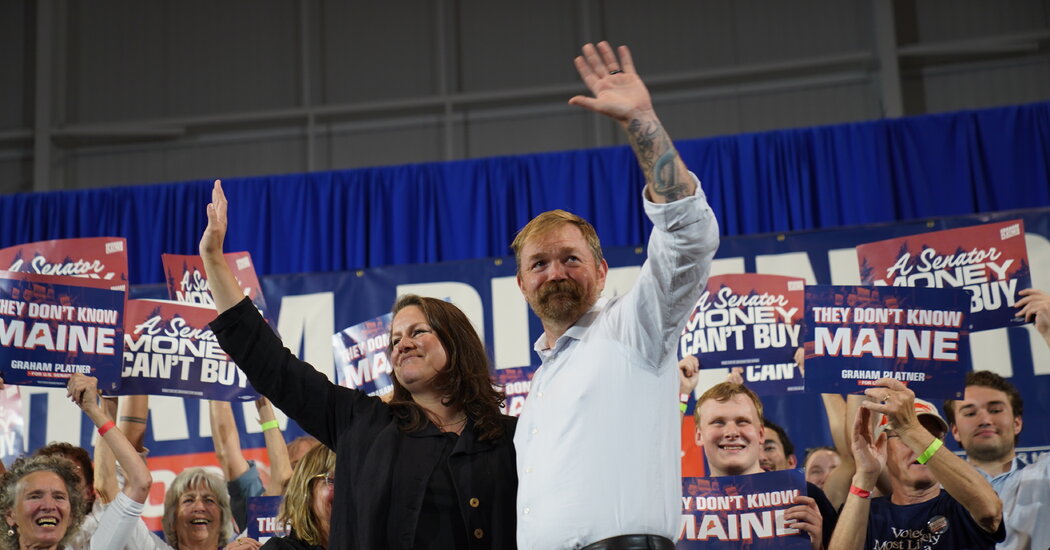
The rise of Graham Platner is the kind of underdog story that usually defines the mythology of American politics, a narrative of a relative outsider capturing the imagination of working-class voters. A Marine Corps veteran who returned home to Maine to labor on a quiet, mud-slicked oyster farm, Platner’s populist appeal struck a deep chord with everyday citizens who feel increasingly alienated by professional politicians. On Tuesday, this political novice achieved the unthinkable by defeating the state’s sitting governor, Janet Mills, in the Democratic primary for the United States Senate. The victory marks a stunning ascent, thrusting a man accustomed to the quiet rhythms of coastal life into the harsh, blinding glare of a high-stakes national campaign. This autumn, Platner is set to challenge Senator Susan Collins, a formidable, deeply entrenched Republican incumbent whose moderate brand has withstood decades of political storms. For Platner, the victory is both an extraordinary personal triumph and the beginning of a grueling journey, as he seeks to translate raw, grassroots energy into a campaign capable of unseating one of the most resilient figures in Washington.
Yet, Platner’s journey to the nomination has been far from heroic; indeed, it has been defined by a series of deeply troubling personal revelations that have forced voters to grapple with the messy, flawed humanity of their candidate. Throughout the primary season, his campaign has been heavily weighed down by ghosts of his past, including offensive social media posts about women and rape, as well as a highly controversial tattoo resembling a Nazi symbol, which he has since covered with new ink. The emotional weight of these scandals intensified when multiple women came forward to describe unsettling encounters during their past relationships with him. Rather than retreating, Platner used his victory speech to address these deep fractures in his character, delivering a raw and defiant monologue that sought to reframe his imperfections. He argued that the political establishment is desperately searching for a single flawed headline to define his life, missing the broader truth that his candidacy is not about him, but about a larger populist movement of overworked and struggling Mainers. By exposing his own vulnerabilities, Platner attempted to transform his personal survival into a rallying cry for an electorate that is itself tired of being judged by its worst moments.
This gamble on raw authenticity, however, has left Maine’s electorate deeply divided and skeptical as the general election approaches. Even with Governor Mills having suspended her campaign weeks ago, nearly thirty percent of Democratic primary voters cast their ballots for other candidates, a silent protest that highlights a lingering discomfort over Platner’s personal baggage. This leaves the newcomer with the immense psychological challenge of convincing a proud, independent-minded electorate that his personal errors are less damaging to Maine’s future than Susan Collins’s political record. Platner immediately went on the offensive, aiming directly at the bipartisan, moderate identity that Collins has carefully nurtured for decades. He challenged her directly on her loyalty to the former president, demanding to know why a self-proclaimed independent voice voted with Donald Trump nearly ninety-five percent of the time. By targeting her critical, decisive vote to place Brett Kavanaugh on the Supreme Court and her failure to protect abortion rights, Platner is trying to turn the election into a referendum on political betrayal, betting that voters will forgive his personal flaws if they believe Collins has abandoned her moderate principles.
While Maine faced its own existential political drama, the rest of the country’s primary races illuminated the enduring, almost religious authority that Donald Trump continues to wield over the Republican electorate. In modern conservative politics, the former president’s endorsement remains the ultimate prize, a political liferaft that can instantly elevate a candidate or salvage a sinking campaign. This power was on full display Tuesday as Trump-backed candidates across the nation achieved significant victories, washing away his recent endorsement setback in Iowa. In Nevada, the Republican base fell in lockstep behind Trump’s chosen House candidates, Carrie Buck and Marty O’Donnell, while in North Dakota, Representative Julie Fedorchak easily secured her nomination with his blessing. Meanwhile, Nevada Democrats formalized their own battle lines, selecting Attorney General Aaron Ford to challenge the formidable Republican Governor Joe Lombardo. These results show an electorate that is deeply tribal, hungry for validation from national figures, and increasingly defined by an unyielding loyalty to political brands rather than traditional legislative achievements.
The human cost of maintaining this political loyalty was perhaps most visible in South Carolina, where Senator Lindsey Graham engaged in a desperate fight for his political life. Graham’s path from a fierce, public critic of Donald Trump to one of his most devoted congressional allies has long made him a target of intense suspicion among the passionate MAGA base, who often view him as a pragmatic opportunist. Facing a serious primary challenge from conservative Mark Lynch, Graham was staring down the highly embarrassing prospect of being forced into a runoff election if he failed to secure a clear majority. However, the transactional nature of modern politics saved him; armed with Trump’s crucial endorsement and a massive campaign war chest worth millions of dollars, Graham managed to survive the night without a runoff. His victory is a testament to the bitter realities of political self-preservation, demonstrating how a veteran lawmaker must continually reshape his identity and swallow his pride to appease the shifting passions of the voters he represents.
Ultimately, this single night of primary contests offers a vivid, complicated portrait of a nation standing at a historical crossroads, deeply torn between the desire for populist disruption and the comfort of political survival. From the muddy banks of Maine’s oyster beds to the sprawling suburbs of Nevada and the conservative strongholds of the American South, voters are wrestling with questions of redemption, loyalty, and trust. They are being asked to decide whether they prefer highly flawed, authentic outsiders who mirror their own struggles, or polished, resilient establishment figures who know exactly how to navigate the levers of power. As the primary season closes, these deeply personal battles will merge into a high-stakes national narrative. The upcoming autumn elections will not merely decide which party controls the chambers of Congress; they will serve as a profound test of what the American public is willing to forgive, what they are willing to overlook, and what kind of leadership they truly believe in.