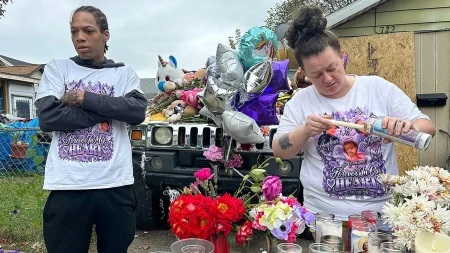



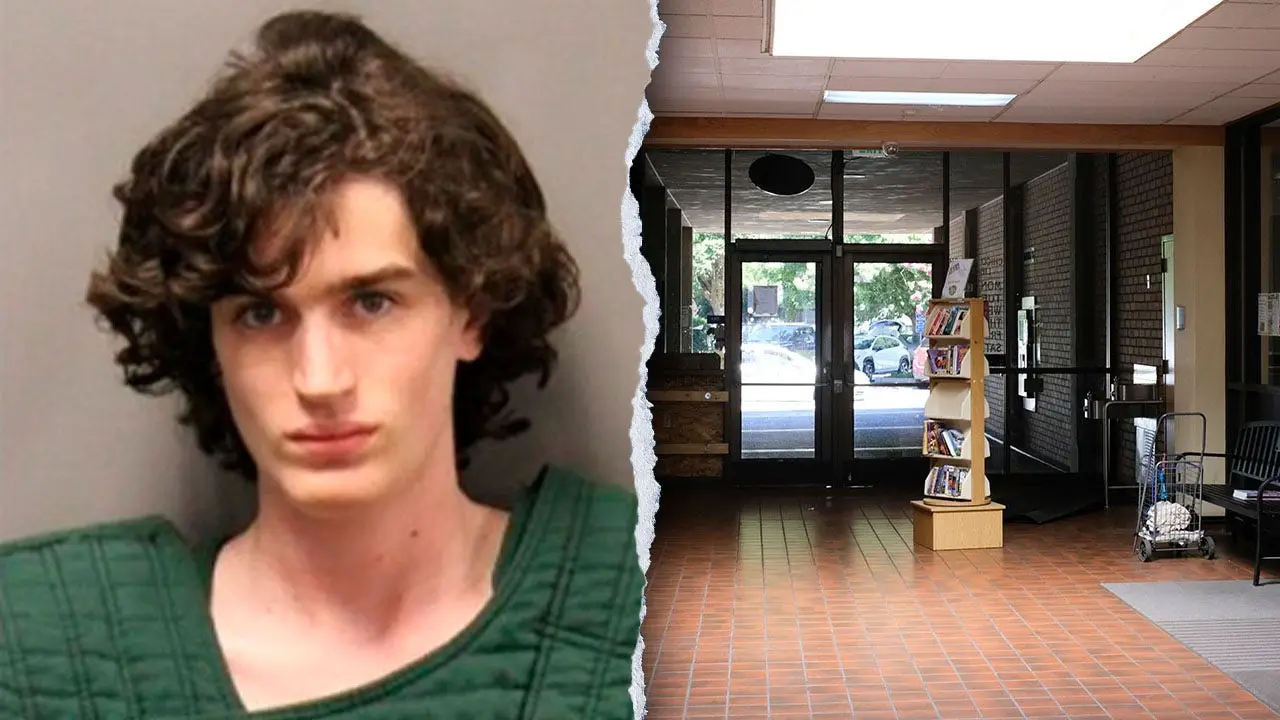
On a warm Monday afternoon in Northern California, the Butte County Library’s Chico branch should have been a sanctuary of quiet learning, community connection, and gentle solace. Instead, it became the stage for an unspeakable tragedy that shattered the peace of a close-knit town and left a community mourning the senseless loss of two vibrant lives. The victims, 46-year-old Jacob Hull and 74-year-old Robert Johnson, were ordinary citizens going about their day, completely unaware that their lives would be cut short by a stranger’s random and calculated act of violence. Jacob Hull was shot at the library’s main entrance, suffering fatal wounds to his leg and head, while Robert Johnson was struck down inside the building he had likely visited for peace and quiet. An underage girl was also injured in the chaos, her physical wounds treated at a local hospital, though the emotional scars of surviving such a terrifying ordeal will undoubtedly linger for a lifetime. The suddenness of the attack stripped Chico of its sense of safety, transforming a beloved public space into a crime scene wrapped in yellow tape and heavy grief. For the families of Hull and Johnson, a normal Monday dissolved into an eternal nightmare of shock, confusion, and overwhelming sorrow. As the community gathers to light candles and leave flowers at the library’s steps, they are left to grapple with the agonizing question of how a place built on the foundations of knowledge and community could be so violently violated. The human toll of this tragedy extends far beyond those who were physically struck by the bullets; it encompasses the traumatized eyewitnesses, the brokenhearted relatives, and the entire city of Chico, all of whom must now find a way to navigate a world that feels significantly colder and more dangerous than it did before. In the coming weeks, their strength will be tested as they seek to support one another through the darkest hours of this unprecedented ordeal, drawing upon the legacy of kindness that these two men left in their wake.
The calculated coldness of the attack is perhaps its most chilling aspect, suggesting a premeditated design that took advantage of the building’s open-door policy. The suspect, 18-year-old Bradley Scott Sayer, had no known personal connection to the library, its employees, or any of his victims, making the violence entirely random and impossible to predict. According to the Chico Police Department, Sayer first entered the library to perform a nonchalant walkthrough of the building, assessing its layout and the people inside before returning to his vehicle parked outside. There, he retrieved a shotgun and walked purposefully back toward the main doors of the Butte County Library, where he immediately opened fire. A total of eight devastating shots echoed through the quiet halls of the facility, sending patrons screaming and scrambling for cover among the bookshelves. Local dispatchers were flooded with multiple 911 calls, with one audio recording capturing the chilling background noise of ear-splitting gunshots and terrified screams. Officers rushed to the scene, exemplifying extraordinary courage as they established a tight perimeter around the building. Moments later, Sayer emerged from the library and surrendered to the police without further physical resistance. Chico Police Chief Billy Aldridge praised the rapid, heroic intervention of his officers, noting that less than four minutes elapsed between the very first emergency call and the suspect being taken into custody. This incredibly swift response undoubtedly saved countless lives, preventing the gunman from carrying out an even larger slaughter inside the crowded public building, though it came too late to save the lives of the two men who lay mortally wounded. The efficiency of the police response highlights the training and preparedness of local law enforcement when confronting active threats, yet it also serves as a sobering reminder of how quickly a peaceful space can transition into a battleground within mere seconds, forever altering the lives of everyone present.
Behind this horrific act of violence lies a deeply disturbing psychological landscape influenced by the dark history of American mass shootings. Investigators quickly discovered that the 18-year-old suspect was heavily obsessed with the infamous 1999 Columbine High School massacre, a tragedy that continues to cast a long, grim shadow over the nation twenty-five years later. On the day of the shooting, Sayer point-blank targeted his victims while wearing a white T-shirt inscribed with the words “natural selection”—a deliberate, sickening mimicry of the shirt worn by Eric Harris, one of the two teenage killers who slaughtered twelve students and a teacher in Colorado. This choice of clothing was not an accident; it was a loud, symbolic declaration of Sayer’s allegiance to a subculture of violence that romanticizes mass murder. Butte County District Attorney Michael Ramsey confirmed this dark obsession, stating that Sayer had been a devoted “fan” of the Columbine shooters on various social media platforms for a significant period. This revelation exposes a modern societal crisis: the radicalization of isolated young men who find communities of hate online, where notorious killers are elevated to the status of antiheroes and dark role models. Rather than seeing the Columbine tragedy as a cautionary tale of ultimate tragedy and ruin, Sayer and others like him view it as a blueprint for infamy, seeking to replicate the horror to secure their own place in the ledger of violence. This deadly digital pipeline poses a unique challenge to federal and local authorities, as the virtual worship of mass shooters acts as a powerful catalyst for real-world atrocities, turning vulnerable youth into active threats against their own communities. The tragedy highlights the urgent need to address the toxic online spaces that act as breeding grounds for disillusionment and mass-casualty fantasies, where young people are quietly desensitized to human suffering and enticed into committing acts of terror.
The tragedy is compounded by the unsettling reality that Sayer was a young man who had seemingly stood on the precipice of a promising future just days prior. Having graduated from Chico High School on June 5, he should have been celebrating a milestone of maturity and planning his next steps in life alongside his peers. Instead, within a week of receiving his diploma, his life diverged into absolute ruin, leaving his classmates, teachers, and neighbors struggling to reconcile the teenager they knew with the cold-blooded killer portrayed in the news. The FBI’s Sacramento office, led by Special Agent in Charge Sid Patel, immediately joined the investigation to uncover the broader networks and mechanisms behind the shooting. A meticulous search of Sayer’s vehicle parked in the library lot revealed that the shotgun used in the attack was not his only weapon; investigators discovered two additional firearms hidden inside, suggesting he may have planned a much longer, more devastating campaign of violence. The presence of multiple firearms raises critical questions about how an 18-year-old high school graduate was able to acquire such lethal weaponry and whether any red flags were missed by those around him in the preceding months. As federal and state investigators trace the origin of these guns, the community is left to wonder how a young neighbor, who sat in their classrooms and walked their streets, could harbor such profound malice in secret, hiding an arsenal of weapons while preparing to tear his own community apart. This stark contrast between Sayer’s recent academic achievement and his devastating actions underscores the hidden double lives that digital radicalization facilitates, where a quiet student can secretly build an identity as a heavily armed threat ready to destroy lives at a moment’s notice, leaving a trail of devastation in their wake.
The tragedy at the Butte County Library is an agonizing reminder of a broader, national epidemic of gun violence that continues to shatter the peace and security of communities across the United States. Public spaces that once represented the ultimate bedrock of civic life—schools, grocery stores, places of worship, and now quiet public libraries—have increasingly become targets of unspeakable hostility, leaving citizens with a pervasive sense of vulnerability. This local nightmare in Chico occurs against a backdrop of widespread violence across the nation, echoing the relentless trauma experienced in urban centers and small towns alike, where normal, everyday activities now carry an underlying layer of modern anxiety. For the library workers who dedicate their lives to cultivating a welcoming, educational environment for children, students, and lifelong learners, the psychological aftermath of this event will permanently reshape how they view their workplace, transforming a once-peaceful haven of books into a scene of terrifying violence and profound grief. The physical first responders, who arrived in under four minutes to witness a horrific scene, must also carry the heavy mental burden of confronting such senseless destruction, their professional duty requiring them to absorb trauma so that others might survive. As the nation watches yet another tight-knit community cross this painful threshold of tragedy, the complex dialogues surrounding public safety, mental health intervention, and gun legislation are reignited with immediate urgency. Behind every statistic and news headline lies a complex web of grieving families, traumatized witnesses, and broken neighbors whose lives have been irrevocably altered by a few minutes of madness. True healing for Chico will require not only time but also a collective acknowledgement of this shared trauma, as we strive to rebuild a society where the sanctuaries of our daily lives remain safe, open, and protected from the shadows of violence.
As the devastating reality of this loss continues to settle over northern California, the focus now shifts toward the pursuit of legal justice and community healing. Butte County District Attorney Michael Ramsey announced that Sayer is scheduled to be arraigned on Thursday, marking the formal beginning of a legal process that will seek to hold the young gunman accountable for his devastating crimes. While the court system can offer a structured path toward legal retribution, it cannot undo the immense damage inflicted on the families of Jacob Hull and Robert Johnson, nor can it quickly soothe the trauma experienced by the young girl who was injured in the crossfire. For the grieving relatives of the deceased, the upcoming trial will likely be a grueling, emotional journey, forcing them to relive the worst day of their lives in public view while seeking some semblance of closure. The town of Chico must now embark on its own journey of recovery, leaning on mutual support, counseling, and shared strength to rebuild the sense of safety that was stolen from them on Monday. Over time, the Butte County Library’s Chico branch will reopen, its doors once again welcoming the public to read, learn, and gather. When it does, it will stand not as a monument to Sayer’s violence, but as a resilient symbol of community defiance against terror, honoring the memories of Hull and Johnson by ensuring that peace, knowledge, and humanity ultimately triumph over the darkness of senseless violence. This pursuit of justice is not merely about punishing a perpetrator, but about reaffirming the value of human life in a society that too often feels desensitized to tragedy. By coming together in memory of those who were lost, the people of Chico can transform their collective grief into a powerful force for unity, ensuring that the legacy of Jacob Hull and Robert Johnson is defined by the love they left behind rather than the violence that took them away.