




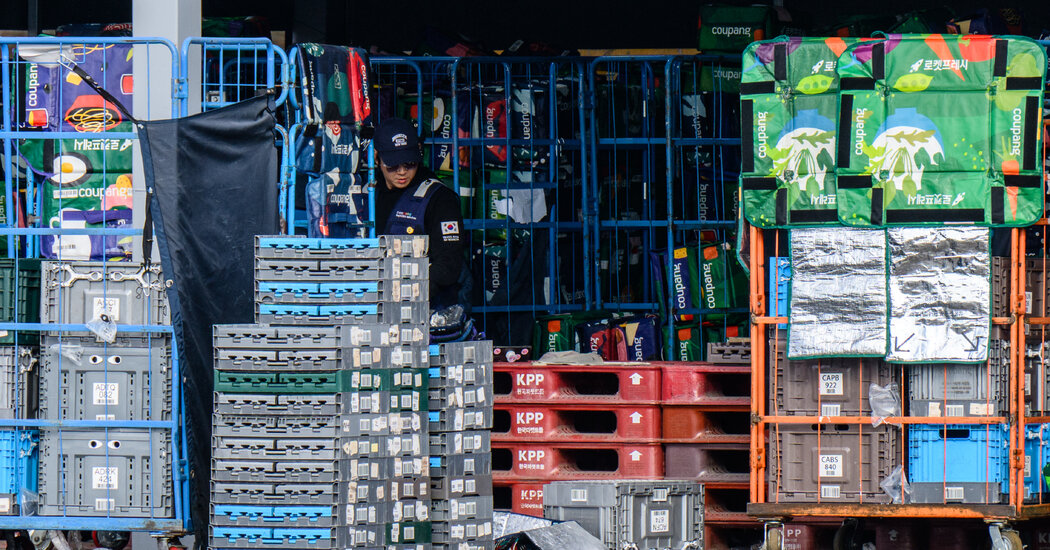
A Record-Shattering Penalty: South Korea Levels Unprecedented Privacy Fine Against E-Commerce Giant Coupang
In an unprecedented regulatory clampdown that has sent shockwaves through the global e-commerce sector, South Korea’s Personal Information Protection Commission (PIPC) has penalized Coupang, the undisputed titan of the nation’s digital retail landscape, with a record-setting administrative fine of 624.7 billion won—approximately $409 million USD. This staggering financial penalty, handed down on Thursday, represents the most severe data-privacy sanction ever imposed by the South Korean government, signaling a major paradigm shift in how sovereign authorities police consumer data security. Often affectionately referred to by industry analysts as the “Amazon of South Korea” due to its overwhelming dominance and pioneering logistics network, Coupang now faces a fiscal reprimand that drastically overshadows its financial triumphs from the previous year. To put the scale of the fine into clear perspective, the $409 million penalty is nearly double the $214 million in total net annual profit that the e-commerce giant managed to record throughout the entirety of last year. Despite being legally incorporated in the United States and listed on the New York Stock Exchange, the company generates the vast majority of its operating revenue within the highly digitized borders of South Korea, establishing a complex corporate identity that has complicated its regulatory standing. In the immediate aftermath of the commission’s public announcement, Coupang swiftly signaled its intention to mount a aggressive legal defense, declaring that it would formally challenge the historic administrative ruling in the South Korean court system and setting the stage for a protracted, high-stakes judicial battle.
The Anatomy of a Corporate Security Failure: How Millions of Users Were Exposed
At the dark core of this escalating regulatory crisis is a series of fundamental, systemic vulnerabilities that South Korean investigators assert left the personal information of millions of ordinary citizens dangerously exposed on the open web. According to the comprehensive findings published by the Personal Information Protection Commission on Thursday, the catastrophic data breach—which was first uncovered by cybersecurity monitors last year—compromised the sensitive personal details of over 33 million registered Coupang customer accounts, along with an additional 4 million nonmember individuals who had never interacted with the platform but whose details were archived through association with Coupang users, such as relatives named in delivery profiles. Even more concerning to regulatory authorities was the revelation that Coupang had systematically, and allegedly illegally, harvested, tracked, and stored the private online browsing histories and external app activities of over 11 million users across diverse third-party applications and digital platforms without obtaining requisite, transparent consumer consent. Dismissing any defense that would frame the company as a victim of state-sponsored cyber warfare or elite hacking collectives, PIPC Chairwoman Song Kyung-hee delivered a scathing public assessment of the platform’s administrative negligence, emphasizing that the severe data leak did not stem from a highly sophisticated external cyberattack, but was rather a direct consequence of Coupang’s own systemic operational failures, inadequate security infrastructure, and systemic lack of proactive data-shielding protocols. This sharp administrative rebuke underscores a growing consensus among global regulatory bodies that multi-billion-dollar tech corporations must be held fully accountable for basic custodial failures when managing the sensitive metadata of the populace.
The Friction of Innovation: How Coupang’s Rapid Domestic Ascent Collided with Regulatory Oversight
To understand the profound impact of this regulatory collision, one must examine the meteoric, decade-long rise of Coupang and its deep integration into the daily rhythm of contemporary South Korean urban life. Founded in 2010 by visionary Korean-American entrepreneur Bom Kim in Seoul, his birth city, the platform achieved legendary domestic status primarily through its revolutionary “Rocket Delivery” service—a hyper-efficient, proprietary logistics network that guaranteed doorstep deliveries within mere hours and turned the company’s signature delivery trucks into ubiquitous features of the municipal landscape. However, the corporate fairytale began to unravel dynamically last November, when investigative disclosures revealed that a outsourced former employee stationed at one of the company’s regional hubs in China had successfully maintained unauthorized, unmitigated access to deep databases containing vast expanses of sensitive consumer data. The resulting domestic public outrage was rapidly compounded when the company’s enigmatic founder, Bom Kim, drew the ire of South Korean national lawmakers by flatly refusing to appear before an official parliamentary hearing organized to investigate the structural security lapse. This perceived snub of legislative authority marked a major turning point, quickly cooling what had once been a cozy, mutually beneficial relationship between the pioneering e-commerce titan and Seoul’s regulatory establishment, while simultaneously paving the way for a much harsher government-wide response. The historic scale of the resulting 624.7 billion won penalty becomes even more striking when compared to the country’s previous high-water mark for data breaches: a modest $88 million fine levied just last year against domestic telecommunications giant SK Telecom.
Crossing Borders: The Escalating Geopolitical Fallout Between Seoul and Washington
What began as a localized regulatory enforcement action has fast degenerated into a highly charged, complex diplomatic dispute, creating an uncomfortable friction point in the strategic bilateral alliance between Washington and Seoul. In the weeks leading up to the historic fine, Coupang’s corporate leadership, working alongside a vocal contingent of prominent Republican members of the United States Congress, began aggressively lobbying Washington, accusing the South Korean regulatory apparatus of hostile protectionism and weaponizing domestic administrative processes to uniquely disadvantage a prominent, US-incorporated enterprise. Conversely, South Korean government officials have mounted an unyielding defense of their regulatory sovereign rights, characterizing the domestic investigation as a clinical, objective exercise of “due process” while dismissing the escalating pressure from American lawmakers as unwarranted, external interference in the country’s sovereign domestic judicial affairs. Behind closed doors, South Korean diplomats have privately expressed deep frustration, warning that Coupang’s aggressive and relentless lobbying campaign on Capitol Hill has grown so intense that it has actively stalled delicate, high-level diplomatic negotiations between Seoul and Washington over a vital, multi-sector trade and security partnership. The high-level deadlock carries significant economic stakes for both allied nations, as a failure to finalize the strategic bilateral agreement could potentially expose South Korean exports to punitive, highly disruptive American tariffs, demonstrating how the private data governance failures of a single e-commerce company can ripple outward to destabilize macro-level international relations.
Legal Reckoning and Corporate Defense: Coupang Vows to Fight the Ruling in Court
In response to the historic fine, Coupang released a highly calculated, carefully calibrated public response that attempted to strike a delicate balance between remorseful corporate responsibility and robust legal defiance. The e-commerce giant reiterated a formal public apology for the distress caused to its millions of loyal users, pledging to invest heavily in upgrading its cyber defense architectures and reinforcing its internal data protection policies to prevent future vulnerabilities. However, the company also expressed profound disappointment and regret that the regulatory commission’s final ruling failed to adequately recognize or account for what Coupang described as extensive, proactive, and preemptive mitigation measures it had instituted to protect consumers from potential secondary harms and financial fraud. In an official, sternly worded corporate statement, Coupang made it clear that while it respects the regulatory oversight of the South Korean government, it fundamentally disputes the underlying factual interpretations and the sheer, disproportionate scale of the penalty. The company announced that once it receives the formal, written copy of the commission’s administrative ruling detailing the specific legal determinations, it will seek full judicial recourse, confidently expecting the objective facts of the case to be vindicated and the unprecedented fine to be dramatically reduced or overturned entirely through a transparent, evidence-based series of domestic court appeals.
The Broader Horizon: What Coupang’s Historic Fine Signals to Global Tech and Sovereign Privacy Advocates
Ultimately, the historic showdown taking place in Seoul serves as a powerful, diagnostic bellwether for the future of global technology regulation, illustrating the growing friction between transnational data-driven corporations and sovereign nations determined to project regulatory authority over their citizens’ digital footprints. As national governments worldwide watch South Korea’s aggressive posture with keen interest, the Coupang ruling sets a powerful global precedent that even the most deeply integrated, economically vital digital platforms can no longer operate under the assumption that they are “too big to penalize.” This landmark enforcement action mirrors a broader, worldwide trend of intensifying regulatory scrutiny, reminiscent of the European Union’s aggressive application of General Data Protection Regulation (GDPR) mandates and the evolving patchwork of consumer privacy laws taking root across various United States jurisdictions. For multinational corporations operating across domestic digital borders, Coupang’s costly ordeal delivers an unmistakable corporate warning: the collection, storage, and cross-border commercialization of consumer data is no longer a low-risk corporate asset, but a highly sensitive liability that carries existential financial, legal, and reputational risks if managed without absolute, uncompromised transparency and ironclad security.