


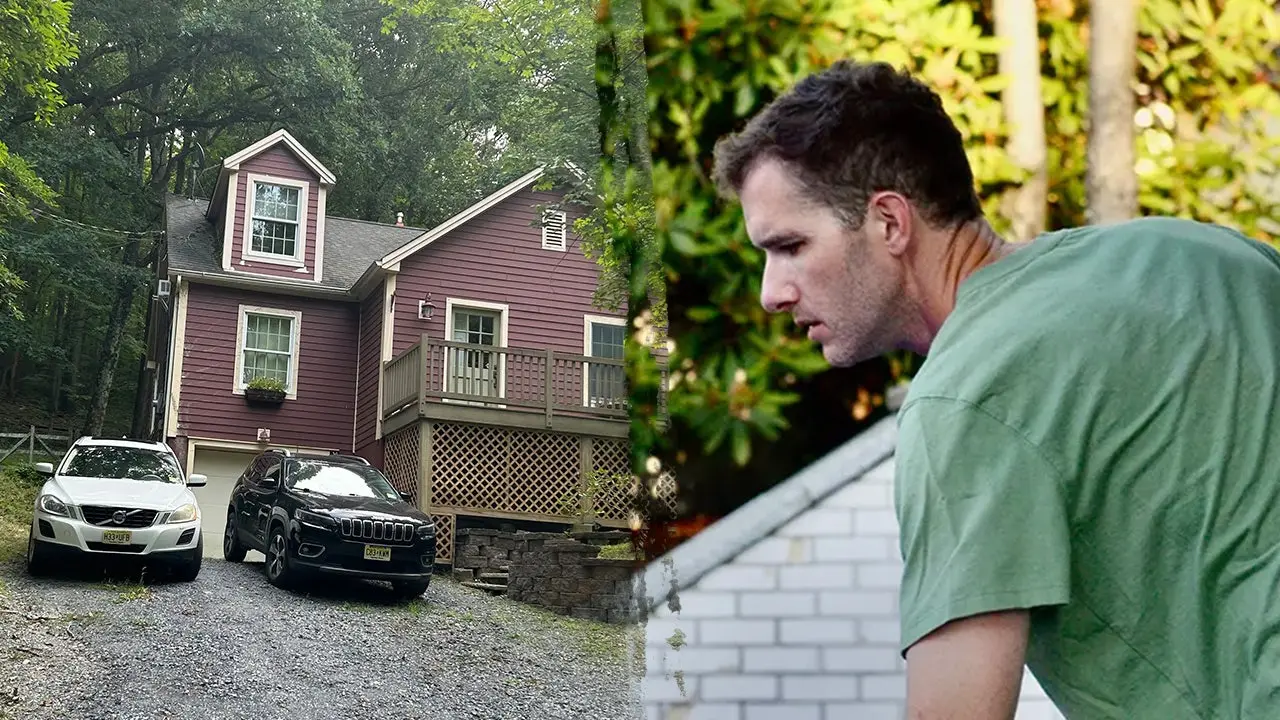
The sun-bleached stillness of a Thursday afternoon in Chester, New Jersey, offered a jarring contrast to the dark, unresolved questions that continue to cling to Pottersville Road. For months, the community has existed in a state of suspended disbelief, a small-town tableau disrupted by a violent death that remains stubbornly unexplained. The familiar sight of a white Volvo SUV, pulling into the driveway of a storybook home, has become a focal point for simmering tensions. That vehicle belongs to Conor Hanlon, the 36-year-old husband of Brooke Hanlon, the wife found brutally stabbed to death inside that very house in early June. The Hanlon name, once just another family in the upper-middle-class enclave, has become synonymous with a mystery that refuses to unfold. While the Morris County Prosecutor’s Office has officially been tight-lipped, the atmosphere among neighbors is fraught with a palpable, restless anxiety. Each week, Conor’s predictable appearances, usually arriving on Thursdays and staying until Friday, have transformed the Hanlon property into a spectacle of silent questions, a touchstone for a community grappling with the duality of routine neighborly life and the specter of violent tragedy.
Conor Hanlon’s actions present a puzzling portrait. He has been seen, multiple times over the past several months, performing mundane acts of domesticity—tending to the lawn, ensuring the property hasn’t fallen into disrepair. For a man engulfed in a murder investigation, these seemingly normal activities project an eerie sense of normalcy. It is a picture that many neighbors struggle to reconcile with the fact that his wife, a 35-year-old mother, took her last breath in the home he continues to maintain. The Bureau of Criminal Investigation, which took over the case, has released close to no details of its progress. No suspects have ever been named, and no person of interest has been brought forward publicly. This vacuum of information has allowed a space for suspicion and speculation to take root and grow, like weeds through the pristine lawn. The presence of his SUV at these times, a conspicuous signal of his continued hold on the property, further deepens the community’s disquiet, prompting many to fasten their gaze on his actions while legal authorities remain frustratingly silent.
Press attention has remained a steady buzz since the initial discovery. Over the summer investigative journalists, much like the neighbors themselves, have been circling the ever-widening circle of unanswered questions. On a Friday, driven perhaps by the growing media attention and the weight of public scrutiny, broke his silence. The quote, “My heart is totally shattered,” given to the Daily Mail, was his first public acknowledgment of the tragedy. When pressed on his possible involvement, his denial was simple, “Of course not,” and his description of the incident as a “tragedy” was stark. These words, dripping with profound emotion yet withholding crucial detail, have been interpreted in myriad ways. For some, they are the raw, gut-wrenching outpouring of an innocent man. For others, they are a well-rehearsed script, lacking the vulnerability expected from someone who has lost his wife. The confrontation with the reporter is emblematic of the wider push for information, a desperate grasp for a sliver of grasp of the reality inside that house, which has so far revealed itself only in moments of admitted legal facearmor.
Various neighbors have taken to watching his movements with a heightened sense of suspicion. One next-door resident recounted that only a little over three weeks before Brooke’s body was discovered, their quiet street was greeted by law enforcement. Officials were knocking on doors, a period of “check-in” within the community. When asking if “everything was OK” between 9:30 and 10 PM, they revealed a key detail: a report of a “911 call in the area.” This tangible police action, weeks before the murder, has now become a critical, ghostly piece of the chronological puzzle. The public’s knowledge of official movement in that direction, before the discovery of the body, proves the reality that something was not right long before. The memory of that night is now being retroactively scrutinized; what could have elicited a wellness check just weeks before, yet brought no official charge afterward? It’s a half-open door into the investigation, which has been sealed shut.
Adding to that simmering unease is the hunting nature of the 911 call Conor made when he found his wife’s body. Records show him pleading for CPR help, his voice filled with panic. The audio tape has become a poignant, and for some, an incriminating piece of evidence, creating a contradictory portrait of a man overcome by despair versus one rehearsing a performance. This new revelation adds a layer of dramatic tension—the actual sound of the frantic call underscores the high stakes of the investigation. The prosecutors have not released a timeline or cause of death, only confirming blunt force trauma, employing the word “homicide” in it’s official capacity. The silence has only deepened the barricades around unraveling truth. Critics have drawn a comparison to this closed-mouth approach. PI’s outside the government have expressed they’d ‘never seen anything like this’—an endorsement of the case’s unusual wall of secrecy, preventing the usual leak cycles from appeasing the public’s appetite for answers.
Today, the Hanlon home and the memories within it are as dark as they ever were. The wife and mother, Brooke, remains a memory, her life cut short in the very place she must have felt safest. The community beyond the Hanlon’s immediate neighbors waits, hoping that the silence—and the slow creep of its weekly normalcy—will break to reveal a solution. The pattern of his visits, his ever-lurking white SUV, remains a focal point for the cells of the collective focus. The ongoing struggle for any kind of conclusion has become a mental toll on the town, a psychological stain that no amount of landscaping is learning to wash away. Another neighbor, in a July statement, adopted a position of fortification and readiness, asserting he was prepared to defend his family and was checking over his shoulder much more, living with the appropriate weight of uncertainty.
In the span of the last few weeks, the drawing room of the Hanlon’s story has become an aperture for witnessing the genre of unresolved grief. The local ever-metronome of the daily news cycle has become a countdown to finding an answer that may never have come. In the absence of law enforcement,[his bosses remain hiss] the only fully-corporalized aspect of the mystery is the figure of the widow-maker, Conor Hanlon, moving through his now-haunted, well-kempt property. The independent nature of the murder, the attack in the sanctity of one’s own bedroom, is a horror story that algebra must solve. And Conor. His weekly stops suggest a profound, unsettling attachment—an inability to let go of the place where the life ended, a life he was supposed to protect. Is it a sign of guilt he’s staging a normalcy he cannot possibly maintain? Or, is it in the missing blanket of one’s home, the object of the lost spouse is still alive– h/he clippings the grasses, fighting so that location doesn’t become a monument to the violent death, but the memory of a life. In the gray space of this puzzling paradox, the community in Chester, NJ, remains taut with a quiet fear, a shared week-by-week observation as the wall of silence and respire seems a fabrication slowly crumbling under the weight of a lost life and the lingering question, “Why?” Without assassins, the story of the murder has become about the keeping of its.
One could argue that’s precisely the sculpture of the very same “human interest” piece that exacerbated the tension. In the vacuum, the role of the detected is placed, but as law entities stay tight-mouthed, the only public action is Hann’s weekly landscaping. The speculation continues, the concern stays, and the phrase “looking over your shoulder” is epitomizing the viewpoint of the area. While the hunt for answers proceeds behind closed doors, the Hanlon house—the visual monolith of the tragedy—remains a structure they must pass, a place of public and private torment, holding to the fate of a woman named Brooke. And until the criminal justice system provides what the case’s dearth of words has not, it’s the mythos of the one remaining neighbor that fills the chessboard —a sharply drawn but completely polarizing portrait of a fractured spirit. In the triviality of everyday life, the white Volvo is now not just a car; it’s the physical manifestation of an unsettled brake, and the shadows of Pottersville, they just keep watching. In a likely twist, the new reporter’s mention of the case’s heavy veil takes a leaf out of the same chapter, emphasizing that this is not just a small town scandal, but an enigmatic, unsolved reality that seeing is alone cannot understand. The residents have become weary, herding in the truth that emerges not from a press release but from the presence of his advancing tires on the same cracked asphalt, the telling of lawnsman, and tiny acts that show how fine the line we walk is between normal and malevolent. It’s an emotional testimony of grief turning into vigil and eventually, necessitate for answers.