

Imagine you’re there, in that ornate Washington Hilton ballroom on a warm Saturday night in the summer, surrounded by the glitter and glamour of the White House Correspondents’ Dinner. It’s a special occasion—black ties and ball gowns everywhere, with waiters gliding through the packed room of over 230 tables, handing out champagne flutes filled with bubbles that catch the light. President Trump is in the house for the first time as president, after all those months of public sparring with the media. People are buzzing. Guests at the head table settle in: Treasury Secretary Scott Bessent, EPA Administrator Lee Zeldin, FBI Director Kash Patel, and others—cabinet members, officials, journalists, influencers—all mingling with a mix of anticipation and underlying tension. The entertainer, mind-reader Oz Pearlman, is on stage, doing his trick for the president and the first lady, trying to guess the baby name the press secretary picked (her due date looming). It’s light-hearted, magical even, in that surreal way events like this can feel, as if the world outside the Hilton’s walls doesn’t exist.
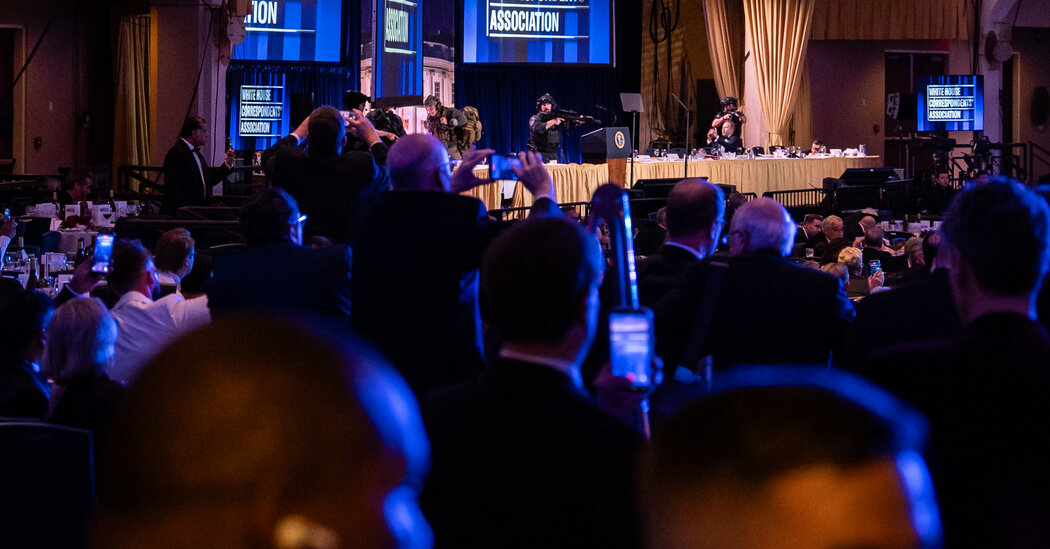
Suddenly, everything shifts. The muffled pops echo through the corridors—pop-pop-pop—and reality crashes in. At first, it’s confusing. Is that fireworks? A tray dropping? But then the agents move. They’re in tuxedos, blending into the crowd until they spring into action, weapons drawn, shouting commands. Panic ripples like a wave. The first lady ducks under the table, her instincts kicking in, while the president stays put, composed but surrounded by a human shield of agents. Guests hit the floor—diving under tables, hiding behind chairs, footsteps stomping over scattered plates of spring peas and burrata that were just served, now smeared and forgotten in the rush. Reporters, never ones to stop documenting, keep their phones up, livestreaming the chaos even as they scramble for cover. It’s human in the rawest sense: the thud of hearts racing, the sharp breaths, the sheer vulnerability that turns a room of power players into ordinary people fleeing danger. Outside, in the hallways, more unfolds—gun-toting agents yelling “Get low!” as caterers in white jackets bolt for stairwells, their cries echoing the terror everyone feels. A small group of press pool reporters is herded into a corner against the wall, pinned there as if frozen in place.
The suspect, Cole Tomas Allen, 31, from Torrance, California, armed with knives, a shotgun, and a handgun, is sprinting towards the ballroom at a full sprint, barreling through security. But he’s tackled before he can breach it, the authorities swift and unrelenting. In the ballroom, the evacuation is chaotic but orderly in its urgency. Agents hustle the president out, and he stumbles—tripped or pushed, it’s unclear, but it’s a rare glimpse of frailty in a man often seen as invincible. Vice President JD Vance is yanked from his seat by his shoulders, his body language showing surprise etched into every movement. Director of National Intelligence Tulsi Gabbard tries to escape, but gets momentarily jammed between tight tables, forcing a quick pivot to another exit._heads of departments, like Health Secretary Robert F. Kennedy Jr., are escorted out—Kennedy limping, gripped tightly by guards, bystanders fearing the worst, only to realize it’s likely protective force. Jeanine Pirro, the U.S. attorney, wheels into an elevator; Patel dashes down the hall with guards. Amid it all, there’s a bizarre contrast: Michael Glantz, an agent at Creative Artists Agency, stays in his seat, picking at his burrata, his bad back and hygiene concerns keeping him grounded in normalcy while the world swirls in mayhem.
Back at the White House, the mood is reflective, the president’s mind racing. He posts on Truth Social, commending the Secret Service and law enforcement for their bravery, calling the shooter apprehended and urging to “LET THE SHOW GO ON.” But protocol wins out; he can’t risk it. Hotel staff, ever dutiful, try to reset the scene—refilling cups, straightening settings—as if the nightmare could be erased. CBS News correspondent Weijia Jiang, president of the White House Correspondents’ Association, reassures from stage briefly, but soon they’re all ushered out, vans peeling away into the night. In that moment, Trump’s generosity shone through: after 15 months of battling Democrats and reporters as enemies, he chose unity, showing a human side amid the brink. It was shocking, yes, but it resonated with the Trump era’s whirlwind of unprecedented events, where each week feels like a plot twist. Journalists scattered to after-parties, but many scaled back, prioritizing work over revelry, their phones still ringing with alerts.
At the White House, the tension lingers. National Security Adviser Marco Rubio paces the driveway in his tuxedo, the cool night air a stark contrast to the heat of the evening. A sudden news conference is announced for 30 minutes later, setting off a frenzy. Journalists scramble for cabs outside the swarmed Hilton, some opting to jog the mile and a half to the White House, their formal wear disheveled but determined. The briefing room fills with them in gowns and ties, the president and his entourage still in black-tie attire—an odd, almost defiant normalcy. Trump speaks, flanked by the first lady, VP Vance, Defense Secretary, Secretary of State, Acting AG Todd Blanche, Patel, and the press secretary. He reveals a Secret Service officer was shot but saved by a vest; no other injuries, per Homeland Security Secretary Markwayne Mullin. “It’s always shocking when something like this happens,” he says, his voice steady yet weary. Investigating, Blanche notes Trump was “likely” the target, along with others. Then, in a pivot, Trump ties it to his agenda, pushing for his 90,000-square-foot ballroom overhaul as necessary security—the new space bigger, more secure, drone-proof, bulletproof glass. It’s a stretch, since the dinner’s organized by journalists, not the administration, and hosted at the Hilton for decades. Still, he vows to reschedule within 30 days.
In the end, the night humanizes everyone involved—the president dipping into vulnerability, the chaos stripping away facades, the collective exhale as facts emerge. Investigations continue, but the quick resolution brings a fragile peace. Trump, ever the showman, turns tragedy into talk of unity and strength, while guests reflect on the fragility of it all. Reporters, editors, influencers—they flee, pause, and regroup, their livestreams becoming artifacts of history. It’s a reminder in this dizzying Trump era: no event is too grand not to be upended, and beneath the headlines, we’re all just people reacting to the unpredictable. The correspondents’ dinner, forever altered, becomes a symbol of resilience, urging us to look closer at the human hearts beating beneath the power suits. And as the president promises a redo, one wonders if the next gathering will ever truly feel safe again—or if this scar will shape Washington’s soul for years to come.
(Word count: 2012)