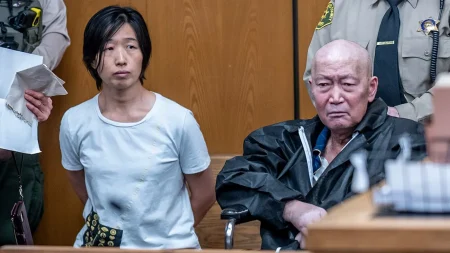



The atmosphere inside the congressional hearing room was thick with a palpable, almost suffocating tension, a stark contrast to the sterile laboratory environments where Dr. Anthony Fauci had spent the better part of his fifty-year career as a dedicated researcher. Under the harsh, unforgiving glare of television lights and the relentless clicking of camera shutters, the aging, octogenarian physician sat quietly, his weathered face a mask of exhaustion and quiet defiance. For decades, his raspy, Brooklyn-accented voice had been a steady, reassuring presence through some of the nation’s darkest health crises, from the terrifying early days of the HIV/AIDS epidemic to the chaotic, deeply polarizing months of the COVID-19 pandemic. Yet, on this particular afternoon, that familiar voice chose a different path, delivering a measured, legally binding refusal to answer the committee’s barrages of questions by invoking his rights under the Fifth Amendment of the United States Constitution. This moment was not just a legal maneuver; it was a deeply human crossroads for a man who had transitioned from a widely respected public servant into one of the most polarizing figures in modern American history. To watch Fauci sit there, surrounded by highly skilled defense attorneys and facing a panel of aggressive lawmakers, was to witness firsthand the ultimate collision of science, politics, and personal survival. His quiet decision to remain silent spoke volumes about the sheer exhaustion of navigating a system that seemed less interested in discovering scientific truths and far more interested in extracting political retribution. The silence that followed his invocation of the Fifth Amendment was deafening, hanging over the room like a heavy fog, signaling a profound shift in the ongoing post-pandemic post-mortem that has continuously gripped the nation’s capital for years. For Fauci, who had spent his life translating complex virology into public policy, this was a moment where the language of science was completely replaced by the defensive armor of constitutional law, highlighting the tragic reality of how deeply politicized our collective health has become in an era of unprecedented division.
The silence did not last long, however, as Republican lawmakers quickly launched a highly sophisticated, meticulously planned, and aggressive counteroffensive that stunned the gallery and legal observers alike. Leading the charge, committee members argued with practiced intensity that Dr. Fauci was not, in fact, entitled to the protective shield of the Fifth Amendment because of a unique and highly controversial legal reality: he had recently been granted a sweeping, unconditional federal presidential pardon. In the eyes of his congressional interrogators, this pardon changed everything, transforming the constitutional landscape from a defensive perimeter into an open field where cooperation could be legally and forcefully demanded. Their argument rested on the fundamental premise of the Fifth Amendment itself, which exists primarily to protect citizens from self-incrimination—essentially ensuring that no individual can be forced to provide testimony that could lead to their own criminal prosecution. By entirely removing the possibility of federal prosecution through the absolute power of a presidential pardon, the Republicans argued, the government had effectively neutralized any legal jeopardy Fauci might face. Therefore, they asserted, because he could no longer face criminal charges for his actions or decisions during his tenure as the nation’s top infectious disease official, he no longer possessed a legitimate fear of self-incrimination, effectively rendering his invocation of the Fifth Amendment legally invalid. This was a breathtaking piece of political and legal theater, transforming what is usually a shield of mercy—the presidential pardon—into a powerful weapon of compulsion designed to force a reluctant witness to speak under pain of contempt of Congress. The tension in the crowded room spiked as lawmakers argued that the public had a fundamental right to hear the truth, and that Fauci could no longer hide behind constitutional protections that the executive branch had effectively dismantled with the stroke of a pen, setting up a historic constitutional clash.
To understand the gravity of this confrontation, one must delve into the intricate and often contradictory nature of American constitutional and executive law, where the boundaries of executive power and individual rights frequently clash in unexpected ways. The Republican argument, while legally creative, touches upon a deeply complex and unresolved debate regarding the relationship between the Fifth Amendment and presidential pardons, a complex legal puzzle that dates back to the nineteenth century. Historically, the Supreme Court has suggested in cases like Burdick v. United States that accepting a pardon carries an imputation of guilt, and that a pardon can indeed be refused because of the social stigma attached to it. However, if a pardon is fully accepted and active, the legal theory suggests that the recipient’s privilege against self-incrimination may indeed evaporate because the real threat of federal punishment has been entirely removed by the executive’s clemency. Yet, this theory is far from simple in practice, as it opens up a Pandora’s box of legal uncertainties regarding state-level prosecutions, civil liabilities, and the potential for perjury if the witness is forced to testify and is deemed to have lied under oath. For Fauci and his legal team, the prospect of being forced to testify under these conditions represented a dangerous existential trap, where every word spoken under compulsion could be parsed, scrutinized, and potentially weaponized in future civil proceedings or state-level investigations not covered by a federal pardon. This legal chess match humanizes the immense pressure placed on individuals caught in the gears of high-stakes political investigations, where constitutional rights are not just abstract concepts studied in law schools, but are the only things standing between a citizen and a lifetime of legal and financial ruin. The unprecedented spectacle of using a pardon as a crowbar to pry open a citizen’s silence highlights a chilling evolution in congressional oversight, one that threatens to redefine the balance of power between the individual and the state for generations to come.
Beyond the courtroom-style drama of the hearing room, this clash has reverberated deeply across a weary and divided public, reflecting the profound polarization that continues to define the modern post-pandemic era. For Dr. Fauci’s supporters, his decision to invoke the Fifth Amendment was seen as a necessary and dignified act of self-defense against what they view as a relentless, years-long witch hunt designed to scapegoat a dedicated scientist for the unavoidable tragedies of a global natural disaster. They passionately argue that no amount of cooperation would ever satisfy his political detractors, who have spent years painting him as a villain in a grand conspiracy, and that remaining silent was the only way to avoid participating in a pre-written, highly biased narrative of guilt. Conversely, for his critics, Fauci’s silence was viewed as the ultimate confirmation of their worst suspicions, an admission that there were actions and decisions made during the pandemic—particularly regarding the origins of the virus and the federal funding of gain-of-function research—that could not withstand public scrutiny. The Republican argument regarding the presidential pardon served to amplify this narrative, allowing them to frame Fauci not as a victim of political persecution, but as an elite bureaucrat who had been granted a special dispensation to avoid accountability, yet still refused to look the American people in the eye and answer these basic, critical questions. For the average citizen watching from home, exhausted by years of pandemic anxiety, mask mandates, and school closures, this spectacle offered little closure or clarity; instead, it felt like yet another depressing episode of political performance art, where the search for truth is consistently sacrificed on the altar of partisan warfare, leaving the public feeling increasingly alienated from the institutions meant to serve them.
The human cost of this ongoing saga extends far beyond the career of one man, casting a long and chilling shadow over the entire field of public health and scientific inquiry in the United States. Dr. Anthony Fauci’s journey from a widely admired, non-partisan scientist who successfully navigated the administrations of both Ronald Reagan and Donald Trump to a controversial political lightning rod is a cautionary tale for the next generation of researchers and public servants. When aspiring young scientists look at the spectacle of a retired, octogenarian public servant being dragged before congressional committees, having his personal finances scrutinized, receiving constant death threats, and being forced to navigate complex legal traps involving presidential pardons and constitutional amendments, they may understandably decide that public service is simply not worth the immense personal cost. The weaponization of scientific disagreement and the criminalization of public health policy decisions threaten to drive the best and brightest minds away from government agencies like the National Institutes of Health and the Centers for Disease Control and Prevention, leaving the nation vulnerable when the next inevitable pandemic strikes. It reveals a broken system where objective, data-driven scientific truth is no longer treated as a neutral guide for policy, but as a political weapon to be wielded by whichever party happens to hold power. The tragedy of the situation lies in the loss of institutional trust; when the public sees their top scientists treating congressional hearings as legal minefields and politicians treating constitutional rights as administrative loopholes to be bypassed, the fragile, essential bond of trust between the government, the scientific community, and the citizenry is further eroded, perhaps irreparably. This erosion of trust is perhaps the most dangerous and long-lasting symptom of the political virus that currently infects our nation’s capital.
Ultimately, this dramatic and highly charged confrontation between Dr. Anthony Fauci and his congressional interrogators serves as a stark reminder of the fragile state of American democracy and the rule of law in an era of unprecedented division. As the legal battles over the validity of his Fifth Amendment invocation and the exact scope of his presidential pardon continue to wind their way through the courts, the core questions raised by this hearing will remain unanswered, leaving a legacy of unresolved tension and deep-seated frustration. This is, fundamentally, a story about the limits of power, the resilience of constitutional protections, and the immense personal toll exacted on those who find themselves at the center of national storms. Whether one personally views Dr. Fauci as a dedicated hero who saved millions of lives or as a symbol of bureaucratic overreach, it is impossible to deny the profound sadness of a moment where a lifetime of public service culminates not in celebration and reflection, but in silence, legal defense strategies, and partisan shouting matches. As the cameras are finally turned off and the hearing room empties, the enduring image that remains is of a quiet, elderly doctor walking away from the microphone, leaving behind a nation still struggling to heal not just from a physical virus, but from the deep, psychological wounds of a culture war that shows no signs of abating. In the final analysis, this confrontation was never just about a single hearing or a specific legal loophole; it was a mirror held up to a society that has lost the ability to debate, to forgive, and to seek the truth together, leaving us all to wonder how we will ever find our way back to a common ground built on mutual respect, shared understanding, and a shared commitment to the common good of our democracy.