



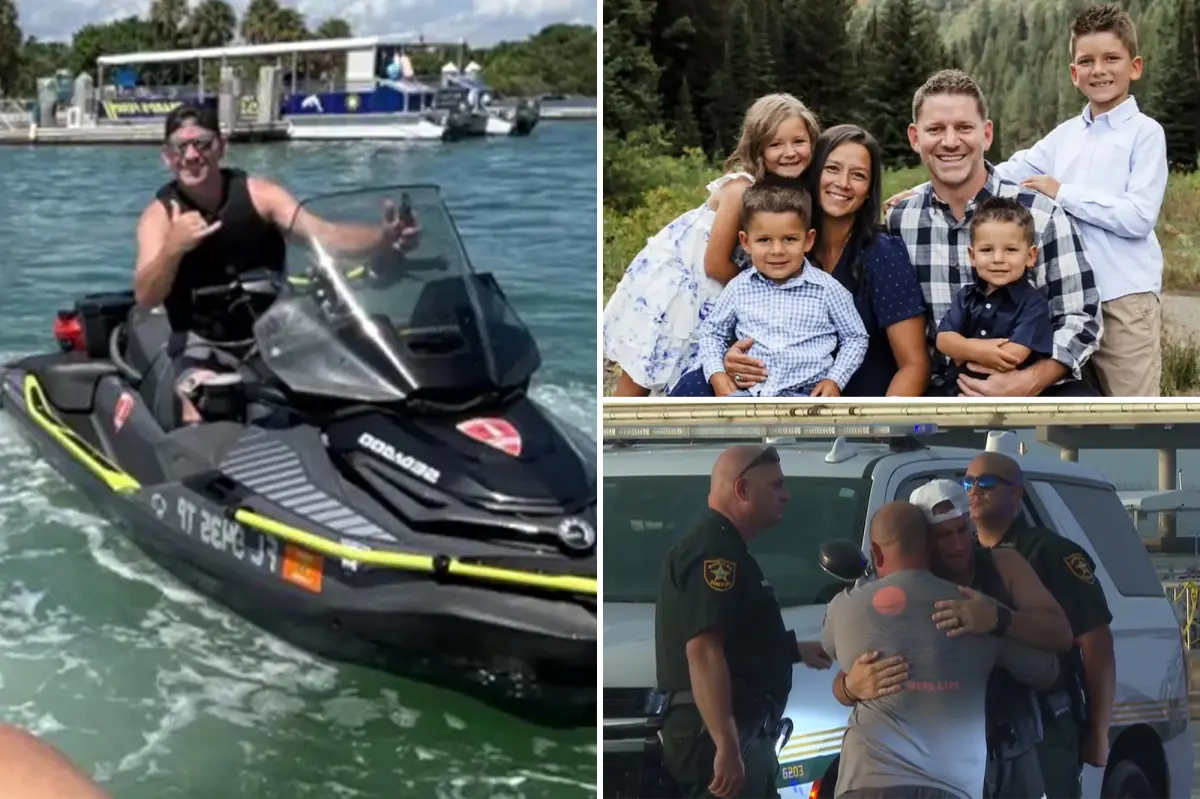
The late-afternoon sky over the Gulf of Mexico had already turned the color of old pewter, and the wind was beginning to speak in a low, urgent voice. Off the coast of Fort de Soto, Florida, a small group of people was making its way back toward shore, aware that a storm was gathering strength behind them. Among them was Steve Matheson, a 47-year-old father of four from Utah, who had been jet-skiing with a friend just before 6:35 p.m. on Saturday. They had seen the warning signs. They were moving. But then they saw something else: a broken-down boat, a collection of strangers in difficulty, unable to make it in on their own. Matheson, without hesitation, stopped to help. It was, by every account, a decision that perfectly summed up the man he was. As the tempest continued to advance, the sky above them became more violent, more charged, until the moment came when there was nowhere left to go. Lightning struck him. His cousin, Marianne Matheson Shuman, said simply: “The lightning took him pretty quickly.” Matheson was rushed to a local hospital, but his injuries were too severe to overcome. He died doing what he had always done: placing himself in the path of need, even when it meant turning away from safety. “Even in his last moments he was helping and serving strangers,” Shuman said. “He would have it no other way.” Those words have become more than a tribute; they are a window into a life defined by quiet generosity, an ordinary man who carried within himself an extraordinary call to serve.
Steve Matheson was, above all, a family man. He leaves behind his wife, Abbie, and their four children, and in the days since his death, the tributes pouring in have all circled around the same truth: he loved his family deeply and made them the center of his world. His friend April Beck remembered him as a “devoted husband and loving father,” someone who “cherished every moment he was able to spend with them.” Beck’s words were not the distant, formal condolences of a bystander; they were a close friend’s portrait of a man whose life was not divided between what he owed at home and what he gave to others, because for Steve, the two were inseparable. He was also a diehard Brigham Young University Cougars football fan, and his devotion to his team was part of a larger faith that anchored his entire existence. As a member of The Church of Jesus Christ of Latter-day Saints, Steve’s belief in God was not a private comfort but a public calling. He had a strong and unwavering faith in his Heavenly Father and in Jesus Christ, and that faith showed itself not in grand moments of performance but in the gentle, consistent way he treated people. Beck noted that his love for his family and his faith were “evident in the way he treated others and the life he chose to live.” In an age when belief is often dismissed or debated, Steve’s religion was simply the grammar of his day-to-day existence: he prayed, he served, he loved, and he showed up. The choices he made on that Florida shoreline were not an accident. They were the natural, even inevitable, outcome of a soul that had spent years practicing the art of putting others first.
The friends who knew Steve best have been telling story after story, and in those stories, a much fuller picture of the man emerges. He was someone who did not wait to be asked. When his friend Mitch Faas needed help moving fireworks ahead of the Pioneer Day holiday — a celebration that remembers the arrival of Brigham Young and the first group of Mormon pioneers who settled in the Salt Lake Valley — Steve was the first person to respond. Faas recalled how he showed up with his oldest son, jumped right in, and worked without making a fuss. It was not the first time, and it would not have been the last. In fact, the last text Faas sent to Steve read, “Thanks for always being someone I can count on bud.” Steve’s reply was just three words: “Always brotha.” Then he added: “We appreciate you and are always willing to help.” That text message reads like an epitaph, but more than that, it reads like a mission statement. Steve did not merely help when he was comfortable or when it was convenient. He helped because helping was the air he breathed. His word was good, his shoulder was available, and his willingness to serve never seemed to run dry. In the era of hectic schedules and scattered attention, Steve was the rare person who made you feel like you were the only one in the room when you spoke to him. He remembered the small things. He showed up for the hard things. And he did it all with a kind of joy that made others want to be better.
Perhaps no memory better captures Steve’s character than the one shared by his friend Aaron Boone. The two men were supposed to play flag football together, and they shared a love for competition and for the game. But Boone also remembered something more intimate, something that happened after Steve’s own father passed away a couple of years ago. Steve’s dad used to come watch him play flag football all the time, and when his father was gone, Steve did not retreat into grief. Instead, he turned his attention to Boone’s father, who also attended the games. Steve “kind of took my father under his wing,” Boone wrote, “almost as if he were his own dad.” He made a point to sit with him, to make sure he was comfortable, to talk with him, to visit before, during, and after the games. This is a memory that says more than any obituary could. It reveals a man who was attentive, who noticed the people around him, especially the older, the lonely, the overlooked. Steve did not need to be in charge or in the spotlight. He simply needed to be there. Boone described the two of them as sharing not only a love for football but also a strong faith, a love for their families, and a soft spot for kids. That soft spot, that tenderness, was present in every part of his life. He saw people not as functions or as opportunities but as human beings deserving of dignity and care. And in one of the cruelest ironies, it was that same instinct—the instinct to help a group of unknown boaters—that placed him in the path of the storm that killed him.
Steve Matheson’s death is the thirteenth lightning strike fatality in the United States this year, according to the Lightning Safety Council. It is a statistic that feels cold and abstract, but behind that number is a man with a family, a history, a future that will now remain unwritten. Just six days before Steve was struck, a heartbreaking double tragedy occurred in Margate, Florida, where two-year-old Kennedi Glasgow and her 31-year-old mother, Kenya Glasgow, were killed in a freak lightning strike in front of their family. The proximity of these two disasters is a reminder of how sudden, how random, and how devastating lightning can be. But it also reminds us that in the blink of an eye, everything can change. There are no safe assurances. There is no way to predict when the ordinary sky will turn violent and when an ordinary moment will become a final one. Steve was not reckless; he was simply selfless. He knew the storm was coming. He could have kept going. But there were people who needed help, and for Steve Matheson, that was enough. He gave his life not because he was careless or naïve, but because he was the kind of person who understood that the value of a life is measured not by how long you live but by how completely you give it away. His death, like the deaths of the mother and child in Margate, forces us to confront our own mortality and to ask ourselves what we are doing with the time we have been given.
In the end, Steve Matheson’s story is not just a story about dying. It is a story about living. He was a husband who loved deeply, a father who showed up fully, and a friend who was always willing to help. His cousin Marianne has offered the words that will now stand as his memorial: “Even in his last moments he was helping and serving strangers.” And then, with a certainty that must bring comfort to his family, she added: “He would have it no other way.” That is the deepest truth about Steve. He would not have wanted to be anywhere else in that moment, because his whole life had been a preparation for it. He had learned that love is not a feeling but an action. He had learned that faith without works is empty. He had learned that the people around us are the most sacred things we will ever encounter. His family and friends are left with an unimaginable ache, but they have also been left with a legacy that cannot be stolen by the storm. Every time someone stops to help a stranded stranger, every time a friend sits with a grieving father at a football game, every time a man shows up with his oldest son to move fireworks before a holiday, Steve Matheson will be there. He will be there because he was the kind of person who left fingerprints on the hearts of everyone he met. And in a world that so often asks what is in it for us, Steve answered with his life: whatever I can do for you. His last text message was a promise and a benediction. “Always brotha.” For Steve, it was true until the very last second of the very last day. And now, for all of us who hear his story, the question is whether we will let it become true for us too.