





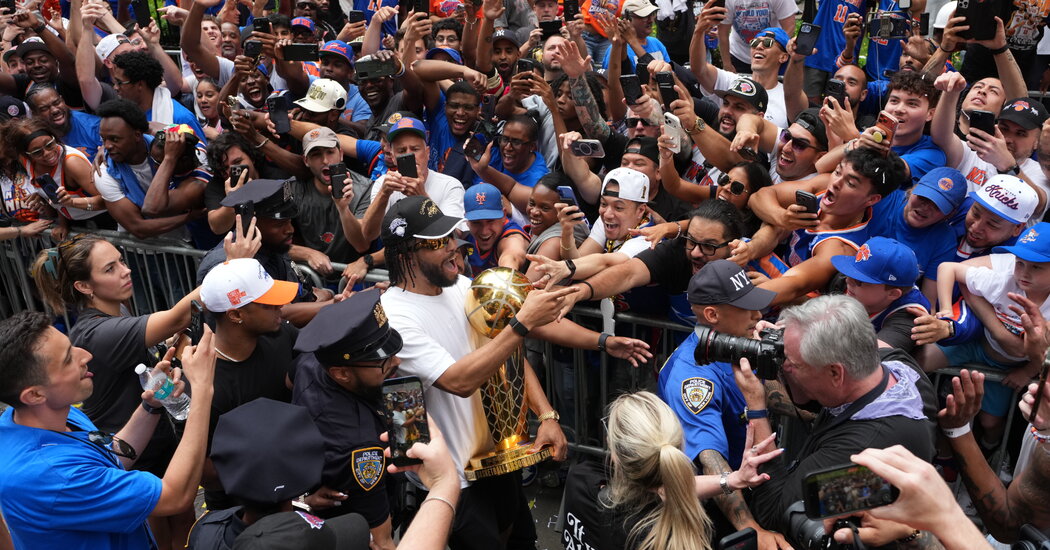
As the first amber rays of dawn kissed the jagged skyline of Lower Manhattan on a historic Thursday morning, the city did not sleep; instead, it breathed a collective, roaring sigh of relief and unbridled joy. From the neon-lit corridors of Times Square to the quiet brownstone stoops of Brooklyn, New Yorkers of every stripe, origin, and generation poured into the paved veins of the metropolis, swept up in a tidal wave of shared euphoria. For fifty-three long, agonizing years, this basketball-obsessed city had harbored a quiet, simmering ache, a generational longing for a moment that had eluded them since the era of rotary phones and vinyl records. Now, that drought was shattered, replaced by the electric reality of the New York Knicks’ first National Basketball Association championship in two generations, a triumph that transformed strangers into family and the concrete streets into a massive, open-air ballroom. The sheer human scale of the gathering was breathtaking, as grandfathers who had witnessed the legendary 1973 championship stood shoulder-to-shoulder with wide-eyed children who had only ever known the Knicks as a symbol of perpetual struggle and noble heartbreak. As the morning progressed, the atmosphere grew thick with the scent of roasted nuts, soft pretzels, and the unmistakable electric charge of a city that had finally reclaimed its crown, proving that no matter how long the winter, spring in New York always has the potential to be magnificent. It was a sensory overload of sights and sounds: car horns honking in rhythmic unison to the beat of the city’s heart, strangers exchanging high-fives across yellow cab hoods, and tears flowing freely down the cheeks of grown men and women who had spent their entire lives waiting for this exact sunrise. This was not merely a victory for a sports franchise; it was a profound cultural awakening, a reclamation of civic pride that proved the beating heart of New York sports was alive, well, and beating stronger than ever before.
To truly comprehend the depth of the emotion flooding the streets, one must understand the heavy, decades-long cross that Knicks fans have carried through the cold winters of disappointment. Since the legendary days of Willis Reed, Walt “Clyde” Frazier, and Earl Monroe, the franchise had wandered through a seemingly infinite desert of near-misses, heartbreaking playoff exits, mismanagement, and seasons that tested the very limits of human loyalty. The agony of the nineties, defined by the grueling but ultimately unrewarded heroism of Patrick Ewing, gave way to a bleak twenty-first century characterized by empty promises, revolving-door coaching staffs, and a Madison Square Garden that often felt more like a theater of tragicomedy than the Mecca of Basketball. Yet, through every losing streak, every draft-night disappointment, and every mocking headline, the fans never truly walked away; they merely buried their hope deep in their chests, waiting for a spark to reignite it. That spark became a roaring wildfire this season, as a roster built on grit, defense, and an unapologetic blue-collar work ethic mirrored the very soul of the city they represent, enduring a grueling winter to emerge as champions. Parents who had spent decades trying to explain the magic of the 1970s to their skeptical children finally had a contemporary masterpiece to share, bridging a massive generational divide with a shared language of orange-and-blue triumph. The championship was a validation of a half-century of unconditional love and loyalty, a glorious proof that the suffering was not in vain, and that the ultimate reward is infinitely sweeter when it is paid for with decades of tears, patience, and unyielding faith in the face of overwhelming odds. This victory washed away the cynicism that had long characterized the local sports scene, replacing it with a pure, childlike wonder that could be felt in every corner of the five boroughs, reminding everyone that loyalty eventually yields its reward.
At the heart of the celebration was the iconic ticker-tape parade, a time-honored New York tradition reserved only for the grandest of achievements and the most heroic of figures. For the first time in the Knicks’ storied eighty-year history, one of these legendary processions was mapped out specifically for them, charting a triumphant course up seventeen blocks of Broadway, through the soaring, concrete canyon of Lower Manhattan to City Hall. This route, universally known as the Canyon of Heroes, became a roaring river of humanity, flanked by millions of ecstatic fans and secured by a massive contingent of ten thousand police officers who, despite their duty, could often be seen smiling and high-fiving the crowd. As the open-top floats carrying the players crept slowly through the dense throng, a blizzard of white and colored paper rained down from the windows of the towering skyscrapers, catching the midday sun like snow in a dream. Office workers leaned out of windows twenty stories up, tossing shredded documents, confetti, and streamers that danced in the updrafts of the canyon, creating a shifting, kinetic canvas of celebration. The team itself looked almost overwhelmed by the sheer scale of the reception, with players laughing, capturing the moment on their phones, and hoisting the Larry O’Brien Trophy high into the air to deafening roars that echoed off the historic limestone facades. Along the route, every lamppost, mailbox, and traffic light seemed to have a fan perched precariously upon it, determined to get a glimpse of the modern-day legends who had finally brought the golden ball back to Pennsylvania Plaza. It was a magnificent display of civic logistics and raw passion, where the rigid structure of the city’s grid system dissolved into a beautiful, chaotic festival of shared pride, transforming the entire financial district into a playground of joy.
The cultural impact of the victory extended far beyond the physical boundaries of the parade route, permeating the very fabric of New York’s daily life and showcasing the unique way the city processes joy. In every neighborhood, enterprising locals seized the moment, setting up folding tables on street corners to sell bootleg shirts, handmade hats, and creative memorabilia that captured the raw, unfiltered spirit of the fan base better than any official merchandise ever could. The city’s famous landmarks joined in the celebration, with municipal buildings across the five boroughs illuminating their facades in brilliant displays of blue and orange light, casting a warm, victorious glow over the rivers and skylines. Even the usually gray and utilitarian infrastructure of Lower Manhattan was transformed for the occasion; forest green trash cans, a staple of the city’s streets, were painted over in the team’s signature vibrant blue and orange hues, signaling that on this day, every detail of the urban landscape belonged to the Knicks. The soundtrack of the city also shifted, as car stereos and public parks blasted Alicia Keys and Jay-Z’s iconic anthem, “Empire State of Mind,” a song that has long served as the modern national anthem of New York but now carried an entirely new, triumphant weight. Keys herself was scheduled to take the stage later in the day, a fitting tribute from an artist whose music is deeply woven into the DNA of the city, promising a performance that would capture the poetic gravity of this historic milestone. This cultural explosion proved that a championship in New York is never just a sporting success; it is a catalyst for artistic expression, economic vitality, and a collective state of mind that elevates the mundane into the extraordinary, proving to the world that when this city celebrates, it does so with an artistic flair that is unmatched.
The culmination of this epic journey took place on the steps of City Hall, where a formal ceremony hosted by Mayor Zohran Mamdani served as the civic crown jewel of the day’s festivities. The young, energetic mayor, reflecting the diverse and dynamic spirit of the modern city, prepared to hand over the keys to the city to a team that had earned them through sheer grit and determination. In a passionate address that resonated with the millions watching at home and the thousands gathered on the grassy lawns of the civic center, Mamdani beautifully articulated the unifying power of this singular achievement. He spoke of how New Yorkers had cheered together in a beautiful mosaic of solidarity, from packed living rooms in the Bronx and lively watch parties in Brooklyn, to neighborhood taverns in Queens and Staten Island, all the way to the hallowed, shaking foundations of Madison Square Garden itself. He captured the essence of the city’s collective voice by concluding his statement with the viral rally cry “Bing bong,” a colloquialism born on the streets of New York that had evolved into the official soundtrack of the team’s historic season. This phrase, simple yet dripping with local flavor, became a unifying battle cry, chanted in unison by the massive crowd as the players took the stage to receive their honors. The ceremony was a powerful reminder that sports possess a unique, almost magical ability to bridge deep political, social, and economic divides, bringing people together under a single banner of shared happiness. In a city often defined by its fast pace and occasional friction, the sight of people from all walks of life—corporate executives, construction workers, teachers, and transit employees—swapping stories and celebrating as equals was a testament to the profound democratic spirit of the game, proving that this victory belonged to everyone who calls New York home.
As the afternoon shadows began to lengthen across the cobblestones of Lower Manhattan and the mountains of blue and orange confetti were swept up by sanitation workers, the true legacy of this day began to settle into the collective consciousness of the city. This championship was never merely about a trophy or a line in a history book; it was a profound testament to the resilience, loyalty, and enduring spirit of New Yorkers who refuse to give up, even when the odds are stacked against them and the wait is agonizingly long. It served as a beautiful reminder that the soul of New York is defined by its ability to endure, to hope, and to celebrate with a passion that is unmatched anywhere else on earth. The memories of this parade—the sight of the players engulfed in a blizzard of paper, the echoes of “Bing bong” bouncing off the brick walls of the boroughs, and the tearful embraces of family members who had waited a lifetime for this moment—will be passed down through generations, becoming part of the rich tapestry of folklore that makes New York City so endlessly fascinating. The long, hard winter had finally given way to a glorious, golden summer, leaving behind a city that felt lighter, closer, and more deeply connected to its own identity than it had in decades. The orange and blue lights atop the Empire State Building would shine through the night, a silent sentinel of victory, reminding every soul from the Hudson to the East River that the wait was over, the crown was back, and the city’s heart was beating in perfect rhythm. As New Yorkers finally headed back to their homes, they did so with their heads held a little higher, secure in the knowledge that they were no longer just survivors of a long sports tragedy, but proud citizens of a championship city.