



A Continent Adrift: The Growing Shadow of Geopolitical Instability Across Europe
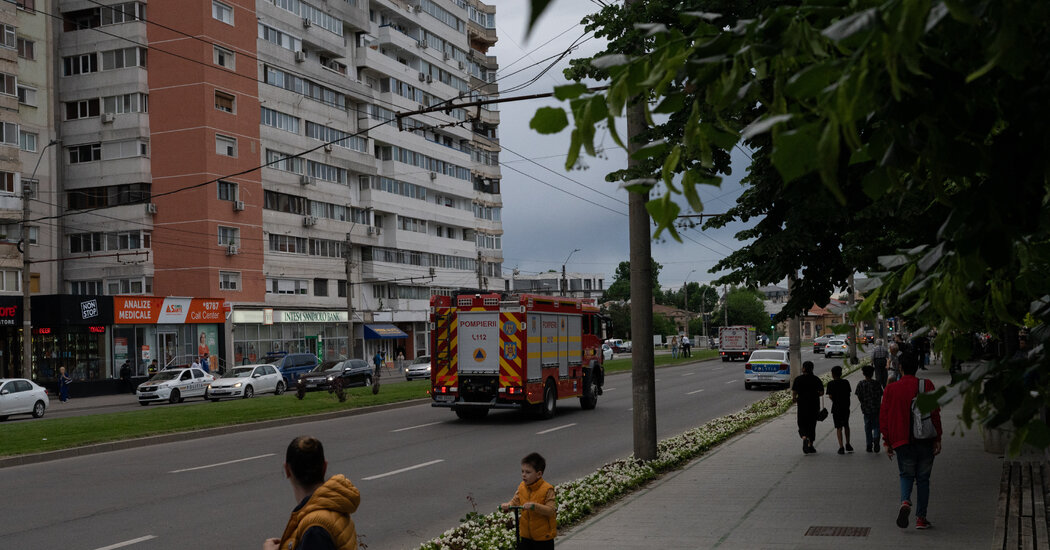
The psychological landscape of modern Europe is increasingly defined by a pervasive, slow-burning anxiety, as a continent accustomed to peace finds itself precariously adrift between an aggressive, revanchist Russian Federation and an increasingly unpredictable United States. This existential unease is not merely a product of abstract geopolitical calculations; it is fueled by the grinding reality of the Russia-Ukraine war, now dragging through its fifth grueling year, alongside severe economic self-harm worsened by escalating conflicts in the Middle East. The fragility of this security architecture was brought into sharp relief on a recent chilly Friday morning when a Russian surveillance and attack drone crashed into a residential building in Romania, injuring two civilians on sovereign NATO territory. While military analysts debate whether the intrusion was an accidental navigation error or a deliberate test of allied resolve, the physical impact on Romanian soil has deeply exacerbated the collective dread felt across Eastern Europe. For European policymakers, this incident serves as a stark reminder that the protective umbrella they have relied upon since the end of the Cold War is fraying at the edges. As the Kremlin demonstrates an increased willingness to take reckless military risks to offset its battlefield stagnation in Ukraine, European leaders are openly warning that a highly militarized, wartime Russian economy could be capable of launching a direct assault on the NATO alliance within the next three to five years. This terrifying timeline is converging with a profound political crisis in Washington, where a returning Trump administration has systematically cast doubt on America’s historic commitment to European security, leaving a wealthy but militarily hollow continent to contemplate its own defense in an era of unprecedented global volatility.
Cracks in the Shield: NATO’s Struggle to Secure Its Eastern Flank
                       NATO'S EASTERN SHIELD
                                │
     ┌──────────────────────────┴──────────────────────────┐
     ▼                                                     ▼
Drone Walls Operation Eastern Sentry
- Physical & electronic monitoring – Response to Polish airspace violation
- Coordinated Baltic-Polish defense – Advanced radar & intercept systems
│ │
└──────────────────────────┬──────────────────────────┘
▼
Defensive Vulnerabilities- Interceptor missile shortages
- High manufacturing lead times
This sudden violation of Romanian airspace has rekindled uncomfortable questions about NATO’s practical capabilities to protect its own frontier, exposing a yawning gap between the alliance’s political rhetoric and its tactical readiness on the ground. Despite highly publicized defensive initiatives—such as the construction of coordinate “drone walls” along the Baltic borders and the establishment of Operation Eastern Sentry, which was launched last September following a deliberate, deep intrusion of Russian drones into Poland—cracks in the alliance’s armor are becoming impossible to ignore. Each time a hostile aerial vehicle crosses into allied territory undetected or unhindered, it validates the strategic calculations of Russian President Vladimir V. Putin, whose primary geopolitical objective remains the fragmentation of the trans-Atlantic alliance. By demonstrating that NATO’s airspace is porous, Moscow seeks to erode public trust in the alliance’s core tenet of collective defense under Article 5, while simultaneously encouraging isolationist factions within Washington to demand a complete withdrawal of American forces and strategic assets from European soil. The long-term danger is that a fragmented Europe, stripped of its American security guarantee, would have no choice but to accommodate Moscow’s security demands, effectively restoring a Russian sphere of influence over the former Eastern Bloc. In the near term, however, Russia’s aggressive posture serves an immediate tactical purpose: to paralyze European decision-making and systematically disrupt the flow of military assistance to Kyiv, thereby tilt the balance of the war decisively in Russia’s favor.
Escalate to De-escalate: The Kremlin’s Strategic Gambits and Hybrid Warfare
To fully understand this pattern of aggression, international security analysts point to a deliberate Russian doctrine of “escalating to de-escalate,” transforming the conflict from a localized war of attrition into a broader crisis of European security. Facing tremendous difficulties on the Ukrainian front lines and a highly effective Ukrainian deep-strike campaign that has brought the war home to the Russian heartland, the Kremlin has resorted to asymmetric tactics designed to intimidate Ukraine’s Western backers. This strategy manifested recently in a series of devastating missile strikes on Kyiv, which featured the combat debut of the Oreshnik—a sophisticated, hypersonic intermediate-range ballistic missile—accompanied by explicit Kremlin warnings that Western embassies in the capital were no longer safe. According to Hanna Notte, a distinguished senior associate and Eastern Europe expert at the James Martin Center for Nonproliferation Studies, these escalations are a calculated effort to pressure the international community by broadening the conflict into what Moscow terms the “strategic hinterland” of Ukraine’s European allies. By unleashing a continuous campaign of cyberattacks, GPS jamming, and physical sabotage against critical European infrastructure, the Kremlin aims to weaponize domestic public anxiety within Western democracies. As Jan Techau, the Europe Director for the Eurasia Group, observes, the Russian leadership is actively seeking to enlarge the scope of the crisis, fostering a sense of vulnerability among European citizens to force a domestic political realization that Ukraine cannot win, thereby compelling Western governments to push Kyiv into a punitive and humiliating peace settlement on Moscow’s terms.
The Transactional Alliance: How Trump’s Foreign Policy Unsettles Washington’s Oldest Allies
                 EUROPE'S GEOPOLITICAL SQUEEZE

     [ Moscow ]                              [ Washington ]
  Wartime Economy                          Transactional Foreign Policy
  Revanchist Posture                       "Paper Tiger" Rhetoric
         │                                         │
         ▼                                         ▼
 ┌────────────────────────────────────────────────────────┐
 │                      EUROPE                            │
 │                      ------                            │
 │   - Critical shortages in air defense systems          │
 │   - Unprepared for conventional state-on-state war     │
 │   - Caught transitions of US military assets           │
 └────────────────────────────────────────────────────────┘
Compounding this sense of isolation is a dramatic, unsettling shift in the wind coming from Washington, where the Trump administration’s foreign policy is actively dismantling decades of diplomatic orthodoxy. President Trump, currently locked in a tense, high-stakes standoff with Tehran over maritime trade corridors and the Strait of Hormuz, has routinely turned his ire toward European allies, openly deriding the NATO alliance as a “paper tiger” that drains American resources without offering reciprocal value. This transactional view of international relations is shared by his cabinet, with Secretary of State Marco Rubio publicly questioning the utility of the trans-Atlantic alliance if European nations refuse to let American forces use local bases for potential military operations in secondary theaters like the Middle East or Asia. This rhetoric marks a historical departure from key principles of collective security, transforming a solemn defense pact into a commercial arrangement where protection is contingent on political compliance. Consequently, European leaders are beginning to realize that the United States may no longer view the defense of Europe as a vital national interest, but rather as an optional commitment that can be bargained away or abandoned if it conflicts with domestic political priorities.
A Sudden Retreat: The Military Reality of America’s Pivot Away from Europe
This rhetorical hostility has rapidly translated into concrete, destabilizing military decisions on the ground, leaving European defense ministries scrambling to plug massive, unexpected gaps in their defensive lines. For years, American military strategists have quietly counseled their European counterparts to invest heavily in their own conventional defense capabilities as Washington prepared for a long-term strategic pivot toward the Indo-Pacific region to counter China. However, under the current administration, the timeline for this transition has accelerated with a suddenness that has caught European generals completely off guard. Just last week, Alexander Velez-Green, a senior defense official at the Pentagon, informed stunned NATO allies that the United States would drastically scale back the rapid-reinforcement forces it had earmarked for Europe in the event of an attack, including critical strategic assets like long-range strike units and air-to-air refueling aircraft. This strategic withdrawal was quickly followed by President Trump’s abrupt executive decision to pull 5,000 highly trained American soldiers, including an elite armored brigade combat team, out of Germany—a retributive move widely seen as political punishment after German Chancellor Friedrich Merz criticized Washington’s aggressive escalations in Iran. To complete the geopolitical whiplash, the Pentagon announced the cancellation of a scheduled armored rotation to Poland, only for President Trump to unilaterally declare he would send 5,000 different troops to Warsaw simply because of his warm personal rapport with the Polish president, creating an atmosphere of deep confusion and unpredictability regarding actual US security policy.
The Price of Hesitation: Rising Risks of Strategic Miscalculation in a Fragile Era
The convergence of these chaotic policy reversals, combined with a severe, systemic shortage of interceptor missiles and advanced air defense systems due to their heavy consumption in Middle Eastern conflicts, has created a highly dangerous security vacuum on the European continent. Julianne Smith, the former U.S. ambassador to NATO, has warned that the current climate of strategic contradiction and allied division is precisely the environment in which devastating military miscalculations occur. If President Putin perceives that Western political cohesion is collapsing, that military supply chains are exhausted, and that the American security guarantee is a dead letter, he may well be emboldened to launch even more aggressive incursions against European targets, confident that the alliance will fail to respond collectively. This bleak reality was underscored by a chilling social media post from former Russian President Dmitry Medvedev, who now serves as the Kremlin’s chief provocateur; preparing Europeans for a bleak new normal, he wrote: “You should realize your authorities have unilaterally entered into a war with Russia. So be vigilant and don’t be surprised by anything. The peaceful sleep is over.” As Europe stands at this historical crossroads, the choice before its leaders is stark: either rapidly overcome national rivalries to forge a self-reliant, unified defense identity, or remain dangerously paralyzed, waiting in the dark to see if the next falling drone signals the end of their century of peace.