

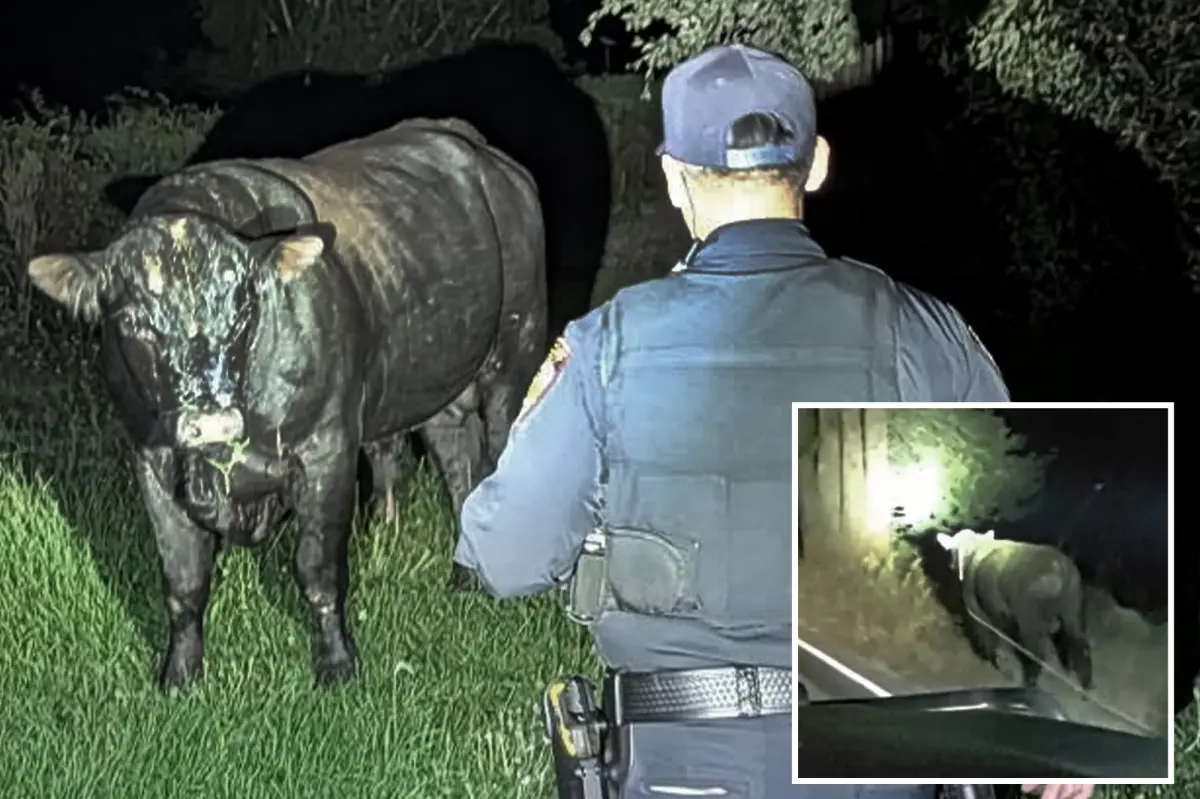
The asphalt of Highway 35 shimmered under the cold, indifferent glare of streetlights, a ribbon of blacktop winding through the serene darkness of San Mateo County. For most, it was a night like any other—commuters heading home, truckers pushing through the late hours, the rhythmic hum of tires filling the air. But that peaceful monotony was shattered by a primal, chaotic force: a massive bull, muscles rippling and hooves pounding, had broken free from its confines and was tearing down the divided highway like a living battering ram. The animal, a behemoth of hide and sinew, did not understand the futuristic world of speeding metal around it. It only knew fear, confusion, and the instinct to run. What followed was not just a traffic disruption, but a dangerous intersection of the modern world and raw, untamed nature. For drivers, the sight of a 1,500-pound animal weaving between cars at high speed was a waking nightmare, and the California Highway Patrol was thrust into a precarious situation, tasked with safely halting a panicked beast that cared nothing for stop signs, speed limits, or the lives of the motorists scattering in its wake.
As word of the renegade bovine spread through the dispatch radios, the CHP officers on scene quickly realized that their standard toolkit—flares, sirens, and traffic cones—was utterly useless. They were wrangling not a malfunctioning driver but a force of nature. The San Mateo County Sheriff’s Office arrived to assist, their patrol cruisers forming a slow-moving caravan behind the galloping animal. They attempted time and time again to loop a rope around its massive neck, leaning out of moving vehicles in a perilous ballet that felt less like modern law enforcement and more like a scene torn from a pre-industrial Western. Each attempt ended in failure. The bull would feint, double back, or simply outrun them, its sheer bulk and power making it nearly impossible to control from a driver’s seat. The officers, brave as they were, were out of their element. They were trained to read human behavior, to negotiate with domestic threats, but this was something else entirely—a conversation that required the ancient language of the cowboy, not the jargon of the law.
It was in this moment of escalating frustration that the desperate call went out, not for backup in the traditional sense, but for a specific kind of expertise that was rapidly fading from the region—the expertise of the old western ranch hand. That call was answered by Samuel Ramos Palomino, the foreman of Sea Horse Ranch. At just past midnight, the jarring sound of a ringing phone pulled Samuel from a deep, exhausted sleep. He was scheduled to be back on the job in only a few hours, his body already aching with the practical fatigue of a working man. But when he heard the details—a lone bull on the highway, officers unable to contain it, the lives of civilians at stake—he did not hesitate. He didn’t grumble about the lost rest; he didn’t contemplate the inconvenience. With the deep-seated sense of duty that defined a lifetime of working with animals, he pulled on his boots, loaded his truck with a heavy rope and his livestock trailer, and drove out into the night to answer a call that modern policing could not. His decision was not born of heroics, but of a simple, ingrained truth: this was a problem he knew how to solve.
What followed was a gritty, slow-motion drama played out under the flickering highway lights. Samuel, a veteran of 35 years, understood that you cannot force a terrified animal—you must read its body language, anticipate its next move, and work with its energy, not against it. For miles, Samuel worked in tandem with the deputies and CHP officers, their cars crawling in a fluid formation while he leaned out of his truck, rope in hand, waiting for the precise moment. The air was thick with tension, the smell of exhaust mixing with the animal’s musky scent. The bull, exhausted and panicked, would frequently turn and charge the line of vehicles, pushing the team to the edge of disaster. It was a test of endurance and nerve. Samuel’s movements were deliberate and calm, a stark contrast to the frantic radio chatter inside the patrol cars. Eventually, after what felt like an eternity, his years of expertise paid off. The rope sailed through the air with an almost poetic precision, snapping taut around the bull’s neck. The immediate relief was palpable, yet the danger wasn’t over. The real test came in the controlled, tense process of coaxing the massive, resistant animal up the ramp of the trailer without causing it to bolt or injure itself.
With the bull finally secured and resting safely in the trailer, the crisis was officially over. But the night was not. Instead of simply dropping the animal off at a random facility and washing his hands of the matter, Samuel went above and beyond his call of duty. He drove the exhausted bull back to his own ranch, providing a safe, warm, and secure enclosure where the animal could calm down and recover from its harrowing ordeal. It was only when he had ensured the creature had food, water, and a safe place to wait out the remaining dark hours that Samuel finally allowed himself to sit down. He looked at the clock. He had just over ninety minutes before he had to get up, shower, and report back to work for another full day of manual labor. He had sacrificed his entire night of sleep—the essential fuel for his body—not for glory, not for a bounty, but because the situation demanded it. His actions had likely prevented a horrific multi-vehicle crash, protected the terrified bull from being shot, and saved the first responders from having to make a tragic split-second decision that they would carry with them forever.
The next day, as the sun rose over the coastal hills and the bull was guided back to its rightful owner, the impact of Samuel’s generosity became clear. He hadn’t just cleaned up a mess; he had repaired a rupture in the night itself. Captain Allen of the Coastside Patrol Bureau and the Half Moon Bay City Manager made it a point to personally seek out Samuel to express their heartfelt gratitude. In a world where community safety often feels like the sole domain of tactical teams and high-tech surveillance, Samuel’s intervention represented a powerful, humbling truth: the best tool for the job isn’t always the newest or the most sophisticated. Sometimes it’s a weathered pair of hands, a deep well of patience, and a stubborn, old-fashioned refusal to give up on a creature in distress. The officials rightly noted that public safety is a partnership, and that Samuel had answered an extraordinary call with an ordinary man’s courage. As he stood there, likely wishing for a nap, Samuel embodied the quiet heroism that binds a community together. He proved that in the dead of night, on a desolate stretch of road, a cowboy’s skill and compassionate heart remain one of the most formidable forces for good—a reminder that true grit is measured not in gunpowder or sirens, but in the willingness to sacrifice your sleep, your comfort, and your safety to lasso a panicked bull and guide it home.