


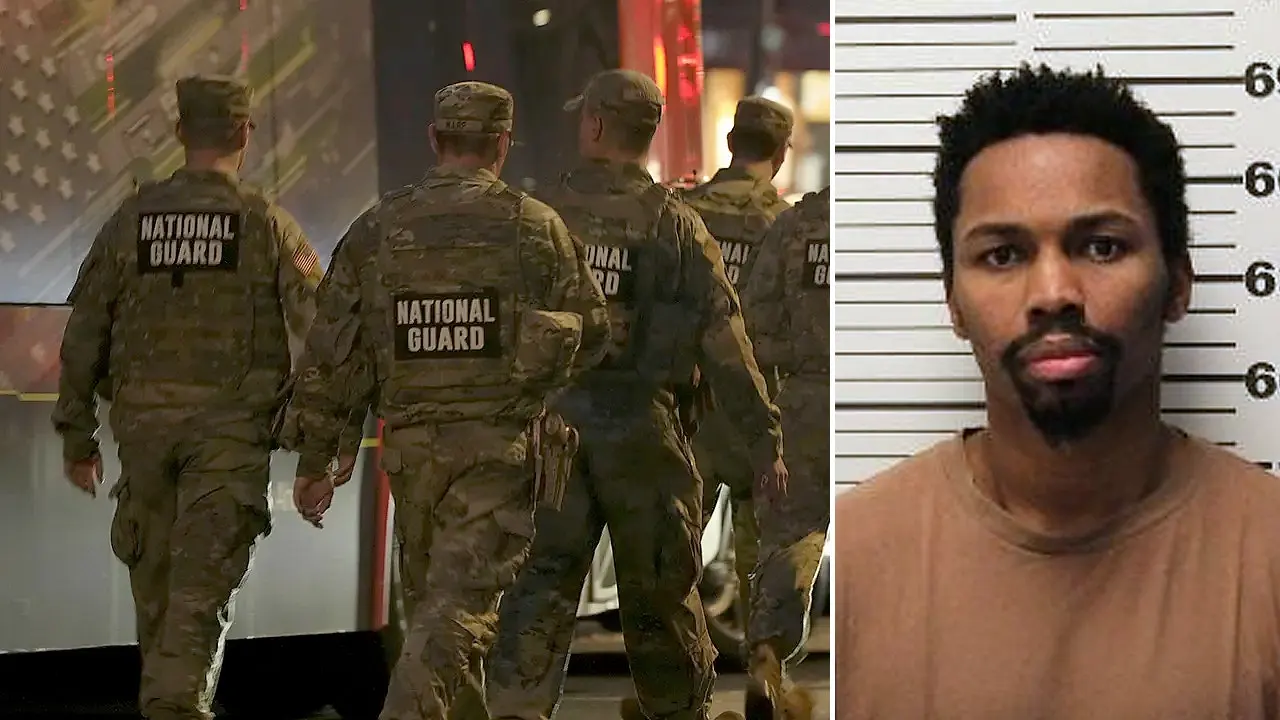
Sunday night in Washington, D.C., began like so many others in the bustling Capitol Hill neighborhood—people finishing errands, others heading out, and the quiet hum of the city settling into darkness. But just before 11:15 p.m., on the 400 block of 8th Street Southeast, that ordinary evening shattered into chaos. A street fight had broken out between at least two men outside a local business, and National Guard members who were stationed in the area stepped in to break it up. In a flash, what should have been an act of service turned into a scene of gunfire. One of the troops was struck in the leg. By Monday, the U.S. Marshals Service had identified the suspected shooter as Jerrell Jackson, a 41-year-old man whose name, it turns out, was already all too familiar to law enforcement. The wounded National Guard member, whose identity has been withheld due to privacy concerns and the ongoing investigation, was treated at a hospital and released. But the emotional aftershock of the shooting—for the service member, their family, their unit, and the community—will not fade as quickly as a physical wound. This was not an isolated act by a stranger; it was a moment of violence that highlighted old wounds in the justice system and the difficult, dangerous work of those who keep the peace.
Jerrell Jackson is not a newcomer to the criminal justice system. Federal officials say he has been convicted of two counts of assaulting a police officer and one count of carrying a pistol without a license, and he has also had three parole violations over the years. But that record only scratches the surface. Court records reviewed by Fox News Digital show that Jackson has faced at least 13 prior criminal cases or arrests in Washington, D.C., dating all the way back to 2004. His alleged offenses over nearly two decades include gun and drug crimes, assault, threats, and unlawful entry. Some of those cases ended in convictions, while others were dismissed or resolved through diversion programs. For anyone who has worked in criminal justice, this pattern is painful and familiar—a person cycling through the system, spending time behind bars, being released on parole, and then returning again. It also raises difficult questions: How many chances should a person get? What more could have been done to break the cycle before a National Guard member was caught in the crossfire? His most recent alleged act—shooting at service members trying to stop a fight—has now brought him under an even harsher legal gaze, and his first court appearance in this case has already put him face-to-face with the possibility of the death penalty, according to reports. It is a sobering reminder that the consequences of a violent moment can be permanent for everyone involved.
The shooting itself unfolded in a confusing, terrifying burst of action. The National Guard members intervened in the fight between at least two men, likely hoping to calm the situation and protect bystanders. At some point, one of the men opened fire. That is when instinct and training took over. The Guard members returned fire, striking Jackson in the abdomen. He was taken to a hospital for treatment and survived. Investigators later recovered a gun in an alley next to the shooting scene, along with at least 14 spent shell casings. The number of casings suggests just how chaotic and dangerous the moment was—multiple shots fired in a public street, in the dark, with innocent people potentially nearby. That no other National Guard members and no civilians were injured is, in many ways, remarkable. It is also a testament to the bravery of those troops, who did not run from danger but moved toward it in order to protect others. Their willingness to intervene, even at great personal risk, is exactly what we ask of those who wear a uniform. But this incident also serves as a stark reminder of how quickly a routine night can turn into a matter of life and death, and how much courage it takes for officers and soldiers to place themselves between danger and the communities they serve.
This shooting comes at a time when the city has been celebrating real progress in public safety. The Trump administration has touted the work of the D.C. Safe and Beautiful Task Force, a multi-agency effort that brings together more than 20 federal and local agencies, as well as the National Guard, to crack down on violent crime in the nation’s capital. The results so far have been striking: more than 18,000 arrests, nearly 2,200 illegal guns seized, and 28 missing children brought home. Murders in Washington have plummeted by 43 percent since 2025, according to officials, and many residents have started to feel a cautious sense of hope that their neighborhoods are becoming safer. The White House has credited these efforts with turning the tide. “Thanks to the President’s Safe and Beautiful Task Force violent crime in the city has drastically decreased,” said White House spokeswoman Lauren Bis. “D.C. residents and visitors are thankful for all the Task Force has done to drive down crime and make our nation’s capital safe again.” That message of progress makes Sunday’s shooting all the more jarring. It is a reminder that even in a city that is becoming safer, dangerous individuals with guns and long criminal histories still exist, and that the work of protecting the public is never truly finished. It also underscores the importance of the task force’s mission—because every illegal gun taken off the street is a potential tragedy prevented, and every repeat offender arrested is a chance to keep another family from experiencing the kind of heartbreak that almost happened here.
Behind the statistics and official statements, there is a human weight to this story. There is a National Guard member in a hospital bed, visited by worried comrades and loved ones, facing surgery or physical therapy, and perhaps wondering whether the danger they volunteered to face was worth the price. There are the family members of that service member, who got a phone call in the middle of the night and felt their hearts stop before they learned their loved one would survive. There are the other Guard members who were on the scene and will carry the sound of those gunshots with them for the rest of their lives. And then there is Jerrell Jackson, a 41-year-old man whose life has been marked by brushes with the law, run-ins with police, and an inability to break free from a cycle of violence and incarceration. It is easy to see him only as the suspect, the man who allegedly shot at soldiers. But his story is also one of broken chances and missed opportunities, of a system that tried repeatedly to contain him, and of a man who may have needed help he never truly received. None of that excuses his alleged actions, and accountability is essential. But in the aftermath of a shooting like this, it is worth pausing to remember that every person involved—the victim, the suspect, the witnesses, the officers—is someone’s family member. Every one of them has a story that goes deeper than the headlines.
As the investigation continues and Jackson faces the legal consequences of his alleged crimes, the wider community is left to process what happened and what it means for the city’s future. There will be briefings and press conferences, court dates and legal arguments. But there will also be quieter moments—a mother holding her child a little closer, a veteran pausing before entering a crowded street, a resident looking around the neighborhood and hoping that the progress made in recent months is not undone by one violent incident. The phrase “thoughts and prayers” is often overused, but in this case, it carries real meaning. “We are praying this National Guard member has a quick and speedy recovery,” Bis said, and those words reflect the sentiment of many who simply want to see a young person recover from a traumatic injury and return to their life. The wounded service member is out of the hospital, which is good news, but healing—both physical and emotional—takes time. Meanwhile, law enforcement has made it clear that no other suspects are at large, and the scene has been contained. The task force that has driven down violent crime in Washington will likely use this incident as renewed motivation to continue its work, to get more guns off the streets, and to ensure that repeat offenders like Jackson are held accountable. It is a hard truth that there are no perfect solutions to the problem of violent crime. But moments like this remind us why we keep trying. We keep trying because of the Guard member who was brave enough to step into a fight and stop the violence. We keep trying because of the families who want to walk the streets without fear. And we keep trying because every American deserves to live in a city that is not only beautiful, but safe. This story is not over, but its next chapter will be written not just in a courtroom, but in the lives of people who refuse to let fear win.