


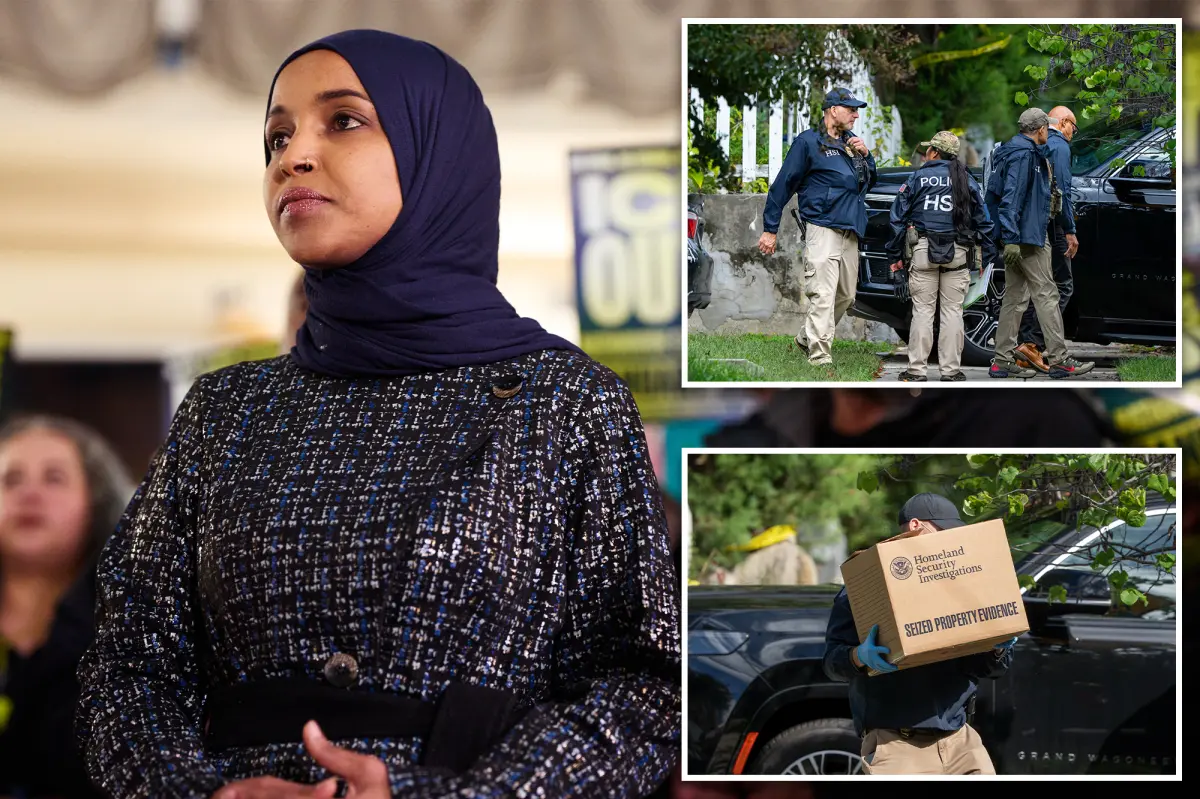
There is a kind of morning that changes everything. For Representative Ilhan Omar, that morning came on a Monday, when federal agents arrived at her home in Washington, D.C., and left with her cell phone. The action was part of a criminal fraud investigation focused on her immigration paperwork. It is a startling step for any member of Congress, but especially for a woman who has spent years in the public eye as one of the first Somali-American lawmakers in the country. The raid did not come with an arrest or charges. It came with questions—questions that have been circling for years, suddenly now given the weight of subpoenas and search warrants. The agents were not just looking for something; they were looking into a story that begins long before Omar entered politics: a story of a child arriving in a new country, a father trying to bring his family to safety, and the complicated paperwork that stands between a refugee and a new life. That paperwork has now become the center of a criminal inquiry, and it has put Omar in an uncomfortable position, not just as a legislator but as a daughter and a mother. The investigation, according to reports, involves more than a dozen subpoenas issued to her family members. It is examining whether statements made on immigration applications were truthful, specifically about her age at the time she left Somalia and came to the United States in 1995. Omar became a naturalized citizen in 2000. At that time, she was listed as seventeen years old, an age that would have allowed her to receive citizenship automatically through her father’s naturalization. If that age is accurate, the process was routine. If not, the records could tell a different story. But a discrepancy is not a crime, and the question is whether investigators can prove that anyone knowingly lied—and whether the people involved even knew the truth. What makes this human is the gap between legal categories and real life. Birth records in refugee camps are often lost, inaccurate, or simply never existed. Age can be a guess made by officials, not a certainty. Still, the law requires answers, and the raid suggests federal authorities believe those answers are hidden somewhere in the family’s history. For Omar, the home where she lives with her family is no longer just a house; it is a scene of a federal action. And as she continues her work in Congress, she must now do so under a cloud that will not lift until the investigation is resolved.
The central issue in the investigation is remarkably specific: a birth year. According to reports, federal investigators are looking into whether Omar’s age on her immigration papers matched her actual birth date. At the center of the probe is a troubling detail that came to light months after Omar took office. Her congressional staff contacted a Minnesota public library and requested that her birth year in historical records be changed from 1981 to 1982. On its face, that may seem like a small correction, the kind of bureaucratic cleanup that any office might do. But to investigators, it could suggest a pattern of trying to adjust the record after the fact. The shift matters because it affects the timeline of her naturalization. If Omar was actually born in 1982, she would have been sixteen years old when she was naturalized in 2000—not seventeen. That difference could change the legal pathway she used to gain citizenship. If she naturalized as a minor through her father, the precise age at the time of the naturalization could be important. A one-year difference might not seem like much in human terms, but in immigration law, years and days are enormous. It can mean the difference between automatic citizenship and a separate application process, between being covered by a parent’s status and having to qualify on one’s own. The old records at the library were apparently the kind of thing most people never think about—a year in a local archive, in an old directory, in a family history. But once it was changed, it became a puzzle for federal agents. They have since issued more than a dozen subpoenas to Omar’s family members, trying to piece together the truth from a mosaic of memories, papers, and official forms. The human side of this is complicated. Imagine being a teenager in a new country, learning a new language, trying to fit in, while your parents handle legal documents that you don’t fully understand. Imagine later becoming a member of Congress, giving speeches, raising a family, and then being asked to explain a year in a library file from decades ago. That is the burden Omar now carries. She has denied any wrongdoing, insisting that she has done nothing wrong. But the investigation is real, and the subpoenas are real. The families involved now have to decide how much to remember and how much to say. It is a difficult place to be, especially when the memory of a loved one—her late father, Nur Omar Mohamed—is itself part of the story. He died before seeing this investigation unfold, but his name is now attached to federal inquiries about the paperwork he submitted when he applied to enter the United States. Investigators are looking at whether his filings contained untruthful statements, particularly about his daughter’s age. For Omar, this is not just legal trouble; it is an intimate reckoning with her family’s past.
Nur Omar Mohamed was, by all accounts, trying to hold his family together in a world of chaos. Somalia’s civil war had torn apart the country, forcing millions to flee. Omar was a child when she left, and her family eventually made their way to the United States. She arrived in 1995, and according to her husband, she was twelve years old at the time. That would make sense for a child war refugee. But the investigation is now asking whether the adults around her made choices about her age in order to make the immigration process easier. It is a question that strikes at a painful reality of refugee experience: in desperate situations, people sometimes do not have exact records, and they do whatever they must to escape violence. A false date on a form, if it happened, could have been a survival strategy, not a crime. But under the law, false statements in immigration matters can be prosecuted as fraud, no matter how sympathetic the reason. The investigation has reportedly looked at her father’s application to enter the United States, examining whether statements on his filings were truthful. The father has passed away, which makes the inquiry more delicate. He cannot explain his decisions. He cannot recount the circumstances of a hasty escape, the lack of documentation, the fear of being sent back. His voice has been replaced by paperwork, and paperwork is cold. For Omar, this is a tragedy on two levels. She is being asked to prove something about a parent she lost, and at the same time to defend her own status as an American citizen. There is a kind of cruel irony in that. She came to this country as a child, embraced public service, won a seat in Congress, and has become a symbol for many immigrants. Now the government is probing the very roots of her citizenship, questioning whether her path to America was built on a lie. The people who know her best, though, describe a different image. They describe a young girl who grew up in Minneapolis, who attended school, who eventually landed at the center of national politics. They describe a mother and wife, a neighbor and activist, not a mastermind of paperwork fraud. But the law does not care about reputations. It cares about documents, dates, declarations, and signatures. And so the family is now caught between two worlds: the world of lived experience, where a girl was simply a child in a war, and the world of legal fact, where every year of her age is a data point subject to verification. The subpoenas sent to family members could force them to testify about private matters they may have never discussed, or to share documents and photos they thought were insignificant. It may bring them closer together, or it may pull them apart. Meanwhile, Omar is continuing her work in Congress, meeting with constituents, casting votes, and trying to maintain some sense of normalcy. But the file on her father is open. The question of her age is now a national story. And behind it all is an ordinary family trying to understand how a personal history of survival became a legal file with criminal implications.
In the middle of the storm, Tim Mynett, Omar’s husband, has tried to hold steady. When asked about the investigation, he responded with a short and confident statement: “My wife came here when she was 12 years old as a child war refugee. No concerns.” Those words, perhaps, are the simplest form of human response to a complicated crisis. They express the love and loyalty of a spouse who sees his wife not as a target but as a refugee, not as a suspect but as a survivor. Mynett’s statement also carries a quiet frustration. He did not list details or legal arguments. He did not attack the investigation. He just stated a fact, as he knows it, and refused to allow the moment to be defined by fear. That is a human reaction under enormous stress. Imagine having your home raided, your spouse’s phone taken, your family’s history dragged into public view, and then being asked by a reporter whether you are worried. You could either sink into anxiety or draw a line. Mynett drew a line. But confidence does not erase the weight of the situation. Federal agents do not raid the home of a member of Congress because they have nothing. They do not issue a dozen subpoenas to family members if the file is empty. At the very least, investigators see enough to justify the extraordinary step. Mynett may be right that there are no concerns. He may also be trying to keep his family’s spirits up in a moment when despair would be easier. The relationship between Mynett and Omar has already been public, with their personal life scrutinized by tabloids and opponents. Now the scrutiny has moved to the tedious, unforgiving world of immigration law. For a husband, this is not a political issue; it is his wife. For a stepfather, this is not a scandal; it is the mother of his child. The public often forgets that people in the center of these stories go home at night, and that home may no longer feel safe. The raid happened at their residence, a place where privacy is supposed to reign. The cell phone that was seized is, in many ways, a modern extension of the self—with messages, photos, memories, and connections to children, friends, and colleagues. Having it taken is like losing a part of one’s personal world, not just evidence. Nobody who has not lived through it can fully understand the violation of having the state walk through your door and take your things. Mynett’s “No concerns” is perhaps not so much a legal assessment as a psychological survival tactic. He is telling himself, and the world, that his family’s story is true, that a child refugee should not be hunted for being a child refugee. Whether the investigation is based on a misunderstanding or on something more serious, his public support matters. It offers Omar a human anchor in a storm that otherwise might sweep away everything. In the end, what a spouse says in such a moment may be the most human detail of all. It shows that beneath the subpoenas, the affidavits, and the political statements, there are still two people standing together, trying to protect a family story they believe in.
Omar herself has responded with a mixture of defiance and outrage. Her office released a statement accusing the Trump administration of weaponizing federal law enforcement against political enemies. The statement recalled the full arc of her career: “For a decade, Donald Trump has relentlessly targeted Congresswoman Ilhan Omar with inflammatory rhetoric, repeatedly putting a target on her back. Now, those attacks have escalated to a pointless federal raid. The Congresswoman has done nothing wrong. No president should be able to use the power of the federal government to intimidate his political enemies.” This is a strong statement, but it is also a familiar one in modern Washington. The lines between legitimate oversight and political persecution are often blurred. Omar has long been a polarizing figure, admired by progressives and reviled by conservatives. Her critics see the investigation as a long-overdue look at the facts. Her supporters see it as revenge. There is no way to know, from the outside, which side is right. But the human reality is that Omar is now carrying the weight of both an actual legal probe and an endless political war. She must wake up each morning and be a legislator, a mother, a wife, and a defendant all at once. That would be hard for anyone. It is even harder when the very document that defines your belonging in your country is under attack. For many Americans, citizenship is taken for granted, a matter of a birth certificate and a quiet assumption. For naturalized citizens, especially those who arrived as refugees, citizenship can feel like a hard-won treasure, a fragile piece of paper that has to be guarded. Omar’s situation represents the nightmare version of that anxiety: an official knock on the door that turns the abstract fear into a concrete crisis. She says she has done nothing wrong, and that may be true. But saying so does not stop the investigation, does not stop the subpoenas, does not stop the feeling of being watched. The statement from her office is also a bid for public empathy. It asks people to imagine what it would be like to have a president repeatedly single you out, to have your name used as a shorthand for an undesirable immigrant, and then to have federal agents at your home. It is an appeal to fairness, and it is also a political argument. Human beings respond to stories of persecution, and Omar’s story is one of rising from refugee to representative. The investigation threatens to rewrite that story. If the allegations remain unresolved, the story will be forever changed, no matter the outcome. If the allegations are disproven, the damage may still have been done. That is the cruel nature of such probes: the process itself becomes a punishment, separate from any ultimate verdict. For Omar, the challenge is to live through the process with her family intact, her reputation bruised but not broken, and her voice still strong in Congress. She insists the raid was pointless. Her husband insists there are no concerns. But the federal government has not announced that the investigation is over. And so a tense standoff continues, not only between a Congresswoman and investigators, but between two versions of a family’s history.
Aside from the immigration fraud investigation, another inquiry into Omar’s federal financial disclosures is underway. Officials have said this review is unrelated to the raid on her home. That distinction is important, although it does little to ease the scrutiny. For someone in Omar’s position, the cumulative effect of multiple investigations can be overwhelming. It affects her ability to focus, her relationships, her health, and her sense of security. It also feeds a public narrative that ties together unrelated things, making the whole picture look darker than any single part might be. The financial disclosure review is typical many members undergo, but when it runs parallel to a criminal investigation, it takes on new weight. The word “investigation” can become a cloud that follows a person everywhere, into committee rooms, into interviews, into conversations with staff. Constituents may wonder, even the supportive ones may wonder if there is fire. That is part of the human cost. The content we have been discussing is not just a list of charges; it is a life. It is a woman who survived a war, came to a new land, entered politics to fight for others, and now faces the possibility that her own origins may be used against her. Regardless of what investigators believe they have found, the broader lesson is about how we treat each other. We should want the truth, but we should also remember that the people at the center of these stories are human beings. They have children to feed, griefs to carry, memories that are fragile, and a need for fairness. As the investigation continues, the public will hear more details, more statements, more subpoenas. But no matter how many documents are examined, there will remain a core of uncertainty—a family story that only the people who lived it can tell, and even they may not agree on all the details. The outcome will depend on the law, on evidence, and on the decisions of federal prosecutors. But the human being named Ilhan Omar will remain, no matter what the verdict is. She is a mother, a friend, a colleague, a Somali-American, a refugee, a woman who wanted to make a difference. If she is innocent, the investigation will be a painful memory, a lesson in the burden of public life. If she is not, it will lead to consequences she will have to face. Either way, the story is bigger than any single headline. It is about the gap between legal truth and personal truth, between official documents and lived experience, between the power of the state and the vulnerability of the individual. It is about how a person’s past can rise up and reshape the present. And it is a reminder that behind every political scandal, there are real people whose names we may know but whose hearts we can only imagine. For now, Omar’s office says she has done nothing wrong. Her husband says he has no concerns. The investigators continue their work. Time will tell what remains of all the stories we tell ourselves about this moment in American politics.