


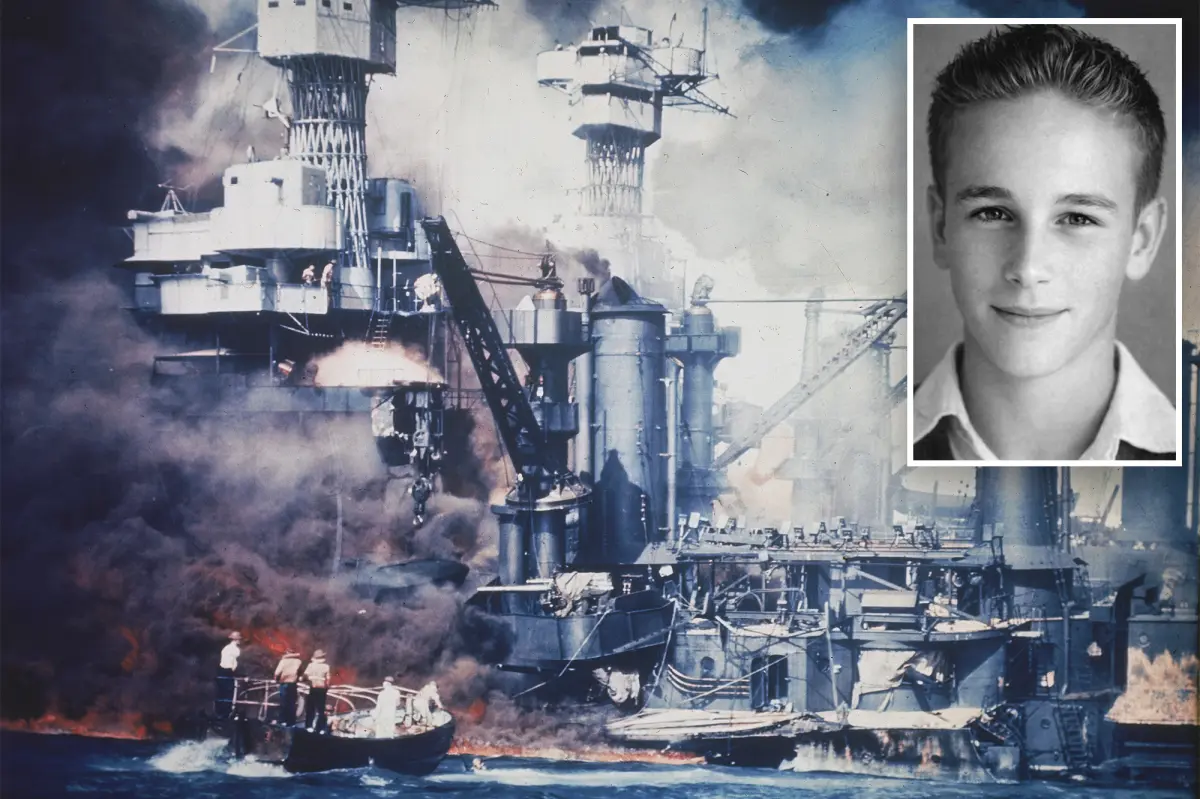
On the morning of December 7, 1941, the peaceful skies over Oahu, Hawaii, were shattered by an unexpected and devastating aerial assault that would forever alter the course of global history and thrust the United States into the crucible of World War II. Among the thousands of brave service members stationed at Pearl Harbor on that fateful Sunday was seventeen-year-old Royle Luker, a spirited youth from the small town of Plainview, Arkansas, who had answered the call of duty with a heart full of hope and a profound sense of patriotism. Serving as a Navy fireman aboard the battleship USS West Virginia, young Luker found himself at the very epicenter of the cataclysmic strike as Japanese torpedoes and bombs tore through the vessel’s heavy steel armor. In the fiery chaos and suffocating smoke of the sinking battleship, 106 of Luker’s shipmates perished alongside him, their lives cut tragically short in a violent flash of warfare. For the Luker family, the devastating news of their teenage son’s demise was compounded by an agonizing lack of closure, as the intensity of the wreckage and the limitations of wartime recovery prevented authorities from identifying his physical remains. Instead of returning home to the quiet hills of Arkansas in a flag-draped casket, Royle’s name was simply added to the solemn Tablets of the Missing at the Honolulu Memorial, leaving behind an empty space in his family’s heart that would persist for nearly eighty-five years.
For more than eight decades, the physical identity of Fireman Royle Luker remained lost to the passage of time, as his unidentified remains lay buried in a Hawaiian cemetery under a simple marker that bore only the word “Unknown.” Across the ocean, in the rolling landscape of Arkansas, his grieving parents, George F. Luker and Nettie Estelle Luker, lived out the remainder of their days with a quiet, lingering sorrow, clutching onto the memories of the boy who had left for the sea and never returned. In his absence, the nation attempted to pay tribute to his immense sacrifice by posthumously bestowing upon him a long list of prestigious military decorations, including the Purple Heart, the Combat Action Ribbon, the Navy Good Conduct Medal, the American Campaign Medal, the Asiatic-Pacific Campaign Medal, the Navy Expeditionary Medal, the Navy Presidential Unit Citation, and the World War II Victory Medal. While these glittering bronze medals and colorful ribbons spoke volumes of his heroism and recognized him officially as a World War II Gold Star Veteran, they were cold comfort to a family who lacked a grave to visit, a physical place to mourn, or the simple peace of knowing where their beloved boy’s bones rested. His memory was preserved as a historical abstraction, a name etched into cold stone overlooking the Pacific, while his true resting place remained a profound mystery locked away in the collective anonymity of a mass grave of fallen brothers.
The turning point in this decades-long vigil came in 2017, when the Defense POW/MIA Accounting Agency (DPAA) embarked on a monumental and deeply emotional scientific mission to finally bring names back to the unidentified casualties of the USS West Virginia. Led by dedicated forensic anthropologists, historians, and military personnel, the agency exhumed thirty-five caskets containing the co-mingled remains of sailors associated with the battleship, determined to use twenty-first-century technology to solve the cold cases of the mid-twentieth century. Through groundbreaking advancements in DNA technology, forensic scientists were able to carefully extract genetic material from the decades-old skeletal remains and painstakingly compare them to reference samples provided by surviving family members. This sophisticated scientific detective work bridged the vast chasm of time, transforming what was once an impossible identification process into an exact science of restoration. By matching mitochondrial DNA lines and analyzing skeletal structures, researchers succeeded in isolating the remains of the seventeen-year-old boy from Plainview, finally stripping away the painful label of “Unknown” and restoring to the young sailor the identity he had sacrificed so long ago in the service of his country.
While Royle’s parents did not live to witness this miraculous scientific resurrection, the news of his identification resonated deeply with his surviving family, who had grown up listening to the mythic, bittersweet tales of the young uncle who died at Pearl Harbor. His living nephews, Donald Bradford Henderson and John Luker, along with his niece, Becky Downen Lensing, received the news of their uncle’s identification as both a shock and a profound blessing, realizing that a legendary chapter of their family’s heritage was finally transitioning from a historical tragedy into a personal homecoming. For these relatives, who had only ever known Royle through yellowed photographs, whispered family anecdotes, and the military medals passed down through the generations, the physical return of his remains represents a powerful link to their ancestral past. It validated the stories told by their parents and grandparents, proving that even after eighty-four years, the bond of family remains unbreakable and the memory of a lost loved one is never truly erased by the fog of time. The announcement of his scientific identification brought a wave of quiet celebration and deep reflection, as the family prepared to welcome home a boy who had left Arkansas as a teenager in the late 1930s and was now returning as a historic hero.
The grand culmination of this long, historic journey will take place on May 30, when Fireman Royle Luker is finally laid to rest with full military honors in his beloved hometown of Plainview, Arkansas. The solemn services, scheduled to begin at the New Bethel Cemetery, will draw together family members, local residents, military officials, and patriotic citizens who wish to pay their respects to a member of the Greatest Generation returning home at last. The ceremony will feature the timeless, heartbreaking rituals of a military burial—the sharp crack of a three-volley rifle salute echoing across the quiet countryside, the haunting, melancholic notes of “Taps” drifting through the pine trees, and the meticulous, silent folding of the American flag before it is presented to his family. This homecoming is a powerful testament to the sacred, unwritten promise made by the United States military to never leave a fallen service member behind, regardless of how many decades have passed or how difficult the journey of recovery may be. By bringing Royle back to the soil of his youth, the community of Plainview not only honors his individual bravery but also rejuvenates the collective spirit of national memory, reminding everyone of the human cost of freedom.
In his final resting place, Royle will be buried immediately adjacent to his parents, George F. Luker, a proud veteran of the First World War, and Nettie Estelle Luker, the mother who spent the latter half of her life dreaming of the day her boy might come home. This spatial reunion in the quiet earth of Arkansas brings a poetic and deeply emotional closure to a family saga that was forged in the fires of two global conflicts and sustained by generations of quiet faith. After nearly eighty-five years of wandering in the anonymity of a distant grave, the boy who went to sea is finally back in the rolling hills that shaped his childhood, resting alongside the father who understood the price of soldiering and the mother who loved him beyond the grave. The journey of Fireman Royle Luker, from the terrifying, smoke-filled decks of the sinking USS West Virginia to the peaceful, sunlit embrace of the New Bethel Cemetery, stands as an inspiring reminder of the endurance of memory, the triumph of modern science, and the eternal sanctity of family. His story is no longer confined to the cold bronze monuments of Hawaii or the dusty pages of history books; it is now beautifully complete, written in the warm, sacred soil of his home, where he will rest in peace forevermore.