






Flight 1492: The Cold Descent and the Silent Horizon of Bogotá
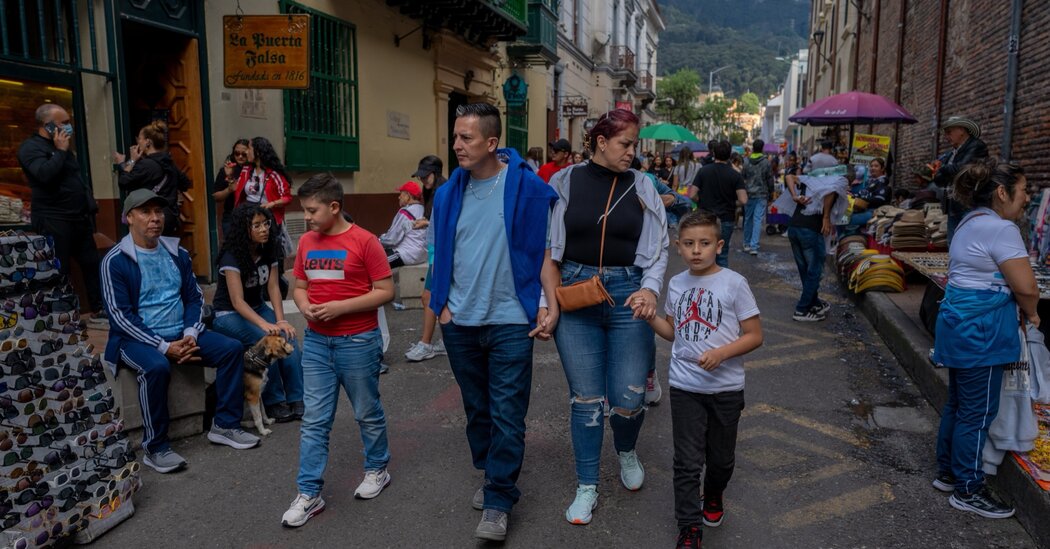
The low-hanging, slate-gray clouds of Bogotá seemed to cling to the sharp peaks of the eastern Andes as the charter flight made its final descent, carrying a cargo of broken dreams and exhausted silence. For Carlos Bedoya, his wife Maria, and their fourteen-year-old daughter Sophia, the landing at El Dorado International Airport was not a homecoming, but a forced arrival into an alien reality. Just seventy-two hours prior, their lives had been firmly anchored in the quiet, tree-lined suburbs of Bergen County, New Jersey, where they had spent fifteen years building a home, paying taxes, and cultivating a modest slice of the American Dream. Now, clutching plastic bags containing the fragmented remnants of their lives—hastily packed winter coats, a few cherished family photographs, and Sophia’s high school honor roll certificates—they walked through the sterile, fluorescent-lit corridors of the deportee processing center. The cold mountain air of Bogotá, thin and sharp at over eight thousand feet, caught in their throats, a visceral physical reminder of how quickly the administrative machinery of deportation from the United States can erase decades of domestic stability. Around them, the hum of the airport was a disorienting symphony of rapid Spanish, a language Sophia spoke with a soft, self-conscious English cadence that marked her instantly as an outsider. In the eyes of the immigration agents stamps were pressed onto paper, finalizing a bureaucratic process that categorized this family not by their years of community service, neighborly kindness, or honest labor, but by their lack of a nine-digit identification number. As they stepped out of the terminal and into the chaotic, rain-slicked streets of Bogotá, the noise of yellow cabs and diesel bus fumes enveloped them, signaling the terrifying commencement of a journey none of them had prepared for: the arduous, deeply destabilizing task of rebuilding life in Colombia from absolute zero.
The Shattered Mosaic of the Bergen County Dream
To understand the depth of their current displacement, one must look back to the early 2000s, when Carlos and Maria first fled the escalating violence and economic stagnation of Colombia’s coffee-growing region. They arrived in the United States on temporary visas, which eventually expired, leaving them in the vulnerable shadow of undocumented status—a reality they managed with meticulous compliance to local laws, hard work, and civic devotion. Carlos established himself as an indispensable hand in a local residential construction firm, known for his precision and reliability, while Maria operated a small, homemade catering and cleaning service that bound her to the neighborhood’s social fabric. Their daughter, Sophia, born in New Jersey, grew up as a thoroughly American teenager, her identity forged in public libraries, varsity track meets, and friendships that spanned the suburban landscape. The illusion of safety they had laboriously constructed shattered on a crisp Tuesday morning in October, during what should have been a routine traffic stop for a broken taillight. Within hours, Carlos was transferred to an Immigration and Customs Enforcement (ICE) detention facility, triggering an unstoppable chain of legal maneuvers, exhausting financial resource drains, and late-night panic attacks for Maria and Sophia. Despite their clean records, lack of any criminal history, and deep-seated community ties, the legal avenues for relief collapsed under the weight of an increasingly unyielding immigration policy. The agonizing family separation that followed—marked by visits behind Plexiglas and the haunting countdown to their collective removal—culminated in a unilateral decision to leave together rather than face the indefinite fracturing of their home, proving that the modern immigrant experience is often defined by a vulnerability that can be activated in an instant.
Navigating the Grim Economic Architecture of Return Migration
The economic reality of their repatriation challenges settled in with brutal immediacy once the initial shock of their arrival subsided. Safely housed in a cramped, borrowed apartment on the northern periphery of Bogotá owned by a distant, state-employed relative, the family faced a financial landscape that was completely unrecognizable to them. In Colombia, a country where the informal labor market hovers near fifty percent and recruitment is heavily gatekept by structural nepotism and age limits, Carlos discovered that his fifteen years of premium American construction experience held little currency. At forty-seven, he was repeatedly deemed “too old” for entry-level labor roles, while his lack of official certifications in Colombia barred him from high-level supervisory positions that match his expertise. Maria’s domestic and culinary business could not be easily replicated without capital, a local customer base, or credit history, leaving her to navigate the hyper-competitive informal food sector where profit margins are razor-thin. For Sophia, the economic displacement was compounded by a profound systemic educational barrier, as public schools in Bogotá are severely underfunded and unprepared to integrate English-dominant students who struggle with academic Spanish. Private bilingual academies, which could have eased her transition, remained financially out of reach, forcing her into a classroom environment where she felt academically paralyzed and socially ostracized. The financial reserves they had managed to rescue from their bank accounts in New Jersey vanished within the first two months, spent on basic orientation costs, security deposits, and the urgent acquisition of identification documents that the Colombian bureaucracy took weeks to process, highlighting the severe economic penalties that accompany the return migration process.
The Quiet War of Identity and Psychological Rupture
Underneath the daily logistical struggles lay a deeper, more insidious crisis of identity and severe psychological impact of deportation that threatened to tear the family’s emotional foundation apart. In New Jersey, they had been the proud Bedoyas; in Bogotá, they were labeled dismissively as los retornados—the returned ones—a term that carried an unspoken, heavy stigma of failure, criminality, or structural rejection. Carlos struggled with a deep, silent depression, his traditional role as the family provider stripped away, replaced by the crushing guilt of having brought his family back to the very hardships he had run from decades ago. Maria, trying to maintain domestic cohesion, spent her nights weeping silently to avoid waking her daughter, mourning the loss of her kitchen, her friends, and the quiet security she had fought so hard to cultivate. Sophia’s grief was the most pronounced and volatile; she experienced a profound sense of exile from her own home country, her homeland, mourning the high school graduation she would never attend, the friends she could only see through glowing smartphone screens, and the security of a culture she understood. She was a teenager caught between two worlds, too American to pass as locally Colombian, yet legally banned from returning to the United States for at least a decade, a victim of a geopolitical boundary that prioritized paper over human psychology. This shared trauma of displacement created a complex emotional dynamic within their tiny apartment, where conversations were heavy with what-ifs and the painful process of grieving a life that was still actively operating without them just a few thousand miles to the north.
Institutional Silence and the Bilingual Call Center Lifeline
This compounding human crisis highlights a gaping void in the systemic infrastructure of both the United States and Colombian governments, which offer virtually no transitional support for repatriated families. While the Colombian government heavily advertises programs like “Bienvenido a Casa,” the administrative reality on the ground is a labyrinth of empty promises, offering little more than informational pamphlets and superficial job coaching that fails to yield actual employment. Left to fend for themselves, the Bedoyas, like thousands of other deportees, found their only viable economic lifeline in the predatory, fast-growing industry of bilingual call centers in Bogotá. These multi-national call centers absorb English-speaking returnees, operationalizing their language skills in high-stress, low-wage environments where they handle customer service complaints for major American corporations—the very corporations that thrive in the economic system they were excluded from. For Sophia, her bilingualism became both a survival tool and a painful daily reminder of her American identity, as she watched older deportees spend ten-hour shifts pacifying customers in cities like Chicago and Atlanta for a fraction of what they would have earned there. In the absence of state aid, survival has become a grassroots security endeavor; the family found solace and practical guidance only through informal mutual support networks run by fellow deportees who share tips on navigating the local health system, obtaining affordable housing, and avoiding the local scams that target returnees perceived as wealthy “gringos.” This self-organized solidarity highlights how the migrant community must repeatedly construct its own safety nets when structural policies prioritize borders over basic human welfare.
Reimagining the Future in the Shadow of the Andes
As the months slow-marched into a full year, the Bedoyas began the incredibly difficult, slow-motion process of reconciling with their new reality and mapping out a fragile future in the shadow of the Andes. Carlos eventually secured a localized role assisting a small, independent contractor, while Maria, utilizing her culinary skills, launched a modest weekend empanada and coffee stand from their doorway, slowly winning over neighbors with her work ethic and warmth. Sophia, showing the fierce, adaptive resilience characteristic of immigrant children, began helping local neighborhood kids with their English homework, a small role that restored a sense of agency, purpose, and pride to her disrupted life. Their recovery is not a story of a cinematic, triumphalist return, but rather a quiet, daily act of revolutionary defiance against a global immigration system that tried to render them invisible. They have started to understand that home is not merely a legal status, a geographically bounded country, or a physical structure, but a portable sanctuary built of shared love, survival instincts, and the unbreakable bonds of family. As they look out over the sprawling, mountain-ringed basin of Bogotá at night, illuminated by millions of tiny, flickering orange streetlights, they do not see the end of their story, but rather a challenging, beautifully complicated new chapter in their enduring quest for dignity, safety, and a place to truly belong.