






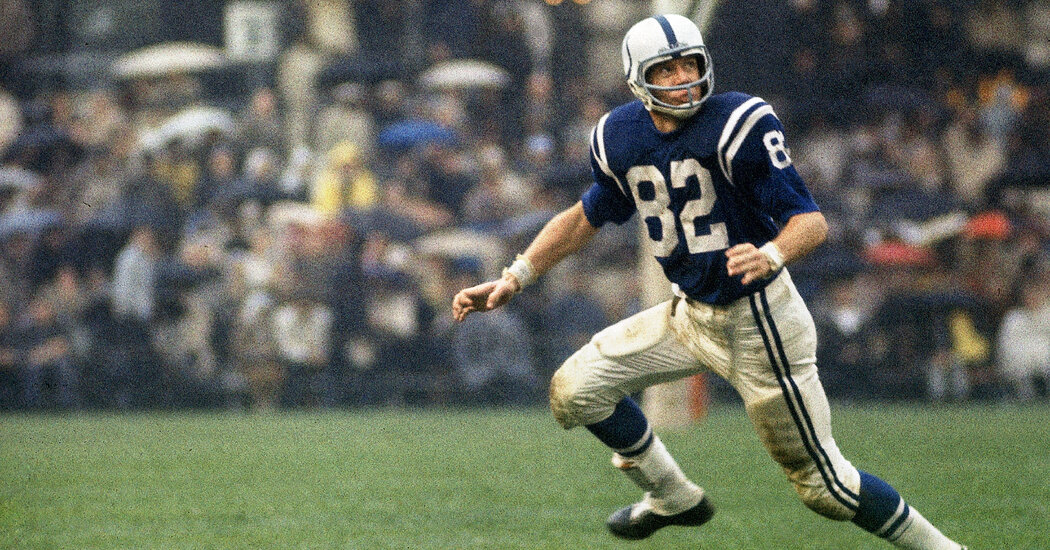
On May 25, the sports world quieted to mourn the passing of Raymond Berry, a legendary figure whose name is synonymous with the golden age of professional football. At 93 years old, Berry drew his final breath in Murfreesboro, Tennessee, leaving behind a legacy that transcended the record books he so effortlessly rewrote. Announced by the Pro Football Hall of Fame, where his bronze bust has stood since 1973, his departure marks the end of an era. To the modern observer, Berry might seem like a relic from a distant, black-and-white past, but to those who saw him play for the Baltimore Colts, he was a revolutionary artist of the gridiron. His story is not just one of touchdowns and championships, but a deeply human testament to what can be achieved when an ordinary person possesses an extraordinary, almost maniacal devotion to their craft. He was the ultimate self-made man, proving that genius in sports is not merely inherited through genetics, but can be meticulously sculpted through sheer willpower.
To understand Raymond Berry is to understand the triumph of substance over style. Standing at six feet two inches and barely scraping together enough weight to look like a professional athlete, the beanpole receiver was the antithesis of the modern, hyper-athletic marvel. He was slow, his eyesight was notably poor, and his left pinkie finger was permanently bent at a grotesque angle from a career’s worth of painful dislocations. Yet, what he lacked in physical gifts, he made up for with a relentless, perfectionist work ethic that bordered on the obsessive. He treated the football field as a laboratory and himself as the primary scientist, famously defining exactly eighty-eight distinct ways to evade a defensive back. To make up for his poor vision and damaged hands, he squeezed Silly Putty constantly to build grip strength, transforming his fingers into “flypaper” that rarely dropped a ball. His teammate and coach, Weeb Ewbank, remarked that while Berry possessed none of the natural traits of a traditional star, his routes were so minutely and flawlessly calibrated that he became entirely unstoppable.
The true magic of Berry’s career, however, lay in his telepathic partnership with quarterback Johnny Unitas. Together, they formed perhaps the most iconic passing duo in NFL history, rewriting the offensive playbook at a time when professional football was dominated by bruising ground games. Their connection on the field was so precise, so thoroughly rehearsed over hours of overtime practices, that they seemed to share a single nervous system. In their thirteen years together with the Colts, they led Baltimore to back-to-back NFL championships in 1958 and 1959, elevating the passing game to an art form and setting the template for the modern, high-flying offenses we see today. Though the massive evolution of the sport has pushed Berry down to 83rd in career receptions and 68th in yardage today, his historical footprint remains monumental. He retired with 631 catches and 9,275 yards, numbers that were utterly unprecedented in his era and cemented his status as the premier receiver of his generation.
Nowhere was Berry’s brilliance more visible than in the legendary 1958 NFL Championship Game, famously lionized as “The Greatest Game Ever Played.” In a grueling, heart-stopping rematch against the New York Giants at Yankee Stadium, televised to millions of homes and marking the first overtime game in league history, Berry put on a clinic. He caught twelve passes—a championship record that stood unchallenged for over half a century—including three consecutive, crucial catches in the final minutes of regulation to set up the game-tying field goal. In the tense overtime period, his steady hands secured two more passes, driving the Colts to a historic 23-17 victory that popularized pro football across America. Yet, despite his heroic performance, Berry remained incredibly humble and remarkably anonymous in his daily life. Just hours after that brutal, career-defining game, the soft-spoken, bespectacled athlete appeared as the mystery guest on the popular game show “What’s My Line?”, highlighting a simpler, more innocent era of sports where superstar athletes could still walk among the public unrecognized.
Behind the scenes of this legendary athletic career was a deeply personal story of grit, family, and humble roots. Born in Corpus Christi, Texas, in 1933, Berry’s journey was anything but easy; even with his own father serving as his high school football coach, he did not earn a starting spot on the team until his senior year. He went on to have an unremarkable college career at Southern Methodist University, catching a meager 33 passes over three seasons, which left pro scouts entirely unimpressed and led to him being drafted in the lowly 20th round as the 232nd overall pick. But Berry’s secret weapon was his devoted wife of 65 years, Sally. During the off-seasons, Sally would stand in their yard and throw footballs to him, purposefully throwing them poorly so that Raymond could practice making difficult, awkward catches. This backyard routine blossomed into what became known in the NFL as the “off-target drill,” a testament to how his domestic life and his professional pursuits were beautifully and intimately intertwined.
In his post-playing years, Berry’s brilliant football mind naturally transitioned into coaching, where he continued to leave his mark by leading the New England Patriots to a Super Bowl appearance in 1986. Beyond his records, he will forever be remembered as one of the game’s greatest innovators. He was a pioneer who wore full pads in the sweltering heat of every practice to simulate game conditions, used the goalposts as shields to shake off defenders, and even wore specialized “runner goggles” to combat the blinding Los Angeles sun. At his core, Raymond Berry was an artist who looked at a game of brute force and saw a canvas for geometric precision and intellectual mastery. He leaves behind Sally, their three children, and nine grandchildren, but also a comforting blueprint for humanity: that greatness is not merely something we are born with, but something we can build, catch by catch, route by route, with our own two hands.