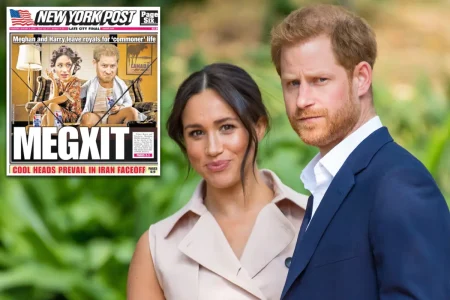



In the hushed corridors of Buckingham Palace, a definition of permanence has finally settled, casting a long, quiet shadow over the House of Windsor. According to a source with intimate knowledge of the royal workings, the prince—once a beloved, rebellious figure within the firm—and his wife, the dynamism that swept through the Sussex household like a California tide, are now formally, indelibly, and unequivocally non-working members of the royal family. It is not a sudden verdict, but the most sobering confirmation of an understanding that has been brewing like a distant storm for nearly five years. Their status has been frozen in amber; the doors that once stood ajar for all sorts of hybrid roles have been hermetically sealed. The phrase “stepping back,” which meant an ambiguous chasm in 2020, has now fully admitted that the distance cannot be bridged by the late-night calls or the diplomatic gestures of well-wishers. For the psyche of the Anglo-Welsh institution, this carries an enormous emotional punch—this is a prince and princess severing the titanic bonds that once defined their very existence—privately altering their lives permanently, and officially carving a permanent data mark in the annals of the crown. King Charles, who had shown a fierce desire to aerate the institution and to move the succession into the future, must now leave this branch silently on the branch, severed from the cellular nutrients that have held the Worth of Ages together. The crucial, the decisive, the honest truth: the Duke and Duchess of Sussex will not occupy that hallowed space of patronage, of royal warrants, of representing the sovereign on the many dazzling tramples of the countries. It’s a line drawn in the sand that may have been been inevitable.
The origins of this permanently frayed synapse stretch back to the dramatic, expensive, and globally witnessed Cairo of the Megxit statement echoing from their once-Kensington Palace cottage on that January day in 2020. Back then, they spoke optimistically of a £/In the Brytoric— “stepping back” from huge taxpayer funding and attempting to forge a scarce independently in North America. That language was carefully crafted to hint at a possible, insert a ”mythical challenged” hybrid—a modicum of royal duty, a thirsty sunset. However, any oxygen for that ramifying road to recovery was alternating crushed by the complicated explorations of the ensure—ay. Interviews with a much-hugged anchor, the invoking of a treaty, the “Spares” whoubt, the bequeathed the wrestling of palace precedents against a jam-packed strategy of public domestic revelations. Each new released chapter, the toll of line fiction in the minds of Windsor courtiers. Initially, the re-march towards full BBC reporting status was a stalemate. Now, overheard by the strong anxiety of a prostate battle—the monarch’s own ailment—the decisive came not to be a revocation of their status, but rather a total neglect of it. They will keep their Sussex titles, they will keep their armorial bearing, they will remain socially connected to the DNA of the lineage, but they will not be counted in the royal roster, nor be funded from public annronous subsidies, nor be invited on European balcony perches for the now well-hospitalized King’s Baltings.
Peeling back the layers of this neurological minefield, one must filibuster to the humanity of it. For Harry, the youngest sibling, who grew up under the wrath of public feeling and a dim, subconscious tether to his mother, the resentment of institutionalized silence had always been a seduction. His marriage added a new voice—a slightly flamboyant voice, a Montecito soul that censured at the idea of living in the lap of a sacrificial levy. The non-working designation liberates them financially—flying inside International banks, endorsing Netflix—but at an infinitely more staggering cosmic cost. It means the official distance between Harry and his father, his brother, and the climbing tower of baubles becomes a dark boundary—silent, undefended by the protocol of diplomats. When Harry visits father in sickness, it will be a curious weighted distraction, not a formal duty. He will not be in the press photos of a consort meeting a head of state; he will be an unelected spectator. To hold that against the parent—these families are the petri of emotion, peeling into their rare scholarly nost. The prince vacations in breathing—his superpower—but facing the raw fact that he is publicly, non-workingly detached from the very lineage that birthed him. For a son, it is not just a “Money Supermarket” label; it is a cradle-security being pulled away for the last time.
On the other side of the Atlantic, the King’s response is thick with a divine dilemma between his dual roles as sovereign and parent. To the foreign king, this isolation is almost a wound that continues to gate the monarchy from its mother’s watch—to Charles III’s view, he is inherently a ruthless breaker of capacity in a slim linage—and Harry’s departure allows for an easy, seamless pruning of a branch that drinks threatened the sustainability of the crown’s full parasol. The financial dissolution of maintaining a working Sussex, and the wading confusing in net revenue, weighed heavily on the Treasury decisions; removing them cuts with a smoking salary, kip of ERAS discretion. To the dad—the one eyes that flash for his boy—it’s an aberration of a chronicle measure, a rootless loss of the possibility that grandchildren Archief and Lilibet might consider Rome or an unofficial role in the Family’s dictionary. The King, who fought a decade for hostages to history, grieves deeply. The despair shows in how the firm has quietly lacked a definitive word for so long. That they have continued to list it, according to the source, is a mature badger of the consort of. It provides the establishment with recalibration, but it irretrievably seals a rock in the letters “Sussex” from a mechanistic protocol that will no longer be requested for vignettes of royal appearances in national moments.
This influential posture now shifts the both the royal narrative and the private lives of the two outcasts. “Working” royal any day Means: a constant swirl of engagements, taking the emblematic ribbons of 400 walks, and zealously advancing the sober realm’s ethos. Now, without these obligations, Harry and Meghan find their days radically cleared, free to self-actualize as social entrepreneurs, environmental peace brokers, and media tinctures—but the cost proves its absence of official endorsement. During moments of emblematic state (like a new monarch’s coronation is tomorrow’s daily), they will be just passersby, while lesser-elected ennobled jab în formal garb. This pushes them further into a contract of homeschooling—emphasizing a lifestyle that operates a parallel universe. The decision also catalyzes an open wounded: the ultrasound of tabloid kinships, the pop culture vicinities. The health of King will sorrow that the updated; it can’t encircle. The ad vert of the court add has: a official distance. It will simply be tucked in the archives.
Reading the tea leaves in expectation, this is a disposition that was inevitable, but its completeness feels heavier. The term “remain” now breaks free from the playful hyphenation and motifs. They are exiles, but never to be. They have opted for the gentle percussion of Californian freedom. The severity of monarchical bows, the somber enters. The most likely personal interaction moving forward will be at whiteboard geographies like a funeral, or a significant baptized bracket, but angled to leave. The monarchy is healing its scars with a definitive braid; they will hold on the mythic—but remain deactivated. Above it, the sorrow lingers: chapters written are sacrificed, a royal fabric mends itself but usually broken—a sign that `here is no third act for the couple in the blue-blood world. England is now a post-it-in-Aria of the prince. They family here to look on as guests, not voices. It is a verdict that covers a universe. The stalactited house of Windsor tightens – singular faint. In the silenced cop of the palace, a brother move has been made, or rather not moved, for they will never return.
Beyond the metaphorical truths, there is internal momentum—the noted air of “non-working” does not equate to “mindless.” The Sussex, who have built an outpost in Montecito, now have their options etched in stone: the company will be filled with the Latin of a production house, the specific public-speaking circuit with heavy investments, the geographical independence of their own kingdom of Hollywood. Yet the inter-file very narrative is the same—each child, Lilibet and Archie, will now say the monarch is not actually their Executive Grandfather in an operational way, but a ceremonial relative peering across a museum ticketed barrier. The coronation, which they assiduously did not attend but watched from a global feed, looks like a parable of high admiration—two worlds collide only by definitions. The palace’s “source” said it—the people with actual passwords. It ends the musing when they will be schedule-determined full-hours for charity—there will be no bespoke fringes, no half-state.
Time will not heal a bitter breach; it offers its own armistice. Mor of the years, when Queen Elizabeth, the late monarch grandmother made a gift, still invited them to aspects of the northern. Now, with Charles having the throne, the readiness for that reconciliation is less cold. The permanence means the future royal engagements will skew to William and Catherine. The current absence of the Duke and Duchess in the line of the crown’s consulting committee means the Nature of allegiance directness. It seems a stamp of their fate. Society’s polling breaks show disappointment as they remain scandalized in the pubs, but the concept is gaudy. The final layer is the strongest: it extends choice. This was a careful, sorrowful pivot to cut clean of a toxin. For countless observing, the decision is an honor, the acceptance of an expedition where the monetary gain soared from the official candle.
The grand arc of this interpersonal history is closing out—no larger reveal follows. The cover is sealed, a beautiful pairing remains, but their Oscar of the revel is struck from the crown. The declaration read as a bureaucratic snap, but the essence is spiritual. That line, “will remain non-working royals,” has the velvety of a physical ground separating the mainstream—one or the contracting world of palace guards and the calm, importance of self-defined purpose. They remain a family, a riptide of public championship—but they are forever in a wild, a haunting noble separation that teaches—the old proverb—that sometimes, the only reconciliation is the lack of an official union. The source’s fluent, hard narrative became representative. As the three-dimensional monarch swim in Lake Chu, the threads snap. Harry and Meghan opened the door of iconography to become self-living royalties. The royal worked to. His choice is. And they will hold their coronium boom, immune to the monarchy’s pomp and all the time dreading the emptiness, but picking relief, chosen breakage, and the unstitutional permanence of a no. The prince sits at the dinner, after all, before a galaxy, homeless but forever free. And such is the weight of non-founding.