


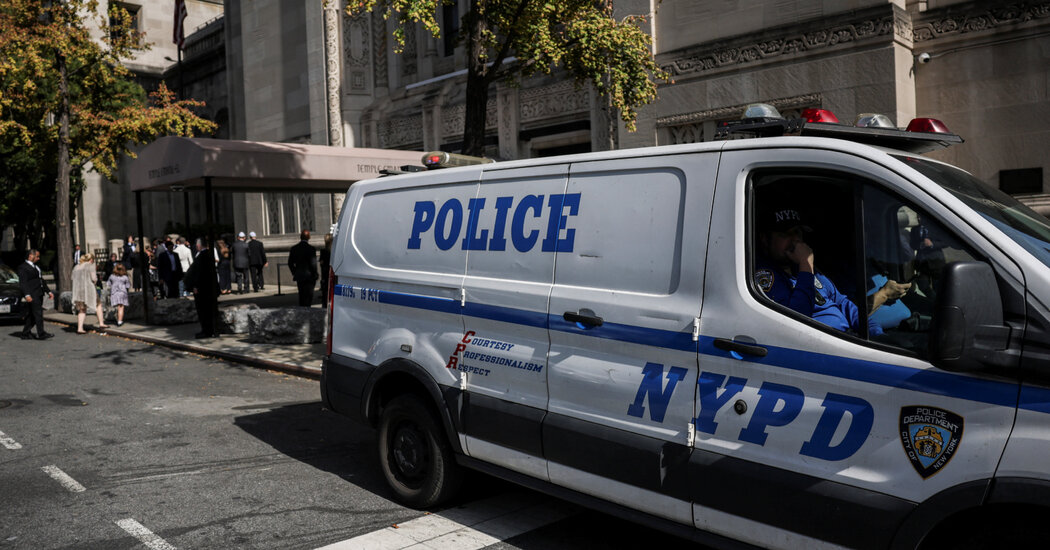
Summarize and humanize this content to 2000 words in 6 paragraphs in EnglishThe commander of an Iranian-backed militia who was charged with planning an attack on a New York synagogue was “targeting the heart of our Jewish community,” Commissioner Jessica S. Tisch said on Friday, hours after federal prosecutors said that they had thwarted the plot.The commander, Mohammad Baqer Saad Dawood al-Saadi, who had organized at least 20 attacks in Europe and Canada, had also planned to kill Americans and Jews in Los Angeles and had set his sights on a synagogue in Manhattan, Ms. Tisch said.She did not name the synagogue but said Mr. al-Saadi had chosen a place that supported Israel and Zionism. Mr. al-Saadi, who was detained in Turkey and handed over to U.S. authorities, appeared in federal court in Manhattan on Friday. He did not enter a plea and a hearing was set for May 29.According to the indictment, the commander wanted to send a message to a congregation that stood for “the right for Israel to exist.”“Right now, we are policing through a period of extraordinary tension and division,” Ms. Tisch said during a speech at Temple Emanu-El, where she had already been scheduled to speak at the Friday night prayer services. “No city experiences that more directly than New York.”Mayor Zohran Mamdani condemned the plot on social media, and thanked law enforcement for their work.“Let me be clear: antisemitism, violent extremism and terrorism have no place in our city,” he said. “This kind of hate is despicable. I’m thankful this alleged attack was stopped before any New Yorkers were hurt.”Ms. Tisch said that she had intended to talk about falling crime rates in New York City and the growing number of anti-Semitic incidents in the city and around the world since the attacks against Israel on Oct. 7, 2023, and the wars that followed in Gaza and in Iran.But she said that she wanted to address “the alarming news” of the allegations that had been revealed earlier on Friday.“In my 18 years in government, I have not seen a threat environment quite like this one,” Ms. Tisch said, as she stood at a lectern in front of the temple’s vast mosaic back wall. “Today’s case is a stark example of how these tensions that originate overseas translate into violence.”Security outside Temple Emanu-El, which Ms. Tisch emphasized was not the commander’s target, underscored the tensions she described.Two police mobile command central vans were parked at East 65th Street and Fifth Avenue, and a police officer stood just outside the entrance.Inside, security officials stood guard at metal detectors. The scene was similar at Central Synagogue, a Reform congregation more than a dozen blocks from Temple Emanu-El on the Upper East Side. A police officer stood outside the temple, where someone from inside the synagogue ordered a reporter to leave.Police are often deployed to places of worship that are facing threats. Synagogue leaders around the city have been on high alert in recent years.Linda Popick, 83, who left Temple Emanu-El after the prayer services, said that Ms. Tisch’s words “resonated with everyone.”She said that she had thought about staying home after she heard about the plot.“I’ve thought many times that Jewish people should all wear some Jewish jewelry or symbol to show that we’re not afraid,” Ms. Popick said. “And when I heard about this, I said to myself, ‘I’m going.’”In 2025, 330 of the 576 recorded hate crimes in New York City targeted Jewish people, according to Police Department data. Acrimonious protests over the conflict in the Middle East have also become common, in some cases leading to scuffles among demonstrators, counterprotesters and law enforcement officers. Several such protests outside synagogues in recent months prompted the City Council to pass two bills addressing how the Police Department manages demonstrations outside houses of worship and schools.Mr. al-Saadi had planned to use cryptocurrency to pay someone to set off improvised explosive devices and fires at the New York synagogue and at two Jewish centers, one in Los Angeles and one in Scottsdale, Ariz. He did not realize he had been trying to hire an undercover law enforcement official, prosecutors said.Mr. al-Saadi agreed to pay $10,000 for the attacks, and on April 4, he paid the officer, who was pretending to be a member of a Mexican cartel, $3,000 in cryptocurrency in anticipation of the synagogue attack in New York.Mr. al-Saadi told the officer that it was “‘most important’” that the “‘incident be recorded.’”Mitchell Silber, former director of intelligence analysis at the Police Department, said that those looking to harm Jewish people have gone on the dark web to recruit attackers who in London lit ambulances on fire that were run by a Jewish volunteer service and firebombed synagogues in the Netherlands. He now serves as chief executive of the Community Security Initiative for the UJA-Federation of New York, which works to detect threats against the Jewish community.“This was a similar pattern where this was crowdsourced on the dark web with the inducement of paying crypto to people to carry out these attacks,” Mr. Silber said.“From the New York perspective, we were wondering if this is just a European phenomenon or will it eventually touch New York,” he said. “And unfortunately, yes.”Anusha Bayya, Debra Kamin and Rylee Kirk contributed reporting.
Plot Was ‘Targeting Heart’ of New York’s Jewish Community, Tisch Says
Keep Reading