




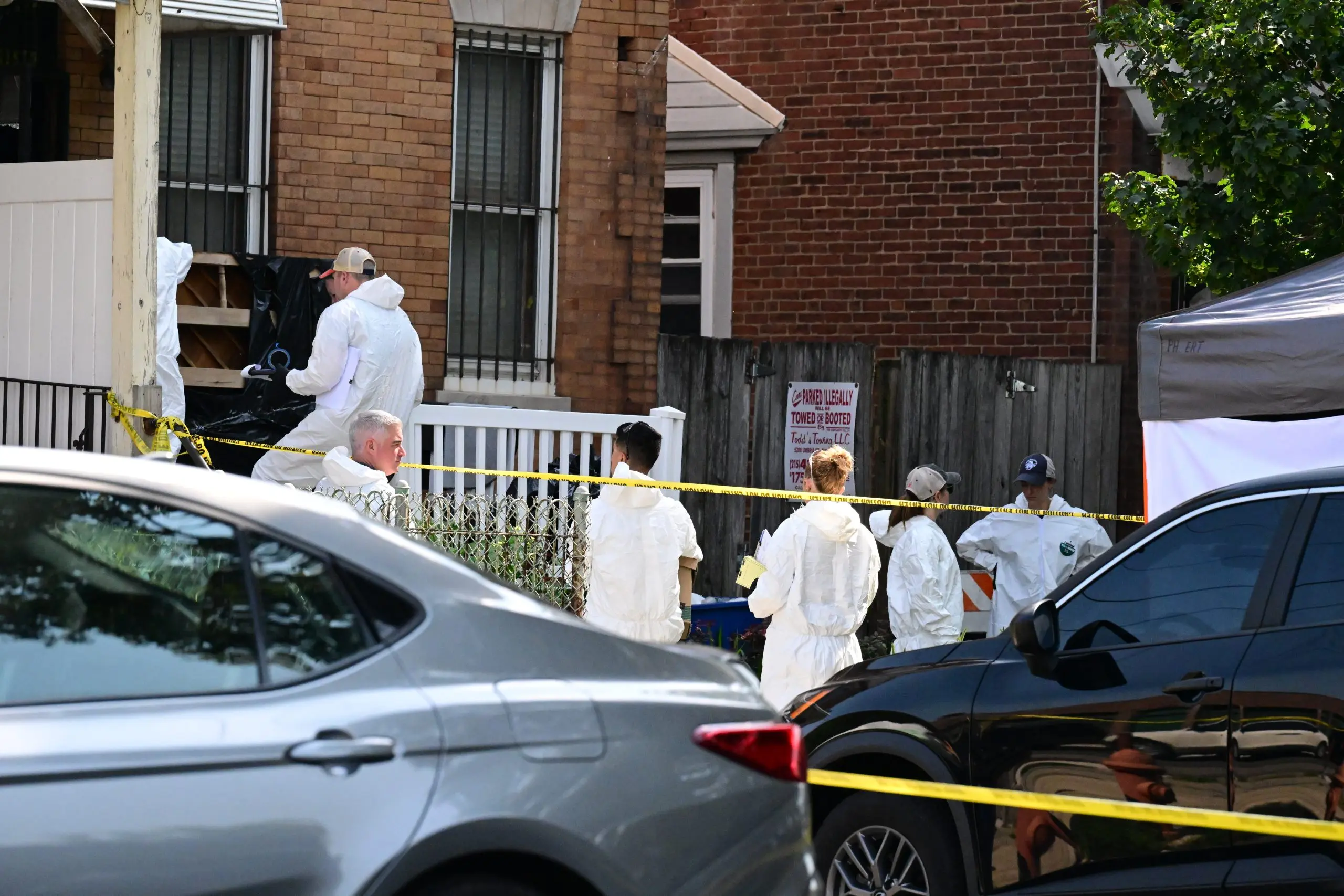
On a quiet Monday morning, the usual rhythm of Philadelphia’s Olney neighborhood was broken by the unmistakable sound of police radios and the careful placement of crime-scene tape. Investigators, accompanied by federal agents, returned to the row house on Chew Avenue that once belonged to Raymond “R.C.” Horsch, a name that has come to represent one of Philadelphia’s most disturbing and unresolved chapters. The search warrant, executed under the watchful eyes of neighbors who have lived with this story for too long, signaled a significant escalation in the investigation into a man suspected of being a serial killer. Roads were closed, driveways were blocked, and heavy equipment was brought in; this was not a routine evidence review but a ground-penetrating search. For the people who call Olney home, the return of investigators on this bright morning was both a relief and a wound reopened. It was a reminder that, despite the passing of time, the answers buried beneath that home were not going to be allowed to stay hidden. The search, described as disruptive by local officials, was the subject of a community meeting where authorities tried to prepare residents for what could be days or weeks of digging, trucks, tents, and forensic teams. Councilmember Anthony Phillips was among those who tried to reassure the public, explaining that police understood how difficult it is to see uniformed officers working day and night on their block. But he also made clear that this was an ongoing, active investigation and that the emotional and physical disruption to the neighborhood was necessary to bring it closer to an end. There was something profoundly unsettling about the image of investigators walking in and out of the home, carrying boxes, their faces serious and unreadable. For the families who have waited years, sometimes decades, for answers, the scene was not just news coverage; it was their lives unfolding in real time.
The story at the center of this investigation is one that reads like a dark, almost unbelievable script. Raymond Horsch, an 82-year-old who died the previous year, was not just an elderly man living in a modest house. He was a producer of brutally themed pornography, a man whose creative output was marked by violence, degradation, and cruelty. He also wrote books, but his name was never famous in the way that celebrity authors or filmmakers are famous. Instead, he operated on the fringes, in the shadowy corners of the commercial adult industry, where violence is not just a suggestion but often the entire point. His house on Chew Avenue, where he lived in the middle of a busy North Philadelphia street, had long been the subject of suspicion and local gossip. But it was not until after his death that the investigation truly began to take shape in a dramatic and public way. That turning point came in June, when his son, Eugene Horsch, now 44, was arrested on charges involving unlawful firearms and forgery. Those charges, which might have been handled as a routine criminal matter, led police to make startling discoveries inside the family home. What exactly they found has not been fully disclosed to the public, but it was enough to link the property to seven missing women and to a possible pattern of serial violence. It is almost impossible to overstate the significance of what happened inside those walls. A son’s arrest for an allegedly unrelated crime apparently opened a door that had been sealed for years, revealing a hidden world of predatory behavior, graphic material, and the remains of lives that intersected with a dangerous and calculating man.
Behind every case number, every missing-persons report, and every evidence bag is a human being whose life mattered. The seven women linked to the Olney home were not just statistics; they were daughters, sisters, mothers, and friends. At least five of them are believed to be dead. Those losses are not movie scenes or podcast episodes; they are the kind of losses that families carry with them every day, the kind that are shaped less by memory than by grief and the painful absence of closure. For years, these families have lived in a strange, suspended place, not quite waiting for news, because they have heard so much of it already, but still holding on. They have answered phone calls from detectives, made flyers, attended court dates, and watched the news in anticipation, hoping that one day someone would take a second look, revisit the files, or make the decision to dig in a certain place. Now that day has come, but it has come with no promise that the truth, however complete, will ease the pain. Investigators have linked seven missing women to this neighborhood and this house, but the number of victims could be greater. No one knows yet. The photographs and videos recovered from the home number more than one million, a staggering figure that speaks to the scale of Horsch’s fixation and the depth of his depravity. For the victims’ loved ones, the fact that this material exists, that there were photographs and videos at all, raises questions no family should ever have to consider. Were their daughters on the street before they disappeared? Were they known to Horsch? Did they enter that house willingly or were they taken? And most unbearably, are the remnants of their lives in those images and recordings? These are the thoughts that keep human beings awake at night, and for the families of these seven women, the return of investigators is the latest chapter in an ongoing nightmare that has already seen far too many sleepless hours.
The sheer volume of evidence recovered from the house is mind-numbing. More than a million photos and videos may have been digitized, cataloged, and stored, but the process of reviewing, identifying, and understanding what they contain is slow and emotionally taxing work. Detectives are faced with the challenge of differentiating between images that are legal, however violent, and images that are evidence of crimes, including possible homicides. Raymond Horsch’s background in the production of “brutally themed” pornography complicates matters enormously. What some might see as a bogeyman, investigators must see as a suspect, a man who knew how to use cameras, set design, and lighting, who understood the value of hiding in plain sight. He produced this material professionally, which also means he may have produced it carefully, covering his tracks, disposing of evidence, and keeping only what he believed was safe to keep. But he kept too much. The property has been searched before, but this new search is the most aggressive and likely the most exhaustive attempt yet to uncover the truth. Police are digging in the ground, searching underneath the property, and examining every room, wall, and floorboard for signs of human remains or other evidence of a violent crime. It is methodical, messy, and gruesome work, but it is necessary. Every piece of information that can be extracted, every stain that can be tested, every minute detail that can be traced has the potential to offer a family an answer. And while it may not be the answer they want, it is an answer nonetheless. The investigators themselves deserve recognition for their resilience. They are entering a dark world, spending months looking at objectionable material, interviewing people who may have known something, and trying to build a case under difficult conditions. They are the ones who must not look away, because the families cannot afford for them to.
During a community meeting in Olney, the mood was tense. Neighbors were concerned about the increased police presence, the road closures, and the constant media attention, not to mention the lingering stigma that now clings to an entire neighborhood because of the man who once lived there. Councilmember Anthony Phillips emphasized that the community truly came together, acknowledging the disruption and concern while also making clear that support and resources were on the way. “We all came together just to make sure neighbors understood that this is an ongoing investigation, we understand it is disruptive, neighbors and businesses are concerned, so we need to provide support and resources,” he said. It was a statement that recognized the humanity of everyone involved, not just the victims and their families, but also the people who have to live next door to an active crime scene. The neighborhood is not just a stage for this tragedy; it is a place of homes and small businesses, of people trying to raise their children in peace. Now, peace is hard to find. Children see the lights and commotion outside their windows, and parents must decide how much to tell them about the monster who lived down the street. Local businesses are worried about losing foot traffic, and residents are worried about their property values, but mostly they are worried about the unknown. What else will be found? Who else will be identified? How much longer will the streets be closed? These are not trivial concerns. But the disruption is temporary, while the need for justice is permanent. As investigators continued their work, the community watched, kept their distance in some ways, but also offered guarded support. There is a collective understanding that this search is not happening because the police have nothing better to do. It is happening because seven women deserve to be remembered, and five of them deserve the dignity of having their stories finally told in full.
The search of the Chew Avenue property is far from over, and the true scope of what it will uncover may not be known for months. But the fact that investigators are returning, that they are bringing heavy equipment, federal agents, and a renewed sense of urgency, sends a powerful message: this case will not be forgotten. The law enforcement community, the residents of Olney, and the public at large all feel the weight of that promise. For Raymond Horsch, who died before he could ever face justice, there may be no earthly punishment, but there can be accountability through the truth. His son Eugene remains involved in the legal system, and the discoveries made in that home have turned what might have been a smaller case into something much larger, a case that may yet reveal the final resting places of women who were lost far too young. It is not a cause for celebration. The horror of what happened in that house cannot be undone. No amount of digging can bring back the women who are gone, and no evidence bag can undo the sadness felt by their loved ones. But every shovelful of dirt that is moved, every photograph that is examined, and every woman’s name that is spoken in the course of the investigation is a small act of resistance against the silence and secrecy that allowed all of this to happen. The road ahead is hard. There will be more difficult days for the families, more tough questions for the police, and more trauma for the community. But when the last forensic professional packs up and the roads are reopened, when the yellow tape is removed and life begins to return to normal, the work will not truly be over. It will live on in the memory of the women, in the vigilance of the neighborhood, and in the determination of the investigators who refused to let the case go cold. Raymond Horsch is dead, but his victims, and the hope for their justice, live on in every search that continues to be made.