





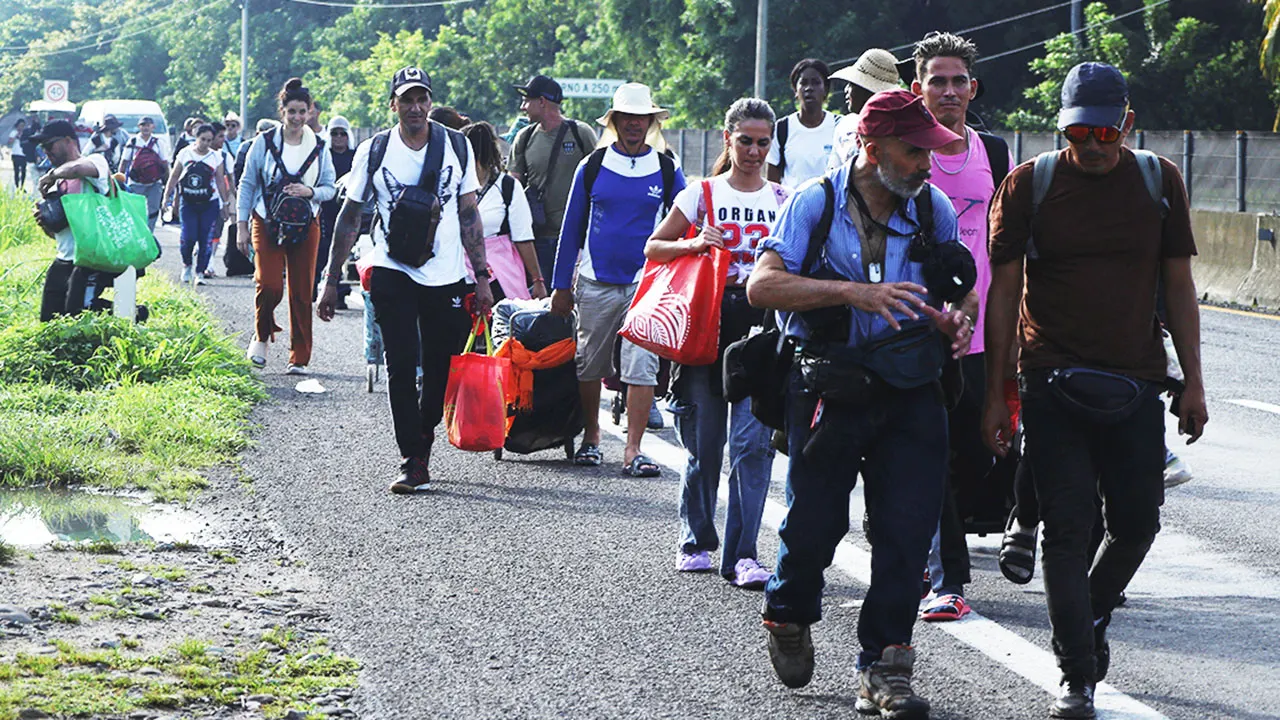
A tense, weary energy hangs in the air along the roads of southern Mexico and the long stretches of Central America that feed into them, because yet another migrant caravan has stepped out of the shadows and begun moving northward. The group, made up of people from Honduras, Guatemala, El Salvador, Ecuador, and Haiti, crossed into Mexico in the hundreds, carrying children, bottles of water, and the desparate hope of a better life. But as these travelers moved forward, they were met not with open arms, but with a stern and unambiguous warning from the Department of Homeland Security. In a carefully worded statement, DHS announced that United States Border Patrol agents are “closely engaged” with international partners and monitoring the caravan’s every move. “Any potential changes” would be addressed, the department said, before reminding anyone listening that under the current leadership, the border has remained closed and secure for sixteen months. For the migrants walking alongside highways and climbing onto freight trains, the message was clear: the United States was no longer a door that could be pried open; it was, in the language of the department’s press release, a wall that would not bend.
And yet, the choice to move is not always a simple calculation of political odds, because behind every pair of tired eyes in that caravan there is a story that statistics cannot capture. This particular caravan reportedly departed San Pedro Sula, Honduras, on September 20th, a detail that may seem small but speaks to a larger pattern of how migration flows have shifted in recent years. No longer are these journeys the chaotic, last-minute decisions of people fleeing immediate violence, though violence certainly still plays a role. Instead, they are increasingly planned, dangerous undertakings, where families gather whatever money they have, entrust their lives to coyotes and smugglers, and hope that the terrain does not betray them. The DHS warning did not single out one nationality or one destination; it applied to all. “Any migrants considering making the journey to the southern border should be aware that the days of ‘catch and release’ are over,” the department said, adding that the “open border policy” of the past has been “sealed shut.” For the people walking north, these words were more than just a press release. They were a verdict. But they also carried the weight of a question that no government memo could answer: if not the United States, then where? The caravan’s members pushed on, at least for now, driven by something stronger than fear of policy—a fear of going back to nothing.
Beyond the roadside camps and crowded migrant shelters, this caravan has become a flashpoint in a much larger political war, one that will only intensify as the midterm elections draw closer. The Department of Homeland Security’s statement contained more than just a warning to the travelers; it was also a message aimed directly at American voters, reminding them that the Trump administration has made immigration enforcement its defining priority. The numbers cited in the Fox News report are central to this narrative: fifteen straight months with zero border releases, apprehensions down by ninety-four percent, and a promise that anyone attempting to enter illegally will be “apprehended, prosecuted, and removed.” These are not small or subtle changes; they represent a wholesale transformation of how the United States treats its southern boundary. President Donald Trump has mandated sweeping deportations and expanded crackdowns nationwide, but the border has become the showpiece. On the other side of the aisle, Democrats and immigrant rights advocates have decried the harshness of these measures, pointing to the human cost of family separation, the harsh conditions in detention facilities, and the increasing criminalization of what were once basic acts of seeking asylum. The political debate has become so charged that even the existence of a caravan, which in previous years might have been treated as a manageable humanitarian issue, is now viewed as a weapon in a rhetorical battle over national security, law, and order. A federal appeals court recently dealt a blow to the administration’s deportation agenda, reminding Americans that even the most powerful executive orders can be challenged in the courts. But for now, DHS seems undeterred, projecting an image of total control at the border even as the caravan in Mexico remains a living symbol that the crisis has not simply disappeared.
The human face of that crisis is perhaps best captured in the words of José Zelaya, a Honduran migrant traveling with seven relatives. Zelaya, speaking to the Spanish-language news agency EFE, told reporters that his goal was simple: “I want to reach the United States.” He insisted the caravan had no organized leadership, that it was not a political movement or a stalking horse for foreign actors. It was, he said, “hunger and need” that drove him and his family from their homeland. Zelaya’s desperation is easy to understand when measured against the conditions that plague much of Central America—economic collapse, gang violence, political corruption, and the ever-present threat of climate change drying up the agricultural land that once sustained entire communities. For a father traveling with seven relatives, the journey north is not an adventure; it is a calculated gamble that every human being makes when they have exhausted every other option. There is also a quiet dignity in his refusal to offer excuses. He does not claim to be a political refugee; he does not invoke complex legal theories of asylum. He simply says that he is hungry, and that his family needs more than what their homeland can give them. That older, more honest form of migration—the kind that has built nations and reshaped continents—lies at the heart of this story. And yet, in the current political climate, it is exactly this kind of honest desperation that has been pushed to the margins, dismissed as “illegal” or “criminal” before the traveler ever sets foot on American soil. Zelaya’s story is a reminder that the debate over immigration is not just about walls, laws, and statistics, but about the deep, unbreakable bonds of family that force ordinary people to make impossible choices.
What makes the situation even more delicate is the fact that this caravan is not arriving in a vacuum. It is moving north at a time when the American government has made it abundantly clear that the border is not open for business, as far as traditional immigration is concerned. DHS’s strong warning must be seen as a deliberate attempt to manage expectations, both among the migrants and among the American public that will eventually vote in the midterms. There is a certain political theater to the way that DHS messages these events; every caravan is monitored, every movement is tracked, and every statement is calibrated to project an image of control. But there is also a genuine humanitarian fragility at stake. When DHS says that the border has remained closed for sixteen months, it is acknowledging that the old system of catch and release—where migrants were often released into the United States while awaiting court hearings—has been replaced by a more rigid posture of apprehension and removal. That posture has made life more difficult for migrants in some ways, but it has not eliminated the root causes that drive them north in the first place. The absence of a massive surge at the border might be read as a success by the administration, and indeed the statistics suggest that illegal crossings have plummeted. But the number of people living in the shadows, the families who have been deported and separated, and the hollow feeling in the communities left behind are harder to quantify. The caravan itself is a reminder that the desire to reach the United States is not a fleeting impulse. It is a constant, slow-burning fire that no amount of strong language from Washington can extinguish.
As the weeks pass and the midterm election draws closer, the fate of the caravan and the ideas it represents remain uncertain. DHS has promised that anyone attempting to enter illegally will be apprehended, prosecuted, and removed, but the administration’s critics will rightly point out that a strong statement is not the same as a sustainable solution. Even with unprecedented enforcement, the United States has not solved the economic and security crises in Central America, nor has it found a way to process the millions of people around the world who would like to emigrate legally. The caravan that left San Pedro Sula on September 20th will eventually reach some kind of endpoint, whether that be in a Mexican border town, a U.S. port of entry, or a detention center far from the homes they left behind. But the larger story is not just about where they end up; it is about the conditions that compelled them to leave and the political environment that greeted them when they arrived. For José Zelaya and his seven relatives, the journey is still ongoing, carried forward by a fragile mixture of hope and hunger. For the Department of Homeland Security, the message is static: the border is closed, the border will remain closed, and anyone who thinks otherwise is living in the past. For the rest of us, the caravan serves as an uncomfortable mirror, reflecting not only the failures of a broken immigration system but also the enduring power of the American dream—even when that dream has become harder to reach, heavier to carry, and more expensive to pursue than it has ever been before.