






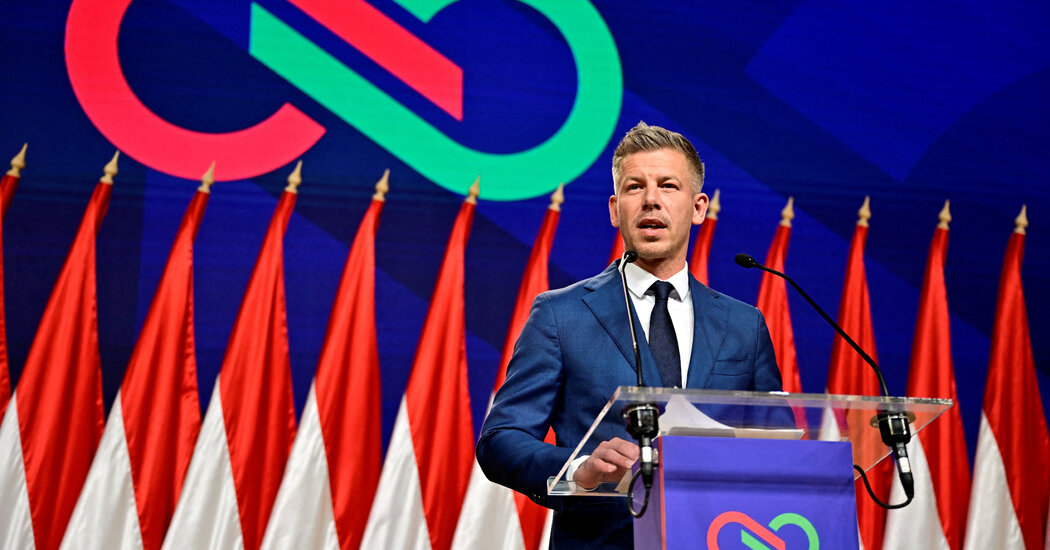
Hungary’s New Era Begins: Peter Magyar Prepares to Lead a Post-Orban World
In a momentous shift that reverberates across Europe and beyond, Peter Magyar, the 45-year-old former opposition leader, is poised to be sworn in as Hungary’s prime minister this Saturday. This feat comes after an arduous uphill campaign that toppled Viktor Orbán, Europe’s quintessential nationalist strongman who clung to power for 16 unbroken years. Magyar’s victory represents not just a political upheaval but a profound rejection of the authoritarian undercurrents that defined Hungary under Orbán’s rule. As the head of the Tisza movement, amelyet he took over in 2024 after disillusionment with Orbán’s Fidesz party, Magyar rode a wave of public fatigue to secure a landslide in parliamentary elections last month—a triumph that has set the stage for what could be a radical reimagining of Hungary’s political landscape.
The April elections were a decisive rebuke to Fidesz’s dominance. Tisza clinched an astounding 141 seats in the National Assembly, dwarfing the governing party’s paltry 52 despite Orban’s arsenal of advantages: voter district gerrymandering that favored rural strongholds, a stranglehold on media outlets that shaped narratives to his liking, and high-profile endorsements from U.S. officials, including President Trump himself. This victory, analysts argue, underscores a growing disillusionment with the “illiberal democracy” Orbán championed—a system that intertwined nationalism with entrenched corruption, eroding public trust and stagnating the economy. Magyar, a seasoned lawyer with a pedigree in international arbitration, has promised to dismantle these structures, reversing democratic regressions and fostering accountability. Yet, his journey from Fidesz insider to its greatest challenger highlights the volatile nature of Hungarian politics, where loyalties can fracture overnight.
As Magyar steps into the premiership, however, he confronts immediate hurdles that test his mettle. His Tisza faction and cabinet are rife with novices—political newcomers untested in the corridors of power—which raises questions about governance stability in a nation weary of instability. Compounding this, Fidesz loyalists entrenched in key institutions—the presidency, chief prosecutor’s office, and heads of regulatory bodies—may not vacate their posts easily. Magyar has demanded their resignations by month’s end, but resistance could stymie reforms, echoing past power struggles that defined Orban’s tenure. Experts warn that without swift purges, the bureaucracy could continue to prioritize partisan interests, potentially sabotaging Magyar’s agenda for transparency and renewal. This transitional phase, fraught with inherited baggage, illustrates the steep learning curve for a leader who promised big changes but must now deliver amid entrenched resistance.
Economic revival looms as a cornerstone of Magyar’s platform, with pledges to hold corrupt officials and businessmen to account while clawing back siphoned state funds. Such moves could inject much-needed stability into an anemic economy, long hamstrung by mismanagement and international sanctions. A pivotal benchmark will be reclaiming over $12 billion in frozen EU funds, slated to expire in August—a sum that could turbocharge infrastructure and social programs but hinges on diplomatic finesse to appease Brussels without alienating domestic conservatives. Former Fidesz stalwarts are already defecting, sensing the tide, which might accelerate defections and ease Magyar’s path to overhauling the system. Observers note that this anti-corruption drive isn’t purely altruistic; it’s a pragmatic tool to rebuild faith in institutions battered by years of graft under Orban.
Public optimism fuels Magyar’s ascent, as evidenced by a recent Median poll—an accurate predictor of the election—that found 72% of Hungarians deem him suitable for the role. Founded by pollster Endre Hann, Median’s data reveals a seismic shift in sentiment: Nearly two-thirds now believe the country is on the right track, a stark jump from pre-election gloom. Hann attributes this to a societal awakening, where voters realized Fidesz’s invincibility was a facade. Yet, this honeymoon is fleeting; the Tisza government must deliver concrete reforms to match inflated expectations. Magyar navigates a delicate tightrope, positioning himself as a fiscal conservative to lure disaffected Fidesz supporters while tenuously winning over liberals wary of his stances on immigration and LGBTQ issues, which echoed Orban’s harder line. His electoral strategy—unity against division—hinged on being the lesser evil to Orban, but sustaining this coalition demands deft balancing amid polarized demands.
Real change, however, may fall short of revolutions. Abroad, hopes for a pivot toward Western liberalism could clash with reality, as Magyar vows to uphold border fortifications against EU asylum norms while keeping ties with the bloc intact. He won’t block the $106 billion aid package for Ukraine but plans to sideline Hungary’s direct funding, preserving national interests without courting isolation. Domestically, progressives eye repeal of the 2021 “child protection law,” which maligns homosexuality and curbs LGBTQ rights, per a European Court of Justice ruling. Yet, enacting this risks fraying Magyar’s conservative base and feeding Fidesz smears of EU puppetry. Civil society leaders like Emese Pasztor of human rights group TASZ see Tisza’s win as a “breath of fresh air,” urging partnership over confrontation. Budapest Mayor Gergely Karácson, long vilified by Orban for his liberal leanings, anticipates smoother city-state relations, ending years of withheld funding and tax warfare that stalled infrastructure. “We’ve battled financially and politically for six years,” Karácson laments, pledging to heal divisions and prevent the return of Orban-era exclusion. As Hungary inches toward this new chapter, the focus sharpens on Magyar’s ability to foster inclusion, ensuring governance is transparent and accessible. If he succeeds, it could redefine not just policy but the very soul of Hungarian democracy—proving that even in polarized times, unity can emerge from the ashes of authoritarianism. This inaugural test will define whether Magyar’s promise of renewal translates into tangible progress for a nation hungry for rebirth.