


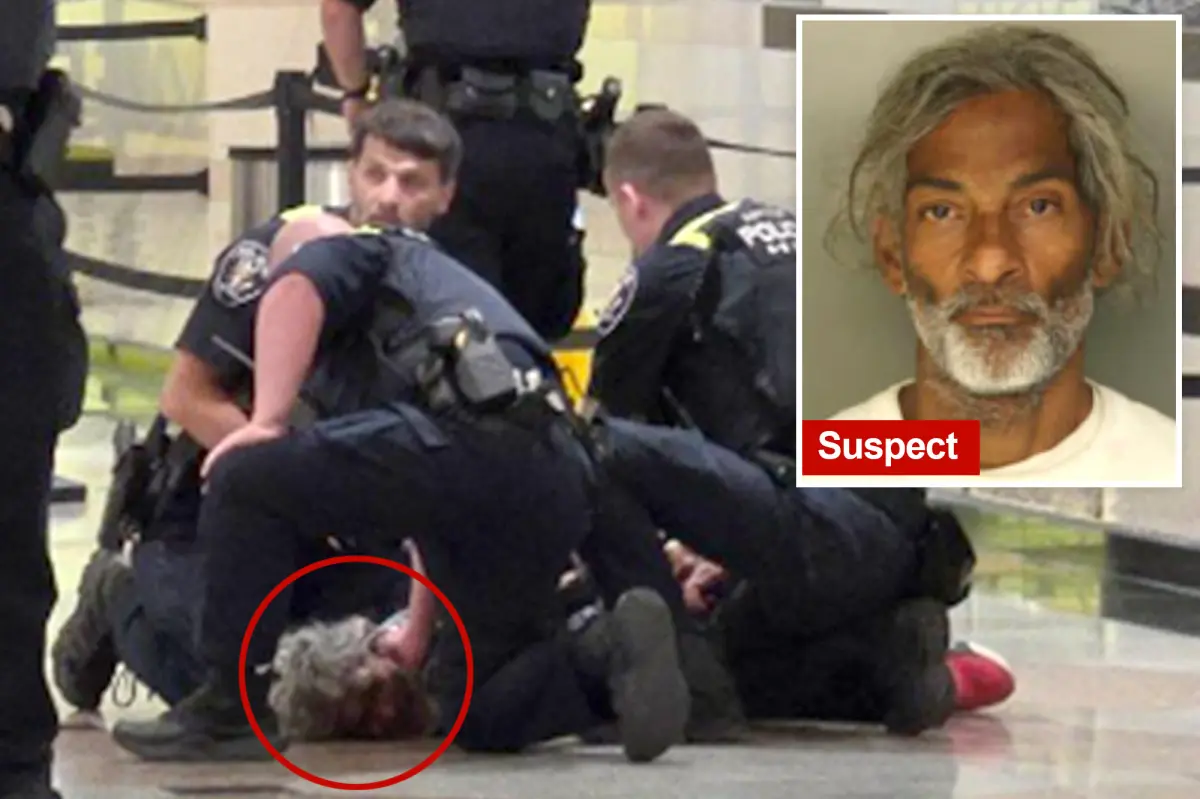
On a chilly Sunday evening, the cavernous, fluorescent-lit concrete walkways of Pennsylvania Station—typically filled with the rhythmic hum of hurried footsteps, the chatter of weekend travelers, and the distant calls of train conductors—shattered into a scene of pure, unadulterated terror. For the thousands of commuters moving through this massive Midtown transportation hub, the station is a mundane, transitional space between work and home, a place where people routinely lower their gaze and lost themselves in their thoughts. But that fragile illusion of safety evaporated in an instant when a sudden wave of violence swept through the crowds, leaving five innocent people bloodied, traumatized, and fighting for their lives. Among those caught in the terrifying chaos was sixty-year-old Henry Obadiah, who found himself staring directly into the eyes of his attacker, a disheveled man whose face was contorted with an animalistic, consuming rage. Before Obadiah could even comprehend the danger or register the physical sensation of the blow, a sharp, double-edged blade had sliced across his face. In the immediate confusion of the assault, the sheer adrenaline masked the severity of the wound, leaving him to realize only moments later, as warm blood poured down his cheek, that he had become the victim of a chaotic and seemingly random stabbing spree. This sudden explosion of violence transformed a typical Sunday commute into a nightmare, reminding every witness of how quickly the sanctuary of public spaces can be violated, and leaving behind a profound psychological scar on a city already grappling with the anxieties of urban safety.
Behind this horrifying outbreak of violence is Hector Deleon, a fifty-one-year-old unhoused man who has lived on the margins of society, battling the debilitating dual demons of severe mental illness and substance abuse. Following the attack, Amtrak police officers acted quickly to subdue Deleon, who was subsequently transported to a local hospital under heavy sedation, too unstable and physically overwhelmed by his own internal turmoil to be immediately processed or officially charged by the court system. When search teams recovered his weapon, they discovered a formidable six-inch “boot dagger”—a fixed, double-sided blade designed specifically for lethal close-quarters combat—which he had allegedly wielded with reckless abandon against passing strangers. To look at Deleon is to witness a profound human tragedy; he is a man who has slipped entirely through the cracks of a fractured social safety net, transitioning from a vulnerable citizen in need of intensive intervention to a highly dangerous perpetrator of public terror. This incident highlights a catastrophic failure of care, revealing how untreated psychiatric disorders and chronic homelessness can fuse with drug abuse to create a volatile mixture, ultimately turning a human being into a vessel of raw, unpredictable violence. Deleon’s descent into this frenzied state was not a sudden derailment, but rather the predictable culmination of a long, unchecked downward spiral, raising difficult questions about why society so often waits for a tragedy to occur before addressing the desperate needs of its most damaged individuals.
This terrifying rampage is made even more tragic by the revelation that it was entirely preventable, as Deleon had carried out an eerily identical knife attack just four years prior in Newark, New Jersey. On February 8, 2022, along the industrial stretches of Frelinghuysen Avenue, a confrontation erupted when a local property owner or worker confronted Deleon, accusing him of trespassing and theft, and demanding that he leave the premises. Infuriated by the confrontation, Deleon’s temper flared instantly into violence as he produced a six-inch knife with a distinctive black-and-gray handle and plunged it directly into the left side of the man’s neck. The victim of that attack narrowly escaped with his life, ending up in a high-intensity trauma ward where surgeons had to meticulously use nine stitches to close the gaping wound near his jugular vein. The chilling similarities between the Newark stabbing and the Penn Station rampage are impossible to ignore, down to the exact size and style of the lethal, fixed-blade weapon used in both assaults. This historical precedent proves that Deleon’s violent impulses were not a novel development, but rather a deeply ingrained, repeating pattern of behavior that was clearly documented in police reports and court files long before he ever stepped foot onto the crowded platforms of Manhattan’s busiest transit center.
Despite the extreme violence of the 2022 Newark assault, which could have easily resulted in a homicide, the criminal justice system responded with a degree of leniency that now seems profoundly misguided. Rather than facing significant incarceration or being placed into a secure, long-term psychiatric rehabilitation facility, Deleon was allowed to plead guilty to aggravated assault and was sentenced to a mere two years of probation. The conditions of his release were shockingly light: one hundred hours of community service and a mandate to continue receiving outpatient mental health treatment. In paper-pushing courtrooms, such plea deals are often rationalized as progressive measures to avoid overcrowding prisons and to offer rehabilitation opportunities to the unhoused. However, this bureaucratic approach completely ignored the reality of monitoring a highly unstable, transient individual with no fixed address or support system. Without rigorous oversight, institutional confinement, or mandatory medication management, the court-ordered mental health treatment became an empty gesture, impossible to enforce for a man drifting through the outer edges of society. This failure of accountability left Deleon free to roam the streets, harboring the same violent tendencies and carrying the same style of lethal weaponry, transforming his probation sentence into a tragic countdown toward his next inevitable outburst.
The failure to intervene became even more undeniable just one month prior to the Penn Station attack, when Deleon was arrested yet again in February of this year on assault charges in New Jersey. Although the precise details of this recent arrest remain obscured by ongoing investigations, it serves as a glaring red flag that his behavior was rapidly escalating and that his compliance with any previous rehabilitation program had completely disintegrated. Each arrest represented a crucial touchpoint where the legal and mental health systems had a direct opportunity to intervene, evaluate his escalating threat level, and remove him from public spaces before he could inflict further harm. Instead, a disjointed and overburdened bureaucracy allowed him to cycle quickly through police precincts and courtrooms, treating each violent episode as an isolated incident rather than part of a continuous, worsening trajectory. This revolving-door justice system ultimately failed both the public and Deleon himself, treating chronic, violent psychosis with temporary detentions and superficial releases rather than the intensive, secure psychiatric confinement required to protect society. By failing to connect the dots of his criminal record, the authorities effectively permitted a ticking time bomb to wander across state lines and enter a highly congested underground terminal, carrying a deadly weapon and looking for a target.
This latest tragedy at Penn Station has reignited a fierce and highly polarized debate surrounding municipal safety, mental health reform, and the daily realities of urban life in the Metropolitan area. For the millions of everyday commuters who rely on these transit systems, the fear of random violence is no longer an abstract concern, but a constant, anxiety-inducing anxiety that shadows their daily routines and forces them to remain hyper-vigilant. This incident occurs against a turbulent political backdrop, where local leaders and advocates are struggling to balance the desperately needed compassion for the unhoused population with the fundamental responsibility to maintain public order and safety. It exposes the harsh truth that shielding violent offenders from the consequences of their actions under the guise of progressive reform often results in innocent, working-class citizens bearing the physical and emotional scars of that leniency. To truly humanize this ongoing crisis, we must look beyond policy debates and recognize the human cost of these systemic failures: the trauma of victims like Henry Obadiah, who must now carry the physical and emotional memories of a random assault, and the tragic waste of a society that has yet to find a way to safely manage, treat, or isolate those who are too broken to live among us without cause for violence. Only by reforming this fragmented safety and judicial network can we hope to restore a sense of safety to our shared public spaces, ensuring that transit hubs remain gateways of connection rather than arenas of unpredictable terror.