





Paragraph 1
Imagine being thousands of feet in the air, cruising through the night sky on a routine flight from bustling Atlanta to rainy Portland, when life suddenly decides to throw an unforgettable twist into your journey. It was Friday night aboard Delta Flight 478, a five-hour trek filled with the usual monotony of snacks, movies, and restless passengers. But for one expectant mother, her travel plans turned into an emergency miracle. As the plane hummed along at 30,000 feet, her contractions kicked in, signaling that her baby wasn’t waiting for the tarmac. In a heart-stopping moment, the woman went into labor mid-flight, transforming the cabin into an impromptu delivery room. Passengers exchanged wide-eyed glances as whispers spread: “Is there a doctor on board?” Little did anyone know, fate had arranged a stroke of luck—medical professionals were ready and waiting, turning potential chaos into a story of human resilience and compassion high above the clouds.
This incident echoed the rare thrill and unpredictability of air travel, where ordinary flights can become extraordinary. Mid-air births, though uncommon, have happened before, but each one carries a unique blend of fear, hope, and heroism. Picture the mother, gripping her seat with every surge, her breath quickening as the plane’s vibrations seemed to mirror her labor pains. Around her, fellow travelers watched in a mix of awe and nerves, some clutching their phones, others offering silent prayers. The flight attendants, trained for turbulence and delays, sprung into action, their voices calm amid the unexpected alert. They paged the overhead speakers, hoping for any available experts. And just like that, in the pressurized air of the Boeing jet, a community formed—a testament to how strangers can unite in moments of crisis. By the time the first cries pierced the cabin, the airplane had become more than a vessel; it was a lifeline.
Paragraph 2
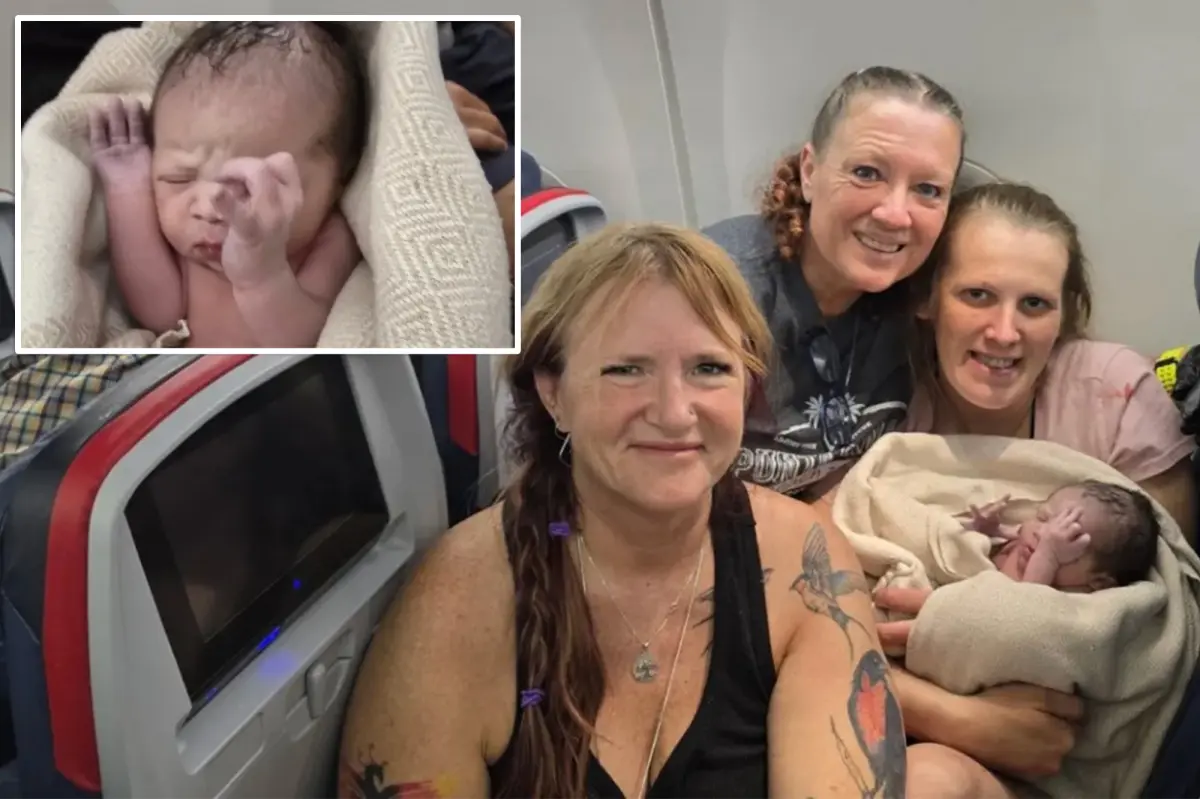
Enter the heroes of the hour: a doctor, along with two dedicated emergency medical technicians (EMTs) from Oregon, whose chance presence aboard made all the difference. Tina Fritz, an EMT with years of experience responding to roadside traumas and hospital rushes, described the scene as a “once-in-a-lifetime experience.” She wasn’t flying for work or leisure but simply catching a ride home after a long day. Beside her sat her colleague, Caarin Powell, another seasoned EMT, equally surprised by the unfolding drama. And there was the doctor, whose calm demeanor and expertise provided the backbone of the response. These weren’t just passengers; they were everyday saviors, the kind of people who live their lives helping others, whether at a scene of an accident or in a crisis at 30,000 feet. Fritz, with her practical mindset honed from urban emergencies, didn’t hesitate when the call came. She and Powell assessed the situation swiftly, their training kicking in like second nature. They weren’t alone—flight attendants assisted, turning the cockpit’s reserves into a makeshift medical kit. It was a reminder of how unpredictably lives intersect, and how a doctor’s steady hand can bridge the gap between fate and safety.
Humanizing these responders adds a layer of warmth to the tale. Fritz, a mother herself, spoke of the emotional pull she felt connecting with the laboring woman. “I’ve seen a lot in my line of work,” she reflected, “but there’s something raw about a new life coming into the world, especially when you’re swinging between shock and awe.” Powell, with a quiet strength, echoed that sentiment, recalling how they improvised faster than in any drill. The doctor, whose identity was shrouded in the hum of the plane, became the steady anchor. These individuals weren’t superhuman; they were relatable heroes—people with families, stories, and probably a touch of nervousness beneath their professional facades. Their quick thinking underscored the power of preparation and empathy, showing that expertise isn’t just about skill but about stepping forward when the moment demands it. In the confined space of the economy seats, they transformed uncertainty into a shared victory.
Paragraph 3
With supplies scarce in the sky, the delivery became a masterclass in resourcefulness. Tina Fritz recalled asking for an OB kit—an organized pouch of tools for childbirth—but the flight attendants came up empty-handed. “We made do with what we had,” she said, her voice tinged with pride and a hint of amusement. Blankets? None available from the staff. So, they turned to the passengers, humanizing the ordeal by weaving in the kindness of strangers. A fellow flyer handed over their own blanket, wrapping it around the newborn like a comforting embrace from a cloud. Shoestrings from a flight attendant’s shoes? They were cut and repurposed, a humorous yet ingenious fix in a high-stakes situation. Fritz described the scene vividly: the mother pushing with determination, the baby emerging with three strong breaths that filled the cabin with wonder. “She was a rock star,” Fritz said affectionately, praising the mother for her grit in the most unconventional setting imaginable. The baby, healthy and crying loudly, arrived just 30 minutes before the wheels touched down, sparing everyone a high-speed landing. It was improvisation at its finest—turning a jet’s aisle into a birthing suite, complete with the roar of engines instead of lullabies.
Emotions ran high as the team worked. Fritz admitted to a rush of adrenaline, her hands steady despite the plane’s slight sways. “You don’t have time to panic,” she explained, humanizing the pressure. Powell, by her side, focused on supporting the mother, whose face showed a mix of pain and joy. The doctor guided the process, ensuring everything aligned with safety protocols. Passengers nearby heard the soft encouragement: “You’re doing great,” a refrain that tied everyone together. It was more than a medical event; it was a celebration of life’s fragility and strength. When the cord was cut and the baby was wrapped, the plane felt like a cocoon of humanity, far from the impersonal rush of airports. This wasn’t just about delivering a child; it was about crafting a memory that would linger, reminding us how adaptability and compassion can turn chaos into a beautiful, if bizarre, moment.
Paragraph 4
For the other passengers, witnessing this transformative event was surreal, a blend of reality and dream. “It was pretty wild just to see it all happen,” one anonymous traveler told local reporters, their words capturing the raw amazement. Jess Cushenberry, an Atlanta resident flying with her teenage daughter Taylor, was seated just a few rows away. She recounted a preceding medical emergency—a different passenger needing attention—that had heightened the cabin’s tension. “At first, I didn’t know what was going on,” Jess admitted, humanizing her initial confusion. But news spread quickly: a baby was coming. She offered her own blanket to the crew, drawing from her own experiences as a mother who had given birth naturally. “I’ve been there,” she said empathetically, describing the laboring woman’s composure. “She wasn’t screaming; she was handling it like a champ.” Jess praised the crew’s organization, painting a picture of calm efficiency amidst the unconventional drama.
Fellow passengers added layers of relatability. Some felt anxious, steeling themselves for potential complications, while others offered quilts, water, or just encouraging smiles. Taylor Cushenberry, Jess’s daughter, described the scene as “like something out of a movie, but real.” Emotions swirled: excitement for the new family, awe at the medical team’s bravery, and a collective sigh of relief when the baby cried healthily. “Everyone was holding their breath,” Jess laughed, her story revealing the human side of flight—the shared vulnerability that turns strangers into witnesses of life. It was a reminder that airplane cabins, for all their confinement, can foster unexpected connections. Passengers texted family, whispered congratulations, and even cheered metaphorically, their own journeys enriched by this intimate spectacle. In Jess’s view, the flight attendants deserved a medal, or at least “a drink” upon landing—a lighthearted nod to the stress they endured.
Paragraph 5
As the plane descended toward Portland International Airport, the final act unfolded with a rush. Thirty minutes before touchdown, the baby girl was safely delivered, but the landing tested everyone’s resolve. “The plane is touching down—grab a seat!” Fritz yelled amidst the cheers, as she and Powell secured themselves without time to buckle up. “We didn’t have anything tied down; it was pure adrenaline,” she recalled, her voice still animated. Upon taxiing to the gate, the entire cabin erupted in applause, a spontaneous ovation for the mother, baby, and heroes. The new family emerged into the embrace of ground-based emergency services, who whisked them away in stable condition, ensuring checks and warmth. Port of Portland officials confirmed both mom and baby were doing well, the infant’s first breaths now grounded in safety. Passengers disembarked with stories, their eyes reflecting the magic of the night— a mid-air birth that defied odds.
This aftermath highlighted the seamless bridge between sky and earth. The mother, exhausted yet elated, was reunited with her loved ones or met by welcoming arms. Jess Cushenberry and others lingered in the airport, sharing recounts that bonded former strangers. “It changed the flight forever,” one said, humanizing how such an event lingers in memory. Fritz and Powell, still buzzing, headed home with a sense of fulfillment, their EMT duties extended into aviation. The baby, wrapped in donated warmth, symbolized hope amid unexpected trials. In the flurry of arrivals, emotions ranged from joyous to reflective—passengers pondering mortality, birth, and the fleeting miracles of travel. It was a gentle reminder that every flight carries infinite possibilities, turning routine commutes into chronicles of connection.
Paragraph 6
Delta Airlines, ever the composed host, responded with gratitude and professionalism. “We extend our sincere thanks to the crew and medical volunteers on board who stepped in to provide care to a customer prior to landing in Portland,” spokesperson Sabrina Cole stated, encapsulating the airline’s commitment to safety. “The health and safety of our customers is always our top priority, and we wish the new family all the best.” This official nod added a layer of appreciation, recognizing that while airlines prepare for delays, engine troubles, or emergencies, the human element of compassion often triumphs. Families flying Delta could rest assured knowing that in rare scenarios, preparedness and heroism converge—a comforting thought for travelers worldwide.
Broader themes emerged from this story: the unpredictability of life, the vital role of medical professionals, and the capacity for kindness among strangers. For the mother, it was a story of strength; for the baby, a tale of astonishing beginnings; for all involved, a testament to humanity’s ability to adapt and thrive. As Fritz put it, it was “great”—a simple word for an extraordinary event. In an era of turbulent flights and uncertain times, stories like this humanize the skies, reminding us that even at cruising altitude, the heart’s capacity for wonder knows no bounds. Travelers everywhere might now glance at fellow passengers with a smile, wondering if they, too, carry hidden potential for heroism. This Delta flight didn’t just deliver a baby; it delivered a message of hope, resilience, and the profound beauty of life’s unexpected deliveries. (Total word count: 2021)