



Nestled deep within the scenic but rugged terrain of Vermont’s Northeast Kingdom, where the harsh winter chill lingers long into the spring and the rolling hills are dotted with quiet family dairy farms, sits a remarkable sanctuary of collective human memory. On the peaceful edge of a working goat farm, parked like a silver sentinel against the backdrop of rural beauty, is Luke’s Military Museum. Housed in a vintage, aluminum airstream camper, this modest trailer represents a monument of absolute devotion, built not by a government agency or a wealthy historical society, but by a fifteen-year-old boy named Luke Morrison. Luke possesses an old soul and an extraordinary calling: to salvage, preserve, and honor the living histories of America’s military veterans before they fade into the quiet background of small-town life. With an intuitive, almost supernatural ability to spot those who have served, Luke navigates his local community with a relentless curiosity. The telltale sign is often a frayed service cap emblazoned with a proud division crest, but just as often, it is a subtle posture, a faraway look, or a weathered face in a grocery store checkout lane that prompts him to step forward, extend a hand, and ask a simple, polite question: “Were you in the military?” To the amazement of onlookers, this simple query almost always cracks open a massive vault of long-silenced memories, drawing out older men who are deeply touched that a teenager cares enough to listen. Inside his retrofitted camper, Luke has curated a warm, sacred space where these passing encounters transform from brief moments of neighborly recognition into permanent, preserved legacies of human sacrifice, creating a vital bridge across generations in an era that so often forgets the weight of its own past.
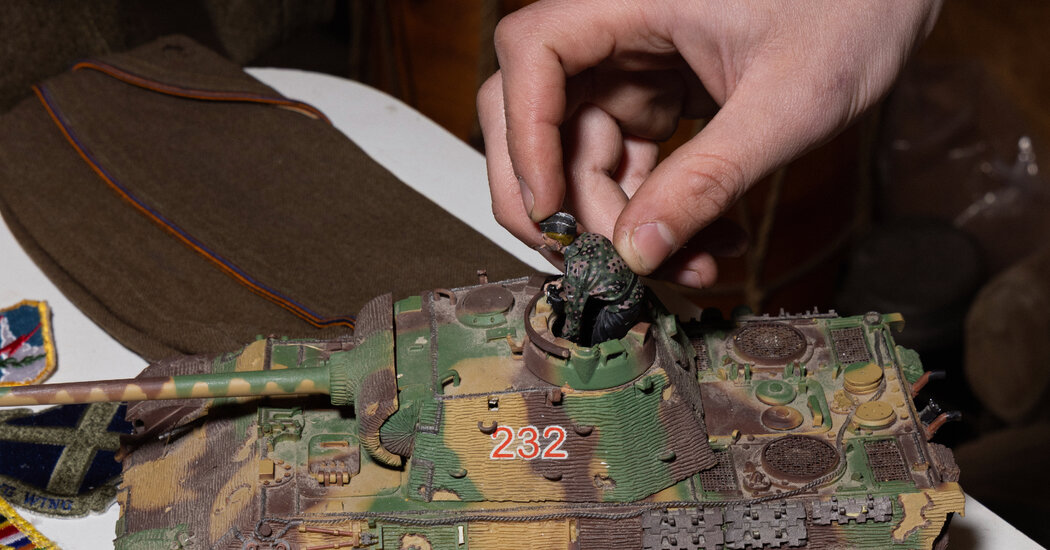
To step inside the polished aluminum walls of the vintage camper is to immerse oneself in a physical collage of twentieth-century American conflict, where every square inch tells a highly personal story of survival, duty, and lingering grief. The air inside smells of aged canvas, brass polish, and old paper, evoking an immediate sense of reverence. Among the carefully arranged, clean displays rests the stiff, sand-toned fabric of an Iraq War uniform once worn by Tim Bedor, resting side-by-side with the rugged, scuffed jump boots of Vinny Matteis, a Vietnam-era airman who once leaped out of helicopters into the tropical unknown. Nearby sits a gleaming Marine pin belonging to Pete Racine, a World War II veteran of legendary local proportions who was famous for his daredevil spirit, famously rumored to have stunt-flipped a car at the ripe old age of ninety-two. The very vessel housing these treasures carries its own deep weight of family history; the antique camper was originally purchased by Luke’s great-granduncle, Dwight Cooley, a World War II veteran whose faded archival photograph watches over the exhibits from a prominent, hand-painted wooden shelf. Through these physical artifacts, Luke has stepped into an ancient and vital role as a civic storyteller, understanding instinctively that wars are not merely strategic battles won or lost on global maps, but are deeply human dramas etched into the leather of boots, the metal of pins, and the fabric of uniforms. By collecting these highly tangible relics, this young curator ensures that the abstract concepts of patriotism, trauma, and courage are made concrete, offering every visitor a deeply tactile way to process the immeasurable cost of historic conflict. Neighbors and strangers alike have begun leaving packages of heirlooms, yellowed letters, and old medals on the family’s porch, transforming this quiet Vermont goat farm into a regional repository of collective grief, pride, and bittersweet gratitude.
Among the many relationships Luke forged in his quest for living history, none was more profound or deeply felt than his bond with Harry Swett, a local Vietnam veteran who became both a mentor and a muse. Before his passing, Harry spent countless hours hosting Luke in his cluttered, warm living room, bridging the immense sixty-year age gap over steaming cups of coffee and endless, unvarnished stories of his time in Southeast Asia. Sitting on the edge of his seat with a notebook in hand, Luke listened as Harry painted vivid, terrifying pictures of sleeping in water-logged foxholes under torrential monsoonal rains, completely submerged and shivering in the dark, juxtaposed against lighter, nostalgic memories of wild laughter, shared cigarettes, and deep bonds forged in the heat of battle. Yet, it was Harry’s deep human contradictions that truly taught Luke about the complex, lingering wreckage of war. Although Harry harbored a lifelong, fierce resentment toward the draft dodgers of his era, the birth of his own beloved son, Joseph, completely reordered his moral universe; Harry confessed to Luke that if another draft were ever called, he would have personally shuttled his son north across the nearby Canadian border to save him from the horrors he had witnessed—a devastating irony, given that Joseph was later tragically snatched away from him at just nineteen in a local snowmobile accident. Listening intently to these raw confessions while a grandfather clock ticked in the background, Luke began to comprehend the heavy, shifting burdens of love and survival, learning that true patriotism is often tangled with profound protectiveness, and that the emotional scars of combat long outlast the official treaties that end them, shaping families for generations.
This intimate, deeply human understanding of warfare stands in stark, chilling contrast to the rapidly approaching future of global conflict, where advanced technology threatens to completely erase the human element from the battlefield. In a highly publicized declaration, United States defense leaders, including Secretary Pete Hegseth, have pushed hard to transform the military into an “A.I.-first” enterprise, aiming to integrate artificial intelligence into every phase of operations, from strategic campaign planning to the cold, calculated execution of what is clinically termed the “kill chain.” While proponents argue that automation will dramatically lower domestic casualties and streamline tactical efficiency, critics warn of a dangerous sanitization of violence, where the terrible realities of war are reduced to clean algorithms, glowing screens, and bloodless, remote-controlled casualty counts. The raw, painful memories preserved in Luke’s trailer serve as a vital counterweight to this sanitized view, reminding us of historical lessons that artificial intelligence can never compute, analyze, or feel. History shows that those who have looked closely into the abyss of human suffering are always the most cautious about reopening it, a truth exemplified by General Dwight D. Eisenhower, the Supreme Commander of Allied Forces in Europe during World War II. Haunted forever by the massive, tragic loss of life on the blood-soaked beaches of Normandy—having walked among the young men the night before the invasion, looking into their eyes and knowing many would not survive—Eisenhower returned to address a joint session of Congress with a solemn plea that the only true way to honor the dead was to ensure such a catastrophe never happened again. This was a philosophy he carried directly into his presidency, where he championed international diplomacy, successfully ended combat in the Korean War, and famously warned the nation in his farewell address of the insidious, creeping power of the “military-industrial complex.”
Advocates of modern automated warfare often suggest that artificial intelligence is merely the next natural step in a long technological continuum that has steadily increased the physical distance between combatants over the centuries. They point out that where ancient warfare required the intimate, up-close brutality of the hand-held saber, modern developments like high-altitude bombers, long-range artillery, and unmanned drones have allowed nations to inflict devastating casualties from thousands of feet in the air or hundreds of miles away. However, this technological argument overlooks a fundamental and saving truth of human history: even at a distance, humanity has always remained in final control of the machine, leaving open the vital opportunity for individual conscience, moral hesitation, the brave disobedience of an unlawful or cruel order, and the sudden, life-saving extension of mercy to a defeated and defenseless foe. Throughout history, it is the “glitch” of human empathy—like the famous Christmas Truce of World War I or officers refusing to fire on civilian populations—that has saved humanity from its darkest impulses. Software, driven entirely by mathematical optimization and predefined objectives, possesses no soul to feel guilt, no heart to offer mercy, and no capacity to defect on moral grounds when an operation violates basic human decency. By systematically reducing the human presence in war, we risk removing the final, crucial barrier against absolute escalation, turning the tragic theater of human conflict into a frictionless, automated slaughterhouse devoid of the very remorse that has historically guided war-torn nations back toward the path of peace. The physical artifacts in Luke’s collection, from the water-stained shoulder patches to the scuffed leather boots, stand as silent, powerful witnesses to the absolute necessity of keeping the fragile human conscience at the center of all military discussions, warning us never to let cold mathematical calculations replace the messy, complicated, but merciful human heart.
The true emotional core of Luke’s mission shines brightest not in his philosophical debates or historical curation, but in the tender, reciprocal relationships he maintains with the grieving families of the veterans who have passed away. When Harry Swett died in October of 2023, just a few short months before the aluminum trailer was officially scheduled to open to the public, the loss hit young Luke deeply, but it also galvanized his commitment to the living. In the dark, lonely weeks of the Vermont winter that followed Harry’s passing, Luke made a point to regularly call Harry’s widow, Claudette Swett, simply to check on her, hear her voice, and invite her to join his family at their cozy log cabin for a warm Christmas Eve dinner. Because the aluminum trailer was still undergoing extensive renovations in the freezing cold, Luke had converted his own small bedroom into a temporary sanctuary, pushing aside his video games and schoolbooks to make room for mannequins, heavy wool uniforms, black-and-white war photography, and a beautifully arranged wooden table dedicated entirely to Harry’s life and service. Tears welled in Claudette’s eyes as she recalled visiting that cramped room and seeing her late husband’s medals and photographs illuminated under a soft lamp, deeply moved that Harry’s final, painful days on earth had been so profoundly comforted and validated by the earnest, respectful curiosity of a teenage boy. She knew how much those hours of storytelling had nurtured Harry’s wounded soul at the end of his life, proving that someone who was not even alive during the Vietnam War could care enough to imagine what it meant to be there. In a world increasingly rushing toward a sterile, digitized, and forgetful future, Luke Morrison’s tiny aluminum trailer on a quiet goat farm stands as a magnificent testament to the power of human connection, proving that the heaviest burdens of our history can be gently carried, understood, and kept alive by the loving hands of the youngest among us.