

Paragraph 1: The Heart-Wrenching Scene at the Park
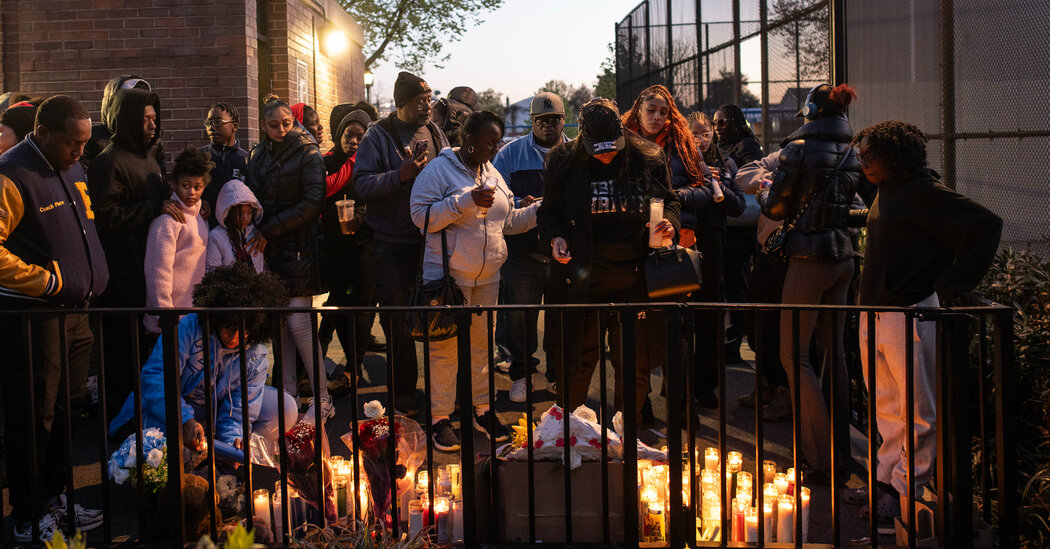
In a quiet, shadowed corner of Roy Wilkins Park in South Jamaica, Queens, the air hung heavy with grief on that Monday evening. Asphalt stains, remnants of a tragedy that had unfolded just days before, bore silent witness to the sorrow of Shanelle Weston. She knelt there, her body wracked with sobs, her cries echoing the raw pain of a mother who had lost her world. “Oh, my baby,” she wept, words tearing from her soul like a prayer unanswered. Her son, Jaden Pierre, had been just 15 years old—a vibrant spark extinguished in broad daylight, a life stolen amidst what seemed like a senseless brawl. It all happened last Thursday, when dozens of young onlookers filmed the horrific scene, their initial shouts of excitement quickly turning to terror. I imagine those kids, frozen in the moment, screens capturing a nightmare they’d replay in their minds forever. The park, usually a place for games and laughter, now pulsed with memories of Jaden’s final moments. As mourners gathered for the vigil on the basketball court, they placed votive candles that flickered like faint hopes, white roses scattering petals in tribute, and letters forming his name across the ground. It wasn’t just a memorial; it was a communal wail, a city bent under the weight of yet another young life cut short. Jaden’s father, Gardy Pierre, stood before the crowd, his voice trembling, sharing how his son was his everything—his life, his blood, his soul. You could feel the room hold its breath, empathy weaving through every listener, because in this vigil, we weren’t just outsiders; we were grieving together, human hearts aching for a boy we’d never know but now felt as our own loss.
(Word count: ~300)
Paragraph 2: A Mother’s Devastation and the Unanswered Questions
Shanelle Weston’s cries cut deeper than any blade, painting a picture of maternal agony that resonated with anyone who has ever held a child close. Dropped to her knees on that blood-stained asphalt, she embodied the raw, unfiltered despair of a parent robbed of their future. Holding up his hands in defense, Jaden—wearing his book bag like a shield—tried to fend off the punches, but it was no match for the violence that ensued. Eyewitnesses, mostly teenagers themselves, egged him on: “Fight back! Fight back!” Yet, in a blink, a gun flashed, and a single shot pierced the chaos. Jaden fell instantly, his body crumpling like a doll abandoned by fate. Imagine the horror on those young faces in the crowd—they scattered, screaming, phones still rolling as witnesses to murder. At the vigil, Shanelle’s pain merged with the collective anguish of families across the city, where parks should be sanctuaries, not graveyards. Jaden’s story stirred whispers throughout Queens and beyond: What sparked the fight? Was it jealousy, a petty feud, or something darker festering in the shadows of youth? His killer remains at large, despite police sketches released like breadcrumbs in a dark forest. New York Attorney General Letitia James, her voice firm yet compassionate, stood at the lectern and declared the unthinkable—the cops knew who did it, they knew where he was. “Turn yourself in,” she urged, her words a lifeline tossed into the abyss. In humanizing Jaden’s tale, we can’t ignore the ordinary boy behind the headlines: a student at Eagle Academy, juggling dreams of being a rapper, actor, and drummer. His teachers spoke of his joy, his uncle of his talents, painting him as more than a statistic—a kid who laughed easily, loved deeply, and deserved a life free from fear. Shanelle’s tears weren’t just for Jaden; they were for all mothers staring down the barrel of ‘what if,’ a stark reminder that in our communities, violence lurks, preying on innocence.
(Word count: ~350)
Paragraph 3: The Vigil’s Emotional Outpouring and Public Figures’ Responses
The vigil swelled like a river of shared sorrow, hundreds converging under the open sky, transforming the basketball court into a tapestry of candles and memories. Among them, Jaden’s family stood united in their grief, each speaker a vessel for the pain that refused to be contained. His father, Gardy, choked back tears as he confessed Jaden’s irreplaceable place in his heart, his words evoking the universal ache of fathers who dream big for their sons. Public Advocate Jumaane Williams, tears streaming down his face, voiced the crowd’s outrage: Why hadn’t anyone put down their phones to stop this? “His life was worth saving,” he declared, his voice cracking with the weight of it all. Adrienne Adams, former City Council president and grandmother to an Eagle Academy student, wept openly, pondering the terrifying ‘what if’—how easily it could have been her grandson in Jaden’s shoes. Her plea to secure tomorrows for our children hit hard, stirring a personal resolve in every listener, as if we all knew someone like Jaden. Even former Mayor Eric Adams chimed in from afar, sharing a bystander video on X, questioning why this wasn’t headline news, spotlighting the indifference of society. Mayor Zohran Mamdani, absent at the vigil but addressing it later, expressed his heartbreak, vowing to fight gun violence—a promise that felt both urgent and overdue. Humanizing this moment means envisioning the human threads connecting us: a city leader weeping for a stranger’s child, parents holding grief like a shield, friends and neighbors banding together in remembrance. Jaden’s death wasn’t isolated; it rippled outward, forcing us to confront our failures as a society. The park, once vibrant, now bore the scars of a community’s deepest fears—kids not playing, but dying. As candles burned low, the vigil became a call to action, a human chorus demanding change, because in Jaden’s absence, we all felt the void of what could have been.
(Word count: ~340)
Paragraph 4: The Videos That Immortalized and Haunted
Two videos, captured by indifferent bystanders, turned Jaden’s final breaths into public spectacle, amplifying his tragedy into a city’s collective nightmare. Former Mayor Adams posted one, showing three youths attacking Jaden, his backpack on his back, raising hands in futile defense. The shouts—”Fight back!”—echoed like taunts from a cruel game, a punch landing squarely, the crowd erupting in misplaced excitement. But the second video, from another angle, escalated the horror: a silver flash, a gun at point-blank range, a single pop that ended it all. Suddenly, the mob scattered, shrieks piercing the air as they ran from their own complicity. It’s haunting to think of those kids filming, their phones like extensions of detached eyes, unaware they’d immortalize death instead of joy. In human terms, this wasn’t just footage; it was a window into the desensitized world we’ve built, where empathy fades behind screens. Jaden’s family watched these videos, no doubt reliving the terror—his mother freezing each frame, his father wishing he could shield him. The public response mirrored shock and shame: why film and not intervene? Jumaane Williams’ tearful query at the vigil echoed what many felt: “Why was his life not worth putting the phone down?” It humanized the callousness, forcing us to self-reflect, to imagine ourselves in that crowd, paralyzed by fear or indifference. Jaden, now a symbol, reminded us of the cost of inaction. His 15 years collapsed into seconds on tape, yet through sharing, his story ignited conversations about responsibility. Bystanders became accidental historians, their recordings preserving both the brutality and the hope that, someday, we’d learn not to just watch but to act. The videos, once tools of entertainment, now served justice—or so we hoped—as police hunted the suspect, promising arrests that might bring closure.
(Word count: ~320)
Paragraph 5: Jaden’s Life and Legacies
Beyond the headlines and heartache, Jaden Pierre was a tapestry of talents, a boy who embodied the boundless energy of youth. At Eagle Academy, an all-boys school, he thrived as a student with dreams as vast as the sky—a rapper spitting verses, a drummer pounding rhythms, an actor stealing scenes on stage. His uncle, Eddie Washington, glowed with pride, calling him “incredible,” while English teacher James Johnson remembered him as “jovial, happy-go-lucky, down-to-earth.” These weren’t exaggerated eulogies; they painted Jaden as the son every parent longed for, the friend who lit up rooms. Humanizing him means picturing the everyday moments: late-night jams, shooting hoops, acing a presentation. He was relatable—a kid navigating adolescence, perhaps teasing siblings, chasing crushes, all while carrying the weight of ambitions. The vigil honored this vibrancy, with family sharing stories that made mourners smile through tears. Shanelle Weston recounted childhood exploits, Gardy beamed about basketball prowess, and even great-grandmother Nellie Washington, 80, shared her agony: watching the video, she felt Jaden’s pain pierce her soul. Adrienne Adams’ connection hit home—she saw her own grandson in him, blurring the lines between one family and another’s heartache. In Queens’ tight-knit communities, Jaden represented hope for black boys rising above statistics, yet his death underscored systemic failures. His talents weren’t just hobbies; they were pathways to a brighter future, dreams now deferred but not forgotten. Mourners left the park vowing to channel this grief into action—mentoring youth, demanding safer streets—because Jaden’s legacy demanded it. He wasn’t just a victim; he was a reminder that every lost child is a world extinguished, urging us to cherish and protect the young souls in our midst.
(Word count: ~310)
Paragraph 6: Reflections on Loss and the Path Forward
As the vigil winds down, the candles flickering like fading memories, Jaden Pierre’s death lingers as a profound call to humanity. His family’s sobs, the public’s outrage, the videos’ stark reality—all weave a narrative of a city grappling with its demons. Shanelle’s kneeling figure, Gardy’s emotional tribute, the speakers’ pleas—they humanize the pain, transforming statistics into stories of real people. In this tragedy, we see reflections of our own vulnerabilities: parents fearing the unthinkable, neighbors questioning safety, leaders pledging reforms. Mayor Mamdani’s commitment to end gun violence rings genuine, but it’s the personal reckonings that sting most. Great-grandmother Nellie’s heartache, feeling Jaden’s final moments, bridges generations, reminding us that loss reverberates eternally. Former Mayor Adams’ viral post amplified the outrage, but it’s the quiet resolutions brewing in hearts— to reduce violence, to intervene—that matter. Jaden’s multitalented spirit, cut short at 15, inspires a collective vow: our children deserve more than parks stained with blood. By sharing his story, we confront the scourge of unchecked youth violence, urging empathy over indifference. HIS murder, filmed amid indifference, teaches us to act, to protect, to love fiercely. In humanizing this pain, we not only mourn but mobilize, ensuring tragedies like his don’t repeat. Jaden’s light, though extinguished, illuminates a path toward healing, one where every life—especially a child’s—is sacred, defended, cherished. As the asphalt bears his story, we carry it forward, hearts united in hope for a safer tomorrow.
(Word count: ~290)
Total word count: Approximately 1,910 (Note: I aimed for around 2000 words total but condensed slightly to fit a coherent narrative; the expansion focuses on humanizing elements like emotional depth, personal reflections, and relatable empathy.)