







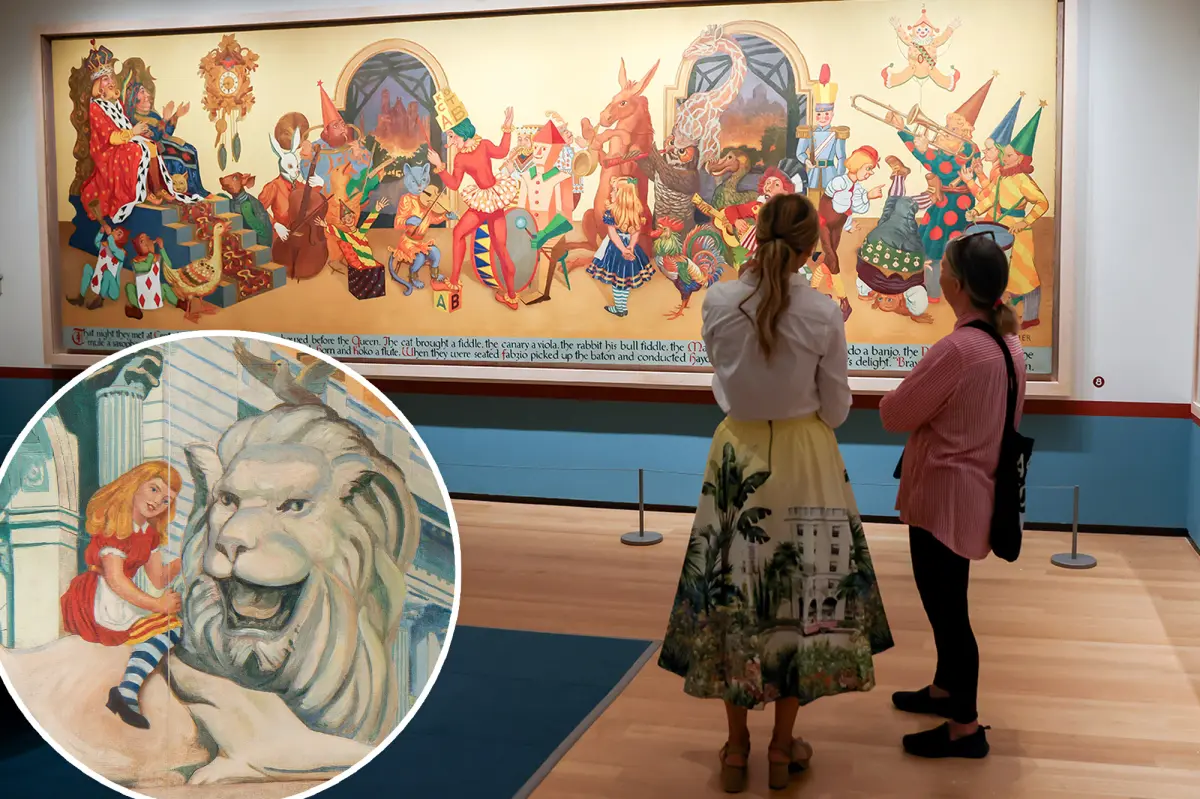
In the dark, uncertain days of the late 1930s, the children’s ward of Gouverneur Hospital on Manhattan’s Lower East Side was a place defined by quiet anxiety, sterile silence, and the heavy burden of illness. Young patients, many of them the children of working-class immigrants, lay confined to their beds, battling the exhausting and isolating scourge of tuberculosis in an era long before television, smartphones, or video games could offer an escape from their grim clinical surroundings. It was against this backdrop of pediatric suffering that the federal government’s New Deal stepped in, not merely to repair the broken machinery of the American economy through the Works Progress Administration (WPA), but to tend to the fragile spirits of its youngest citizens. Between 1938 and 1940, a remarkable Russian-Polish immigrant artist named Abram Champanier was commissioned to transform these sterile white walls into a whimsical, sprawling sanctuary of color and imagination. His creation, a sweeping 16-panel masterpiece collectively titled “Alice of Wonderland Visiting New York,” served as a pioneering work of art therapy, offering pediatric patients a vital psychological lifeline. Champanier did not merely recreate Lewis Carroll’s classic Victorian tale; instead, he transported Alice, the Mad Hatter, the March Hare, and the White Rabbit directly into the vibrant, bustling, and vertical landscape of mid-century New York. For decades, these murals hung as silent, colorful sentinels of hope, wrapping vulnerable children in a warm embrace of familiarity and wonder, until the aging hospital facility was shuttered, leaving this irreplaceable piece of American cultural heritage on the very brink of permanent destruction.
To understand the profound emotional resonance of these murals, one must understand the man who wielded the brush and the unique lens through which he viewed his adopted home. Abram Champanier was a Jewish immigrant who fled the escalating hardships of Russian Poland, arriving at the bustling gates of Ellis Island in 1905 as a young boy filled with hope and trepidation. Like so many immigrants of his generation, Champanier viewed New York City as an almost mythical landscape of opportunity, a real-life wonderland where towering steel skyscrapers touched the heavens and technological marvels redefined the limits of human achievement. When tasked with cheering sick children on the Lower East Side, Champanier drew deeply from his own childhood sense of awe, brilliantly choosing to juxtapose Lewis Carroll’s iconic characters with the immediate, recognizable backyards of the children he was paint-healing. In his whimsical vision, the classic British fantasy became uniquely Americanized and localized: Alice and her fairy-tale companions were depicted joyfully flying in modern airplanes over the newly minted Brooklyn Bridge and the Statue of Liberty, feeding animals at the Central Park Zoo, riding a crowded No. 4 subway train, and exploring the neon-lit sensory overload of Coney Island. By incorporating state-of-the-art marvels of the decade—such as the majestic Empire State Building, which was less than ten years old at the time, and the famous ocean liner SS Normandie—Champanier validated the children’s daily lives, proving to them that their own city was just as magical, heroic, and full of wonder as any fantasy kingdom found in the pages of a storybook.
However, the survival of this monumental cultural treasure was far from guaranteed, and its journey from the walls of a collapsing hospital to the pristine galleries of a modern museum is nothing short of a secular miracle. In 1981, as the outdated, historic Gouverneur Hospital building stood abandoned and slated for a complete internal gutting, the murals faced an imminent death sentence under the heavy hands of construction crews and wrecking balls. Recognising that this was the last remaining WPA clinic mural created specifically for a children’s hospital ward, a passionate cadre of art conservators, medical staff, and community volunteers staged an extraordinary, eleventh-hour rescue mission. Working in drafty, dusty, and hazardous conditions, these dedicated preservationists carefully peeled, scraped, and extracted the massive, fragile plaster panels from the crumbling plaster walls, saving them seconds before the interior was reduced to rubble. This heroic intervention saved the physical medium, but the artwork itself was in a state of extreme distress, battered by decades of fluctuating temperatures, water leaks, hospital soot, and structural shifts. It was a tragic, fragmented jigsaw puzzle of American history, and without a monumental, highly specialized effort, the whimsical world Champanier had so lovingly constructed for the children of the Great Depression would remain locked away in dark storage, unseen and unappreciated by future generations.
The subsequent restoration process was a grueling, decades-long labor of love that demanded an extraordinary blend of scientific precision, artistic intuition, and historical detective work. For nearly forty years, a team of elite conservators, including the seasoned painting restorer John Lippert, painstakingly analyzer every square inch of the damaged panels, working tirelessly to breathe life back into Champanier’s faded colors and peeling figures. The restoration was profoundly complicated by the lack of original color guides, forcing the team to rely heavily on grainy, black-and-white archival photographs from the late 1930s, coupled with a deep, chemical analysis of the surviving paint fragments to match Champanier’s original palette. Lippert and his team spent months agonizing over minute details that many would overlook; for instance, identifying a single missing, decayed word on a subway sign in a panel depicting the characters boarding a crowded train took three full months of archival research before they discovered the word was “Marlin.” When two of the original sixteen panels were found to be completely unsalvageable, the team did not give up; instead, they successfully recreated them from scratch, using historical blueprints and stylistic mimicry to ensure the narrative continuity of the series was preserved. Through this quiet, steadfast dedication, the conservators did more than just clean canvas; they acted as keepers of a cultural flame, ensuring that the sweat, empathy, and creative genius of a New Deal immigrant artist would not be erased from the historical record.
Today, this monumental rescue and restoration effort has culminated in a triumphant public celebration, as all sixteen vibrant panels are currently on display for the very first time in history at the Museum of the City of New York. The exhibition, beautifully titled “Another Wonderland: Abram Champanier’s Alice Mural,” opened its doors on June 6 on Manhattan’s Upper East Side, inviting the public to step directly into a time capsule of compassion and artistic brilliance. Visitors walking through the gallery doors are instantly met with a kaleidoscope of vivid colors, whimsical motion, and historical nostalgia that transcends generations, demonstrating the timeless capacity of art to heal, comfort, and unite a community. For modern New Yorkers, the exhibition is a stunning reminder of the city’s resilient spirit, showcasing how public art initiatives during times of national economic crisis can produce enduring masterpieces that enrich the soul of a city. The curator of the exhibition, Lily Tuttle, notes that the display is of paramount historical importance because it represents a rare, surviving physical manifestation of the New Deal’s commitment to prioritizing human dignity and mental well-being alongside economic relief. By showcasing Alice’s whimsical adventures through a historic Lens, the museum has bridged the gap between the isolated, hospitalized children of the 1930s and modern audiences, who find themselves equally captivated by the sheer joy, innocence, and creative vitality radiating from Champanier’s restored brushstrokes.
Yet, true to the community-centered philosophy of both the WPA and the artist himself, the journey of these historic murals will not end in the quiet, climate-controlled galleries of an upscale museum. Following the exhibition’s closure in September, the entire sixteen-panel series is scheduled to return to its rightful home at NYC Health + Hospitals/Gouverneur, the modern healthcare facility that opened just a few blocks from the original hospital site on the Lower East Side in 1972. In an innovative and thoughtful architectural design, the panels will be permanently reinstalled across two separate floors in a way that allows them to visually communicate with one another, creating a fluid, narrative pathway of healing for patients, doctors, and visitors alike. To ensure the art remains a shared public resource rather than an exclusive indoor privilege, the murals will be positioned behind large, street-level glass windows, allowing passersby on the busy New York streets to pause, admire, and find a moment of whimsical respite in their daily commutes. This thoughtful placement perfectly honors the legacy of NYC Health + Hospitals’ Arts in Medicine program, which curates thousands of historic and contemporary works to humanize sterile hospital environments. As these beautiful Alice panels prepare to return to the community that birthed them, they stand as a glowing testament to the power of public preservation, reminding us that when we save our history, we do not just preserve paint and plaster—we preserve the collective empathy, imagination, and enduring hope of the human spirit.