



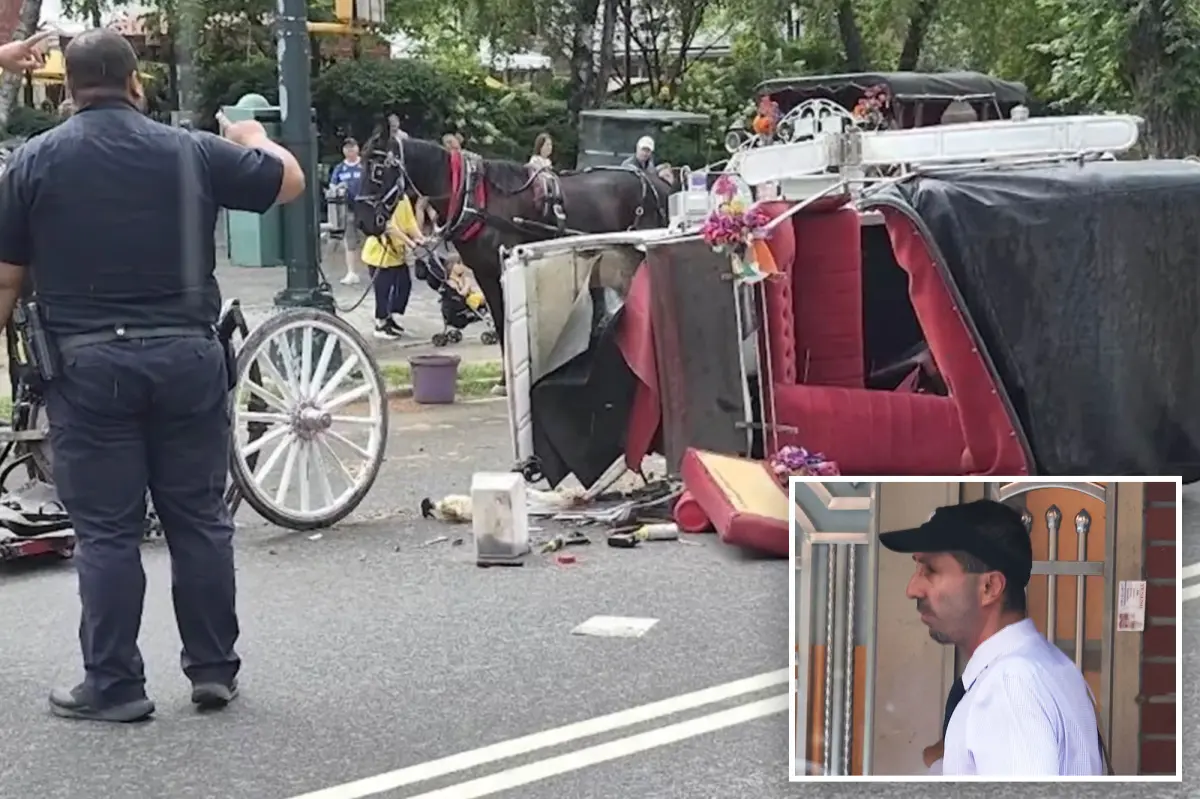
The promise of a dream vacation to New York City is a sentiment shared by millions of families worldwide, representing a triumphant moment of leisure, exploration, and the weaving of lifelong memories. For the Mahajan family, who had traveled from India to experience the iconic skyline and historic streets of Manhattan, this journey was meant to be a celebration of togetherness, culminating in one of the city’s most enduring and romanticized traditions: a leisurely horse-drawn carriage ride through the winding, emerald pathways of Central Park. Among them was eighteen-year-old Romanch Mahajan, a young man standing at the very threshold of adulthood, his life ahead of him full of vibrant potential and youthful ambition. As the family boarded the carriage on that fateful day, there was no premonition of danger, only the gentle creak of wooden wheels, the steady rhythm of hooves, and the anticipation of capturing a perfect moment in time against the backdrop of one of the world’s most famous urban sanctuaries. Yet, in a matter of seconds, this picturesque scene of familial warmth was violently shattered, transformed into a waking nightmare that would claim Romanch’s life and leave a family, an industry, and a city forever scarred by an unimaginable tragedy. The profound sorrow of this event transcends the headlines, reminding us of the fragility of human existence and how swiftly a treasured moment of joy can evaporate into a lifetime of grief.
Behind the reins of the carriage was Ertan Gokdepe, a twenty-year veteran of the Central Park horse-and-buggy industry, whose career had long been defined by vigilance, safety, and a deep appreciation for the tourists he guided daily. Gokdepe was not merely an operator; he was a fixture of the park’s cultural landscape, a man who had safely navigated these paths thousands of times without incident, earning a reputation as a reliable and dedicated professional. On this afternoon, wanting to provide his guests with a keepsake of their journey, Gokdepe made the fatal, split-second decision to step down from the carriage to take a photograph of the smiling family. In the delicate relationship between a carriage driver and their horse, physical presence is the anchor of control; the moment Gokdepe detached himself from the vehicle, that anchor was lost. Sampson, a seven-year-old draft horse of immense strength but sensitive temperament, became suddenly spooked by an unseen trigger in the bustling park environment. Finding himself unrestricted by the reassuring touch and voice of his handler, the animal’s primal flight instinct overrode his training, and he bolted forward with terrifying, uncontrollable velocity, dragging the carriage and its helpless occupants into a chaotic frenzy. For Gokdepe, who now stands emotionally ruined and “absolutely devastated” according to his union representative Christina Hansen, that single, well-intentioned gesture of hospitality became the catalyst for a lifetime of regret, proving that even a twenty-year record of flawless service can be undone in one devastating moment of lapsed protocol.
The ensuing moments of the runaway carriage were filled with a sheer, breathless terror that words can scarcely capture, as the heavy wooden vehicle jolted violently over the park’s paved trails. As Sampson galloped blindly, the sheer force of the motion threatened to capsize the carriage, hurling the passengers about and causing Romanch’s mother, Priya, to be violently thrown from her seat onto the hard ground. Sensing his mother’s mortal peril, Romanch did not hesitate; driven by an instinctive, fierce love and a desperate desire to protect her, the young man reached out, trying to shield her or anchor her to the carriage as it careened out of control. In this heroic, desperate struggle, Romanch lost his footing and fell heavily from the vehicle, his father Deepak later recalling the heartbreaking sound of his son’s final, desperate cry of “Mom!” echoing through the chaos. Though emergency responders rushed to the scene to provide aid, the physical toll of the fall was catastrophic, and the city medical examiner would later rule Romanch’s death as an accident caused by severe blunt force trauma. This clinical, sterile diagnosis stands in stark and painful contrast to the raw, visceral reality of a young life extinguished in an instant—a son who, in his final conscious moments, chose selflessness over self-preservation, leaving behind a grieving father to grapple with the haunting memory of his child’s final protective scream.
The shockwaves of Romanch’s death reverberated instantly through the tight-knit community of carriage drivers and the leadership of Transport Workers Union (TWU) Local 100, plunging the industry into an unprecedented crisis of conscience and operations. Union officials, who have spent decades defending the carriage trade against various political and animal-rights challenges, found themselves confronting a tragedy that defied defense or precedent. Alexander Kemp, a vice president of TWU Local 100, minced no words in his public assessment of the accident, stating unequivocally that a driver must never leave their carriage to take photos, and expressing the union’s full support for a rigorous and transparent investigation. In a dramatic and emotionally charged response to the incident, the union took the extraordinary step of shuttering all stables and halting carriage operations across Central Park, prioritizing a period of introspection and safety analysis over commerce. This self-imposed shutdown transformed the usually bustling blocks near the stables into places of somber quiet, as drivers and union leaders gathered in hushed tones to discuss what transpired and to ask themselves the difficult questions of how such a catastrophic failure occurred and what systemic changes must be implemented to ensure it never happens again. Christina Hansen summarized the collective bewilderment of the workforce, noting that they had entered “uncharted territory”—a dark realization that the romantic nostalgia of their trade had been permanently stained by a fatal safety failure.
This heartbreaking accident has also reignited the fierce, long-simmering debate regarding the presence of horse-drawn carriages in modern-day New York City, elevating it from a political talking point to a matter of life and death. For decades, animal welfare advocates and city reformers have argued that forcing large draft horses to navigate the congested, noisy, and unpredictable environments of Manhattan is inherently hazardous to both the animals and the public. Conversely, supporters of the carriage industry have championed the practice as a historic treasure, a livelihood for working-class families, and an essential element of the city’s tourism allure. The death of Romanch Mahajan has stripped away the abstract nature of these arguments, forcing both sides to confront the reality that when a horse-drawn carriage system fails, the consequences can be fatal. While union representatives stress that this was an isolated infraction by an otherwise exemplary driver, critics view the tragedy as a stark warning sign of the systemic dangers of allowing large, easily startled animals to operate in public spaces. As the city reflects on this loss, the conversation around the future of Central Park’s carriages has shifted from a question of municipal charm to a serious evaluation of public safety, regulatory oversight, and the ethical implications of maintaining nineteenth-century carriage traditions in a twenty-first-century metropolis.
Ultimately, when the news cycle moves on and the carriage wheels eventually begin to turn again in Central Park, the true, enduring weight of this tragedy will remain with the Mahajan family, who returned home to India with their lives permanently altered and an empty seat on their journey back. A mother’s life was spared, but it came at the ultimate cost of her son’s, leaving an agonizing void that no amount of time, investigation, or legal recourse can ever hope to fill. The image of the empty stables and the quieted park pathways serves as a temporary monument to Romanch’s courage—a young man who, when confronted with sudden and terrifying danger, did not retreat in fear, but reached out to save the mother who gave him life. As Ertan Gokdepe grapples with the crushing guilt of a single, well-meaning mistake that yielded a fatal outcome, and as the city’s leaders deliberate on safety policy, the legacy of this tragedy remains a deeply human one. It is a story of a family vacation that ended in unfathomable grief, of a young hero whose final act was one of pure love, and of a bustling city that, for a few quiet days, paused to mourn a young life lost too soon on the winding paths of its most famous park.