


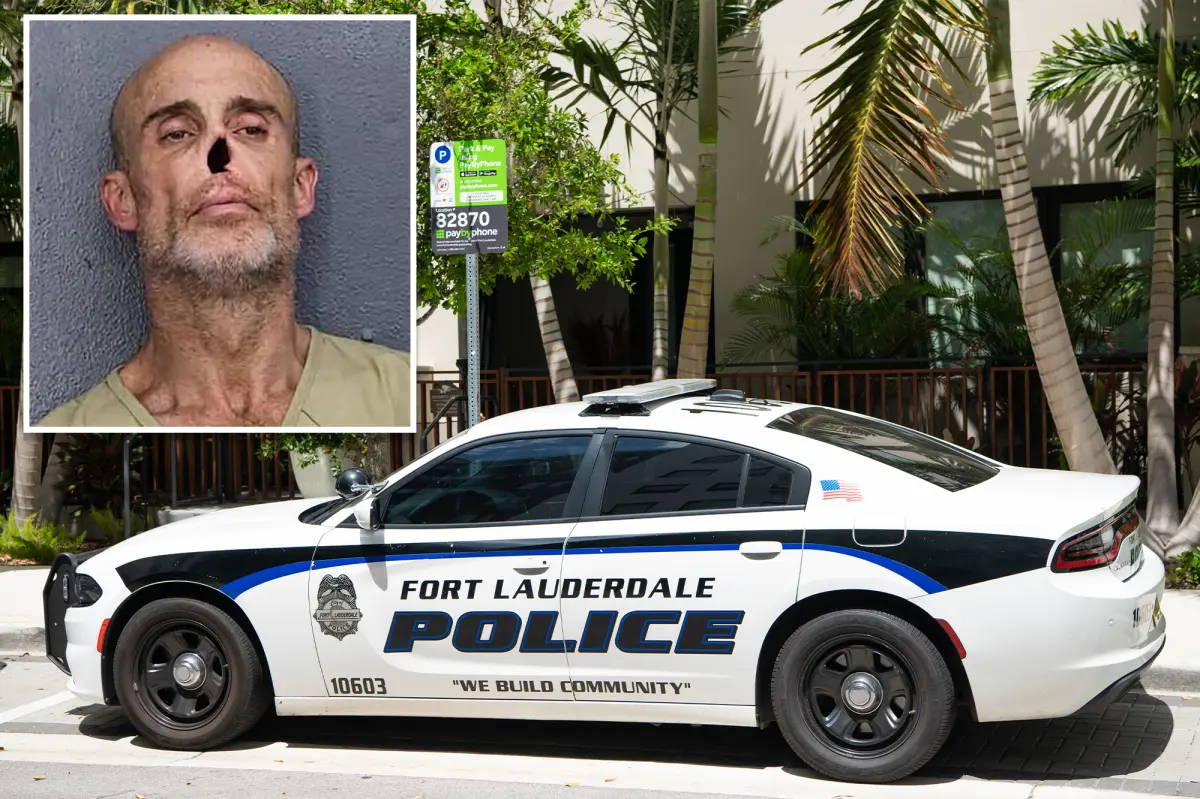
There is a moment in every arrest when a person stops being just a person and becomes a report, a photograph, a list of items found in a bag, and a set of charges read aloud in a courtroom. That moment arrived for Charles Wilson Pastore on September 3 in Fort Lauderdale, Florida. Pastore, 46, a Brooklyn native, was riding in a white Mercedes-Benz when the car was pulled over by police. What should have been a routine traffic stop quickly revealed something much heavier. Police brought in a K-9 unit, and the dog’s nose alerted officers to narcotics hidden inside the vehicle. The discoveries that followed included more than 17 grams of methamphetamine, three and a half grams of crack cocaine, a digital scale still carrying white powder residue, $3,515 in cash, a loaded semi-automatic handgun with its serial number shaved off, and a Florida driver’s license that appeared to be fake. For anyone reading the police report, it looks like the inventory of a life that had gone off course a long time ago. But the report cannot show the years before the traffic stop. It cannot show the roads that led Pastore traveled, the choices that shaped him, or the pain he might have been trying to escape or overcome. It can only tell you what was in the car that afternoon, and what the law says those objects mean. It is easy to read the list and make a quick judgment. It is harder to remember that behind every item was someone who lived, survived, made mistakes, and now has to face them in a public and humiliating way.
Fort Lauderdale Police said the K-9’s keen sense of smell led officers to narcotics that were not simply lying in open view but were hidden, the kind of concealment that suggests intent to sell rather than accidental forgetfulness. The backpack in the backseat told a fuller and more troubling story. The digital scale with white powder residue is the kind of tool used to weigh out individual portions. The $3,515 in cash was not pocket change; it was a stack of money large enough to suggest transactions. The loaded semi-automatic handgun with a shaved serial number was especially alarming because a gun with no traceable serial number is a gun that cannot be tied to its original owner, a weapon carried in a world where violence and drugs often go together. The phony Florida driver’s license added another layer. The possession of a false identification can suggest a life that has learned to avoid being seen too clearly. When the police wrote their affidavit, they were building a case that these were not just personal-use amounts found inside an ordinary vehicle. Investigators alleged that Pastore and the vehicle’s driver were working together and that the two men were acting together to traffic narcotics. That word, “traffic,” is a serious word. It turns a felony into a major case. It can mean the difference between being treated as someone who suffers from an addiction and being treated as someone who sells misery to others. Pastore now faces charges of methamphetamine trafficking, as well as possession of methamphetamine, possession of cocaine, and possession of drug paraphernalia. He did not have to wait long for freedom, but he did have to wait for a very high price. Bail was set at $37,000, and he posted it on September 8, five days after the arrest. No attorney information was immediately available. The driver’s fate remains less clear, but the legal system will decide what happens to him as well.
For many people who read about this case, the first detail that stands out is not the drugs or the gun or the cash. It is the way Pastore was described in the headline: a noseless Brooklyn man. It is a physical detail that turns an otherwise anonymous defendant into a curiosity. But it is also a detail that can make someone seem like a character in a dark story rather than a human being. What does it mean to live without a nose? The police report does not explain the cause. It might have been from an injury, an illness, a medical condition, or some other tragedy that has nothing to do with the arrest. We do not know. It would be unfair to invent a reason. What we can know is that his appearance has made him instantly recognizable in a way that many people never have to think about. Imagine walking through Brooklyn, the neighborhood where you grew up, with people staring or looking away, seeing a face that is unusual in a world that punishes difference. Imagine how many times he has had to answer questions he did not want to answer, or face jokes he could not escape. A person with visible scars or missing features carries a kind of public shame that other people can choose not to think about. That does not make him guilty or innocent, but it should make us pause before using his face as a punchline. A mugshot is not a biography. It is a single frame in a much longer film, stripped of context and full of judgment.
The arrest, the car, the drugs, the gun, the money, the fake license — all of it fits into a familiar pattern of urban crisis and personal collapse. Meth trafficking is not a victimless offense, and communities that struggle with addiction and violence are torn apart by the very things found in that Mercedes-Benz. If Pastore was involved in that world, he is not merely a victim. He has allegedly participated in a system that feeds on human weakness. But why did he get there? Most people do not wake up one morning and decide to become a criminal. They take small steps, and they fall into larger ones. Perhaps he struggled with substances himself, or perhaps he was desperate for money, or perhaps he was forced into a partnership with someone he trusted and feared. Perhaps no one ever offered him real help or gave him a reason to believe that his life could be different. The justice system sees the evidence, not the path. It does not ask about childhood traumas, untreated mental illness, or the absence of meaningful opportunity. It asks only whether he had the drugs, the weapon, and the scale. And according to the charges, the answer is that he did. The serious nature of the case deserves respect for that seriousness. Carrying a loaded gun with a scraped-off serial number can get someone killed. Selling meth and crack can destroy families. At the same time, punishing the poor and the broken without ever addressing the causes is like treating a wound without cleaning it. The infection will come back. Pastore’s case is not only his own. It is part of a larger web of policy failures, economic collapse with jobs and safety nets, and lives left without a real second chance.
There is a temptation to look at someone like Pastore and decide that he has wasted his life. At 46, he is old enough to know better and still young enough to change. He could have decades ahead of him if he survives them. He has already spent days in jail, but not a lifetime. He was released after making bail, and the sound of the cell door opening does not always mean that he is free. He will still face a court, a judge, the weight of the charges, and the outcome of the prosecution. If he is guilty, he should be held accountable. If he is innocent, he is still presumed innocent until proven. But whatever the legal result, this incident does not have to be the final sentence of his biography. People do change. People who have lived through addiction, violence, shame and terrible luck can also become people who reach out, ask for help, walk away from old friends, and build a quieter life. There will be people in his life who love him and who are not ready to give up on him. Even a man with no nose, a man with a record, a man accused of a crime, has a mother or father, maybe children, friends who still remember who he was before the troubles. They are watching the story now with fear and worry, not with online mockery. The law will not be able to love him, but the lives around them are not measured by the worst days. The public, if they are going to be honest, should be no less human.
And that is the hardest part of regard for daily news. The future for Pastore is unknown. There will be courtrooms, legal discussions, and maybe plea deals; or a trial; a conviction; or an appointment. The charges are not proven, and no defense has publicly been made. His lawyer, when he appears, may say they were in the back seat, that he was with the wrong person, that he didn’t know everything that’s in the bag, or that he is going to take responsibility and try to rebuild a life. The court process will uncover the truth. But the entire article, the arrest and the headlines, have already changed his life forever. He has been described as nose-less in the world’s eyes. He has been made into a public symbol. He may be addicted, or he may be suffering from chronic pain, or he may be mentally ill. He may not be any of these things. But the most human thing we can do is continue to look at him as a person. Not all stories end at the arrests. Many begin there. For Charles Wilson Pastore, September 3 could be the final day of his old life, or it could be the line between the self-destruction and the healing. That is up to the courts in part, and up to him in the end. What is not up to the courts are the things that matter more than any drug, cash or weapon: the worth of his own humanity, equal to that of anyone who passes this story by on their phone. He is no longer just a mugshot. He is a man with a future still unsettled, a face still living, a heart still beating. And no matter what he did or what he will do, the story is not over until he is gone.