



Here is a summarized and humanized account of the somber news, expanded into a reflective, six-paragraph narrative that captures the weight of the moment and the legacy of the late monarch.
—
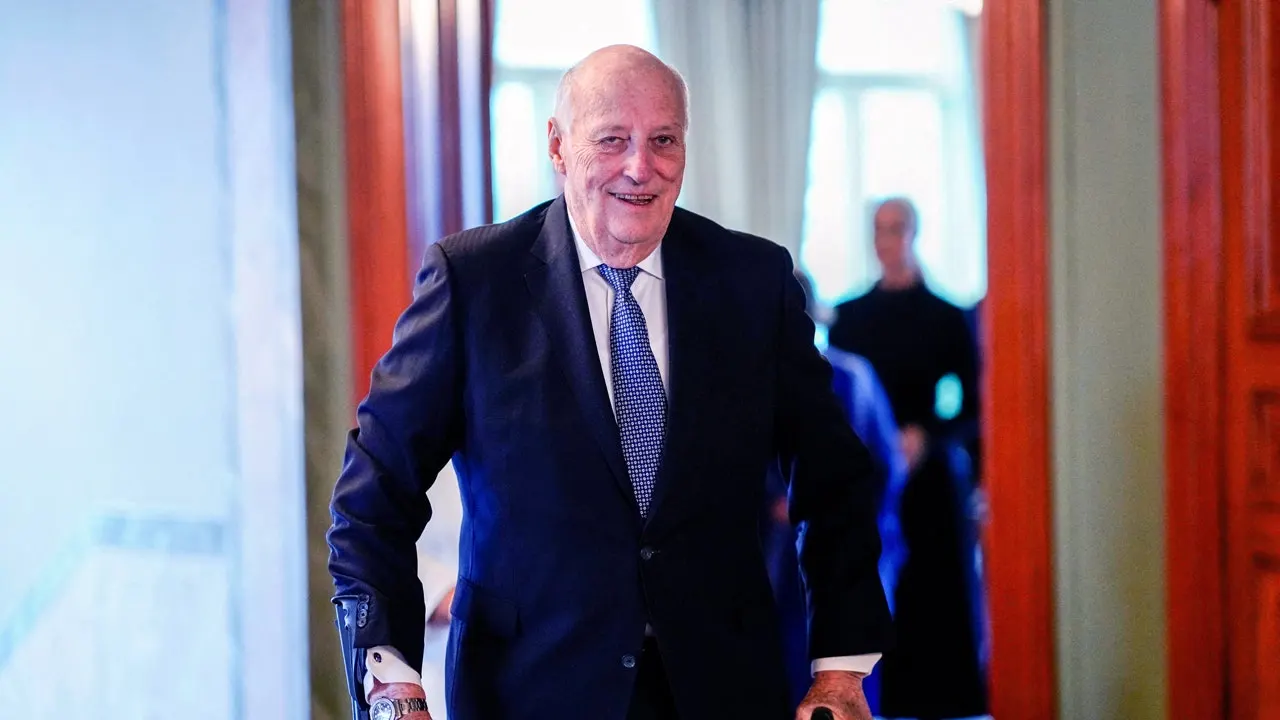
The first light of dawn had barely touched the rooftops of Oslo when a profound silence fell over the Norwegian capital. At 6:35 AM on Friday, August 28th, the heart of the nation’s monarchy quietly stopped beating. King Harald V, the sovereign who had guided Norway through the final decade of the 20th century and well into the 21st, passed away peacefully at Oslo University Hospital, Rikshospitalet, surrounded by the quiet dignity that had characterized his entire public life. The formal announcement, issued by the Royal House of Norway, carried a weight of finality that sent a shockwave across the country: “It is with deep grief that we announce that His Majesty King Harald has passed away.” For a people who had grown up seeing his gentle smile on postage stamps, school walls, and national celebrations, the news felt less like a political event and more like the loss of a beloved family elder. Outside the hospital gates, and later at the Royal Palace, mourners began to gather instinctively, clutching bouquets of roses and lighting candles against the cool August air. Flags across the kingdom—from the fjord-side villages to the Arctic outposts of Svalbard—were lowered to half-mast, signaling a nation in mourning. Prime Minister Jonas Gahr Støre addressed the nation within the hour, his voice trembling with emotion as he described Harald as a “unifying force” and a “man of the people.” The peaceful nature of his passing offered a thin silver lining to the immense grief; he had not suffered, he had not struggled. He had simply slipped away, leaving behind a legacy etched in the collective memory of a people who had come to affectionately call him “Kongen”—The King.
Harald’s story was one of profound historical weight, beginning long before he took the throne. Born on February 21, 1937, at Skaugum, the royal residence outside Oslo, he was the first Norwegian prince born in the country in 567 years. His childhood, however, was shattered by World War II. When the Germans invaded Norway in 1940, the three-year-old prince was forced into exile with his mother, Crown Princess Märtha, and his siblings, fleeing to safety in the United States. This formative experience of displacement and resistance instilled in him a deep, lifelong understanding of the fragility of peace and the resilience of the Norwegian spirit. He returned to Norway after the war, attending Oslo Cathedral School and later the University of Oslo, where he studied economics and political science. He also dedicated himself to military training, becoming a capable officer and a skilled sailor—a passion he would carry throughout his life. When his father, King Olav V, passed away in January 1991, Harald assumed the throne at the age of 54. His reign was defined by a quiet, undemonstrative steadiness. He took his constitutional duties seriously, giving royal assent to laws and serving as a symbol of national unity. He oversaw Norway’s transformation into a modern, thriving petroleum economy while retaining a profound respect for its agricultural, maritime, and cultural roots. He made it his mission to be a king for all Norwegians, regardless of their political leanings or backgrounds, embodying the egalitarian spirit of a society that prized modesty and solidarity.
Perhaps the most humanizing aspect of King Harald’s life was his enduring love story, which proved that beneath the crown lay the heart of a romantic and stubborn man. In the 1950s, he fell deeply in love with a commoner, Sonja Haraldsen. The romance sparked a constitutional crisis, as the Norwegian constitution mandated that the king choose a bride from a royal family. For nine long years, Harald refused to marry anyone else, risking his right to the throne. Finally, in 1968, his father relented, and Harald married his beloved Sonja, a decision that fundamentally modernized the Norwegian monarchy and endeared him to the public as a man of deep personal conviction. Their marriage was a partnership of equals, which stood as a testament to the power of love over tradition. Beyond his role as a constitutional monarch, Harald was a passionate athlete, representing Norway in sailing at the 1964, 1968, and 1972 Olympic Games. In his later years, he faced a series of serious health challenges that laid bare his vulnerability to the nation. He underwent heart bypass surgery in 2005, a heart valve replacement in 2020, and several hospitalizations for infections in the years that followed. Each time he recovered, returning to his duties with a stubborn resilience that mirrored the stoic character of his people. He spoke openly about his aging and his health, displaying a refreshing honesty that demystified the crown. He joked about his walking stick and his hearing aids, often connecting with ordinary Norwegians through his self-deprecating humor, and he always made time to talk to the children who waited to greet him.
Now, the immense weight of the crown rests on the shoulders of Crown Prince Haakon, who at 53 years old, ascends the throne as King Haakon VIII. Haakon has spent his entire adult life preparing for this moment, shadowing his father through official engagements, state visits, and cabinet meetings. Yet, Haakon assumes the throne in a vastly different world than his father did. In 1991, Norway was emerging from a period of economic uncertainty; today, it is a highly developed, globally influential nation. Haakon, born in 1973, is a product of progressive Scandinavian values. He studied political science at the University of California, Berkeley, and later at the London School of Economics. His marriage to Mette-Marit Tjessem Høiby in 2001 was another landmark moment for the monarchy, as she was a single mother, and her background initially drew intense media scrutiny. Their love story, though controversial at the time, demonstrated yet again the monarchy’s capacity to adapt and embrace modern social realities. Haakon is known for his advocacy on issues such as climate change, sustainable development, and the rights of young people, and he has spoken movingly about the mental health crisis affecting Norwegian youth. He carries a more casual, approachable air, often seen in jeans and sneakers at cultural events. While he undoubtedly reveres his father’s legacy, Haakon will likely shape the monarchy to reflect his own generation’s sensitivities. The immediate successor, Princess Ingrid Alexandra, 21, stands next in line, representing the future of a dynasty that continues to evolve. As Haakon steps into the role of sovereign, he faces the challenge of maintaining the deep public affection his father cultivated while navigating a more fragmented, media-savvy, and politically complex landscape.
The formal period of national mourning has already begun, blending ancient royal protocol with deeply personal public sentiment. Across Norway, centers for civic life have become places of pilgrimage. At the Royal Palace in Oslo, the daily changing of the guard has taken on a somber, ceremonial gravity, with thousands lining the streets to pay their respects. The government has begun preparations for a state funeral, an event of immense significance that will draw heads of state from around the world. The funeral will be a complex choreography of military honors, religious services, and public processions, culminating in a burial alongside his predecessors at Akershus Fortress. Yet, beyond the pomp, the true measure of Harald’s legacy lies in the simple, profound bond he forged with his people. In a country that prides itself on egalitarianism and informality, Harald managed to be both a constitutional monarch and a relatable neighbor. He famously used public transport on several occasions, shocking chauffeurs and delighting commuters. He attended local sporting events incognito, cheering alongside the masses. His speeches on national crises—from the Utøya massacre in 2011 to the COVID-19 pandemic—were masterclasses in empathy and unity. When he addressed the nation after Utøya, he said, “We are a small country, but we are a proud people. We have the right to be angry, but we also have the duty to be strong.” This ability to articulate the collective heart of the nation made him irreplaceable, and the flags at half-mast are not just a symbol of protocol; they are a physical manifestation of a national heartbreak.
There is a profound human poignancy in the image of a king dying peacefully in a hospital bed just after dawn. It strips away the regalia, the crown, and the sceptre, leaving only a man who lived a long and purposeful life. For Harald, death was not an enemy to be feared but a natural conclusion to a rich journey, and his final hours, reportedly calm and painless, reflect a life concluded with grace. For the Norwegian people, the dawn of August 28th will forever be etched in their memories as the moment the country lost its patriarch. The days ahead will be filled with cascading flowers, candlelit vigils, and heartfelt eulogies. Yet, as the nation mourns, life will inevitably march forward. King Haakon VIII will be proclaimed from the balcony of the Royal Palace to the cheers of the assembled crowd, a tradition that underscores the continuity of the state. The transition will not erase the ache of loss; it will, however, provide a structure for moving forward. Harald’s legacy will live on not just in the constitution, but in the very DNA of the nation itself. He taught Norwegians that leadership is not about exerting power but about embodying resilience, compassion, and unity. As the sun sets on this era, a new one begins. The echo of his voice, the memory of his handshake, and the warmth of his character will persist in the soul of Norway, a gentle conclusion to a story written in service, love, and unwavering duty.