



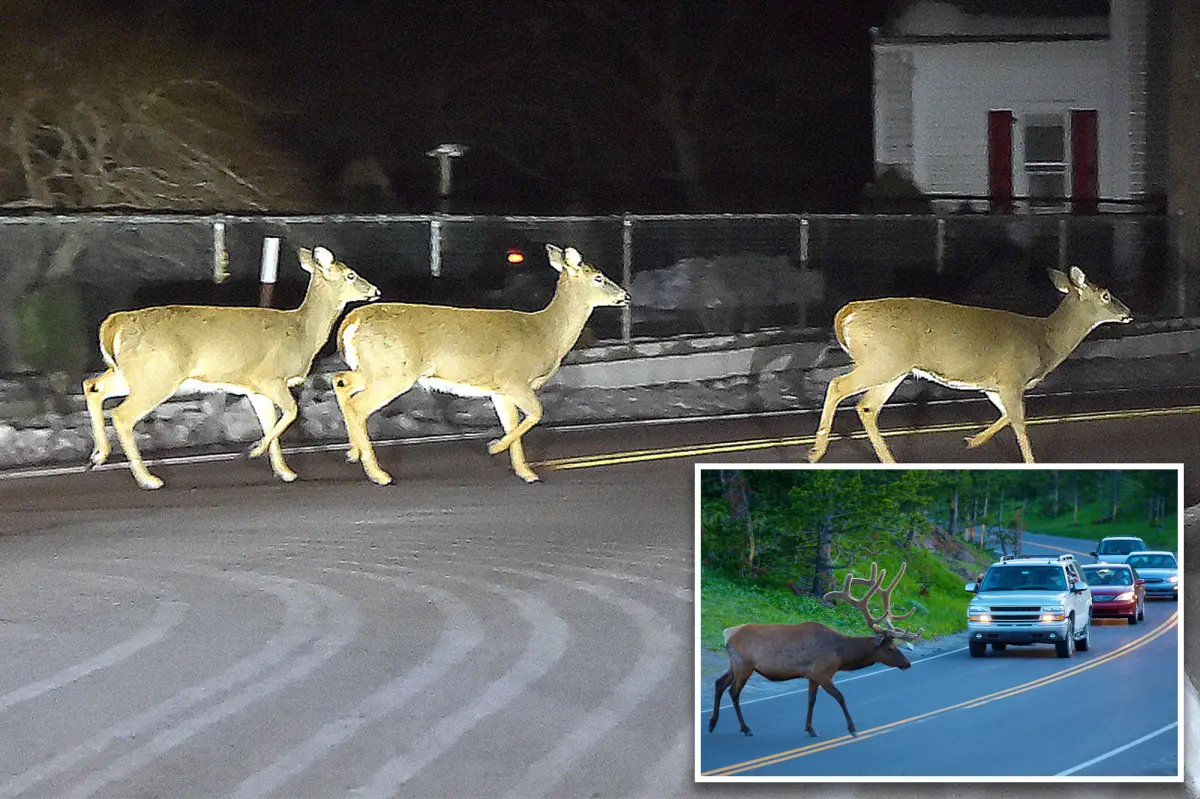
They’re hard to miss. You’re driving home after a long day, maybe thinking about dinner, replaying a conversation, or just counting the minutes until you’re off the road. Then, out of nowhere, a pair of glowing eyes appears in your headlights. A deer is standing in the middle of the lane, frozen, staring at you as if it has never seen a car before. You slam on the brakes, your heart pounds, and you wonder if you’ll stop in time. Maybe you’ve already seen the signs, literally: yellow diamond-shaped warnings showing a leaping deer, posted along highways and rural routes. They are easy to ignore when the sun is high and the roads are clear, but in October and November, that leaping deer might actually be ahead of you. That scene is playing out across New Jersey right now, and state officials are urging everyone to take it seriously. The Department of Environmental Protection issued a warning on Friday: commuters should be wary of an increased number of horny deer as mating season kicks into full swing. Yes, horny deer. That’s the official phrase, sort of, and it’s hard to miss either. The agency explained that motorists should expect more white-tailed deer activity in the morning and evening on roadways “as bucks attempt to court does” during this prime season. Known as the fall rut, the peak mating time for deer in the Garden State continues from mid-to-late October through the middle of December. During these weeks, deer aren’t just wandering; they are focused on romance, and that makes them impulsive and unpredictable. They cross roads without warning, chase each other through traffic, and seem to appear out of thin air. For drivers, this is a serious safety threat. Collisions with deer can damage vehicles, cause injuries, and even take lives. “Collisions with deer pose a very serious safety threat and can cause significant damage to vehicles and possible loss of life,” said Dave Golden, assistant commissioner for NJDEP Fish & Wildlife. “It’s especially important that drivers be extra vigilant to this threat and take time to know steps that can be taken to reduce the risk of collision.” The warning might make people chuckle, especially the thought of love-crazed deer causing everyday chaos, but the message is deadly serious. In New Jersey, where deer are common in every county, the risk touches everyone, from city drivers cruising through leafy suburbs to rural residents on two-lane roads.
So what exactly is the fall rut? It’s the breeding season for white-tailed deer, and it fundamentally changes how these animals behave. During most of the year, white-tailed deer are cautious, quiet, and routine-driven. They follow familiar trails, feed at particular times, and avoid open spaces where they might feel exposed. But when the rut arrives, everything shifts. Bucks are flooded with hormones and driven by an instinct to find and mate with does. They become more aggressive, less cautious, and constantly on the move. They forget to eat, lose weight, and roam far beyond their normal territories. Does, for their part, are also moving more, either to keep ahead of suitors or to search for the best place to raise future young. Young bucks, full of energy and inexperience, sometimes wander into roads they’ve never crossed before. The result is a dramatic surge in deer activity, particularly at dawn and dusk. These low-light hours are exactly when human commuters are heading to work or returning home. It’s a collision of two worlds: a wild animal’s most urgent survival ritual and a busy society’s daily commute. The state’s warning emphasizes this overlap. It’s not just that deer are around; it’s that they’re around at the precise times and places where cars are moving fastest. That’s what makes the fall rut so dangerous. Dave Golden’s warning is more than just a quote; it’s a reminder that this is not a mild inconvenience. At highway speeds, hitting a deer can feel like hitting a wall. Even slower collisions can cause serious damage, with deer flying through windshields in the worst-case scenarios. Both people and animals suffer, and the experience is terrifying for everyone involved. For all the humor attached to the phrase “horny deer,” there is nothing funny about standing on a dark road, waiting for emergency services, looking at the wreckage of an otherwise ordinary evening. Maybe that’s why officials are speaking up now, before the worst of the season arrives, hoping that a little awareness will prevent a lot of pain.
One of the biggest reasons this warning comes with extra urgency is the calendar. Daylight saving time ends on November 1, and that simple shift changes everything about the commute. After the clocks fall back, darkness arrives earlier in the evening, and the morning commute often begins in dim twilight or pitch-black conditions. That means more drivers are on the road during the exact periods when bucks are doing their most reckless romantic roaming. The department specifically warned that visibility issues, combined with peak periods of deer mating activity, can significantly increase the risk of car collisions. It’s a one-two punch: deer are more active, and humans are less able to see them. Even in the best light, a deer can appear suddenly from behind trees, shrubs, or a roadside embankment. In the dark, it’s almost impossible to predict. Drivers who are tired, distracted by their phones, or just trying to get home quickly have very little time to react. The phrase “raunchy activity” might make people laugh, and yes, it’s a little absurd to picture love-struck deer causing traffic backups. But the numbers behind the warning are no joke. In New Jersey alone, an estimated 25,000 car accidents involving deer occur every year, according to the New Jersey Conservation Foundation. That’s an average of nearly 70 crashes per day, every single day, not just during the rut. Imagine that: somewhere in the state, at any given hour, a driver is dealing with a deer-related crash. New York faces the same challenge. The New York State Department of Transportation estimates 60,000 to 70,000 accidents are caused by deer each year in New York State. To address the problem, the agency recently launched a new ad campaign, reminding drivers that deer don’t respect traffic rules and that a moment of distraction can lead to tragedy. With both states dealing with such staggering numbers, the need for public awareness has never been clearer.
Why are there so many deer in New Jersey? It’s a question that many drivers might ask after narrowly avoiding a collision. The white-tailed deer population in the state has reached problematic numbers, particularly in suburban areas. According to Gothamist, an estimated 100,000 deer are currently roaming throughout New Jersey. That’s a remarkable number for such a densely populated state, and it explains why deer sightings are so common. The reason is a combination of factors. Over the past several decades, suburban development expanded into forests and farmland, creating a patchwork of habitats. Deer thrived in these areas, finding abundant food in people’s gardens, landscaped yards, and roadside plantings. At the same time, natural predators like wolves and mountain lions have been largely eliminated from the region. With fewer threats and plenty of resources, the deer population grew unchecked. In many neighborhoods, deer are now as common as squirrels, and they’ve become a familiar, almost accepted part of life. But their large numbers bring real problems. Beyond the risk of car accidents, deer cause significant ecological damage. They eat native plants and tree seedlings, interfering with forest regeneration. They damage agricultural crops and ornamental gardens. They also serve as hosts for ticks, contributing to the spread of Lyme disease and other tick-borne illnesses. For communities, the challenges are complex. There are no simple solutions, and any discussion of population management raises emotional debates. But the immediate concern for state officials is public safety. During the fall rut, the risk of a serious accident is at its highest, and the most effective way to prevent harm is to remind drivers to be prepared. The recent ad campaigns and warnings are designed to do just that, not as a criticism of deer, but as a call for shared responsibility between humans and wildlife. After all, the deer were here first; we just happen to be sharing the road with them now.
So what can drivers actually do to stay safe? The Department of Environmental Protection has a few key pieces of advice, and they’re worth taking seriously. First, slow down. This is the simplest and most effective thing you can do. Speed gives you less time to react, longer stopping distances, and more severe impacts. If conditions are dark, foggy, or rainy, slow down even more. Second, watch for “Deer Crossing” signs. Those signs are placed at locations where deer activity has been documented. They are not there to decorate the roadside; they’re there to save lives. When you see one, take your foot off the accelerator, scan both sides of the road, and prepare to stop. Third, use your high beams whenever it’s legal and safe to do so. High beams illuminate the eyes of deer at a much greater distance, giving you vital extra seconds to react. Just remember to dim them when approaching other vehicles. Also, be aware that deer whistles and other gadgets often don’t work as promised. The best tool is your own attention. Keep your eyes moving, check the sides of the road, and don’t let a phone conversation or a favorite podcast distract you. If you see a deer in the road, brake firmly and stay in your lane. Swerving can cause you to lose control or collide with another vehicle, which is often far more dangerous than hitting the deer. Honk your horn in a long burst; the sound may scare the deer away. And if you see one deer, always expect more. They rarely travel alone, and the first one to cross is often followed by others. Be especially careful on roads near woods, water, and open fields, because those are natural deer corridors. If a collision does happen, try to move your vehicle to a safe location, turn on hazard lights, and call authorities. Don’t approach injured deer; they can be frightened and dangerous. Stay in your car if possible, especially on busy roads. It may not be the most exciting advice, but it’s the kind that can save a life.
There is something strangely poetic about the fall rut. The leaves turn red and gold, the air carries a crisp chill, and the forests echo with the rustle of creatures preparing for winter. Deer, full of ancient instinct, begin their seasonal dance of courtship. It’s beautiful, in a wild and unscripted way. But for drivers, it’s also a time to be especially careful. The NJDEP’s warning is more than a bureaucratic headline; it’s a gentle but urgent reminder that love is in the air, and love can make animals—and people—do silly, unpredictable things. It’s easy to read a story about “horny deer” and smile. The image of a love-struck buck wandering onto a highway is almost comical. Yet the reality is much harsher. Every year, thousands of families experience the aftermath of a deer collision. Some are lucky, walking away with only a dented fender and a racing heart. Others face hospital visits, insurance nightmares, and grief. No one wants to be a statistic. So, this season, let’s honor the warning the best way we can: with patience and awareness. Drive a little slower, especially in the early morning and after sunset. Put down your phone, even if it’s just for a few minutes. Watch for those glowing eyes at the edge of the road. Remind your loved ones to give themselves extra time. Maybe it feels like unnecessary advice, but it can change everything. And as you navigate the roads, try to remember that the deer are not the enemy. They’re just wild animals trying to survive, to find a mate, and to continue their line in a world that has changed fast around them. We share this land, and the autumn months are when that shared landscape becomes most apparent. So let’s look out for each other, on both sides of the windshield. Stay alert, stay calm, and stay safe. New Jersey, the deer are definitely in the mood, and that means all of us need to be on our toes.