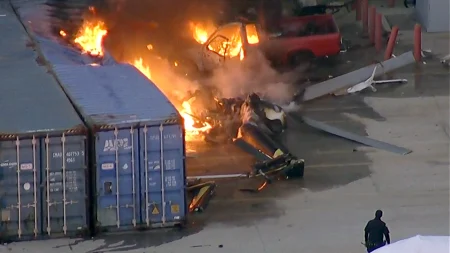



The brief dispatch—just two sentences from a breaking news moment—announces that NBC4 Los Angeles identified a helicopter as belonging to their station, while authorities have yet to confirm how many people were on board. From those scant details, a human story unfolds, one that is not yet written but already felt. This is the moment before clarity, the anxious space where families, colleagues, and viewers hold their breath. We do not know if this is a routine mishap or a tragedy, a hard landing or a catastrophic failure. What we do know is that a helicopter bearing the logo of a trusted local news station has become the center of an urgent, public wait. The words themselves are clinical, but behind them are the trembling hands of a news director pacing the floor, the silent prayers of friends who saw the flight tracker go dark, and the collective hope of a city that has learned to depend on those familiar aircraft humming above its freeways. To humanize this content is to acknowledge that every breaking news alert carries a human weight far heavier than the pixels on a screen.
The helicopter belongs to NBC4 Los Angeles—but the verb “belong” is a cold comfort, for it also belongs to a crew who climbed aboard with coffee cups and flight checklists, perhaps joking about the morning traffic or the haze over the hills. They are the unseen strangers we watch through telephoto lenses, the voices that crackle through scanners, the people who bring us the chaos of fires, the drama of police chases, and the quiet dignity of community parades. In the newsroom, their desks sit empty, monitors still showing their last assigned story. A producer in the assignment desk clutches a phone, trying every number, while the anchor who introduced their live shot hours ago now stares at the silence. The unknowable number of people aboard is the cruelest detail of all; it turns a headline into a warehouse of possibilities. Is it the pilot with twenty years of experience, the reporter who just bought a house, the photographer with a child’s drawing taped to the back of his camera? We cannot know yet, and so we imagine them all—because to imagine is to prepare our hearts for the worst, even while our minds beg for the best.
News helicopters are not glamorous machines; they are ornery, loud, and often leased on tight budgets, but they are also the eyes of the city. They hover through smoke, dodge wires, and brave rotor-wash turbulence so that viewers can turn on the evening news and understand where the danger is, where the help is, and where the story is. The crew who flies these birds do not think of themselves as daredevils; they think of themselves as civilians doing a job, but their job insists on gravity-defying courage. Every takeoff is a bet against physics, every landing a negotiation with wind and steel. When the authorities remain silent about the number aboard, the silence becomes a bell jar over the community. It is the same silence that follows a canceled flight, a delayed text, a voicemail that goes straight to the machine. The public’s relationship with these helicopters is intimate—we curse their noise during a quiet afternoon, yet we rely on their shadows during a wildfire. Now, that shadow has vanished from the sky, and the absence feels like a missing tooth in the grin of the city.
As the minutes stretch into an hour, the community begins to respond in ways both digital and physical. The station’s phone lines are lit up with callers wanting to help, offering spare bedrooms, blood donations, or simply prayers. On social media, a hashtag emerges—fumbling, uncertain, wary—#NBC4Wait. Strangers share memories of seeing the helicopter at airshows, or the time it helped find a lost grandmother. A retired firefighter posts about the physics of autorotation, explaining how skilled pilots can glide even with an engine failure, giving anxious readers the vocabulary of hope. Meanwhile, reporters from competing stations stand in front of the same building, their own faces pale, because they know the crew better than anyone. They trade rumors with nervous laughter, then go silent when a manager steps out with a phone pressed to an ear. In this gray zone of unconfirmed truth, the human instinct to organize emerges—families gather in living rooms, office breakrooms become prayer chapels, and children ask if the TV people will be okay. The authorities’ official silence is not negligence but protocol; every word they release could risk the integrity of a rescue operation or a recovery. Yet for those waiting, protocol is a punishment, and every unanswered ring is a decade of pain.
The reporters and photographers on that helicopter are not just employees; they are the memory-keepers of our culture. Through their lenses, we have seen the city celebrate championships and mourn mass tragedies. They have filmed the first responders who might now be rushing toward their own crash site. This is the bitter symmetry of journalism—the reporters who cover the story become the story, and the audience who watched them becomes the witness. As the afternoon light bends into dusk, the facts remain stubbornly few. No number, no condition, no name. Newsroom veterans will later say that these are the hardest hours of their careers, not because of the work, but because the work is stuck in neutral while the engine of dread idles. A young intern, tasked with refreshing the fax machine and checking the scanner, finds herself crying in the supply closet for people she met only last week. The pilot who always ate a tuna sandwich before a flight. The reporter who hummed off-key during live commercial breaks. The photographer who carried a lucky dime in his boot. They are not yet absent, but they are not yet present, and so they exist in a purgatory of uncertain care, held aloft by nothing but hope.
In the end, this two-sentence alert is a tiny door into a vast cathedral of human emotion. We do not yet know the final chapter—whether the crew will walk away with scrapes and a story, or whether something sacred will be lost to the sky. But the briefness of the content reminds us that all news, at its root, is about people: fragile, mortal, and interconnected. NBC4 Los Angeles said the helicopter belonged to the station. That sentence is an ownership claim, but the true ownership lies with the public that has watched and trusted and depended on those flying journalists. And the unchased number of people aboard? That number is every loved one, every colleague, every viewer who has ever looked up at a helicopter and wondered, not about its technology, but about the faces inside. Until the authorities speak, the city holds its breath, and that held breath is the most human thing of all. We wait, not as consumers of a news product, but as neighbors. And when the news finally breaks—whatever it is—the wait will en it, but the hum of that helicopter will remain in our minds, a reminder that every life is a story worth covering, and every story is a life worth grieving, or gladdening, or both.