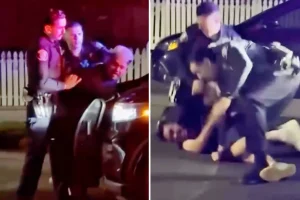


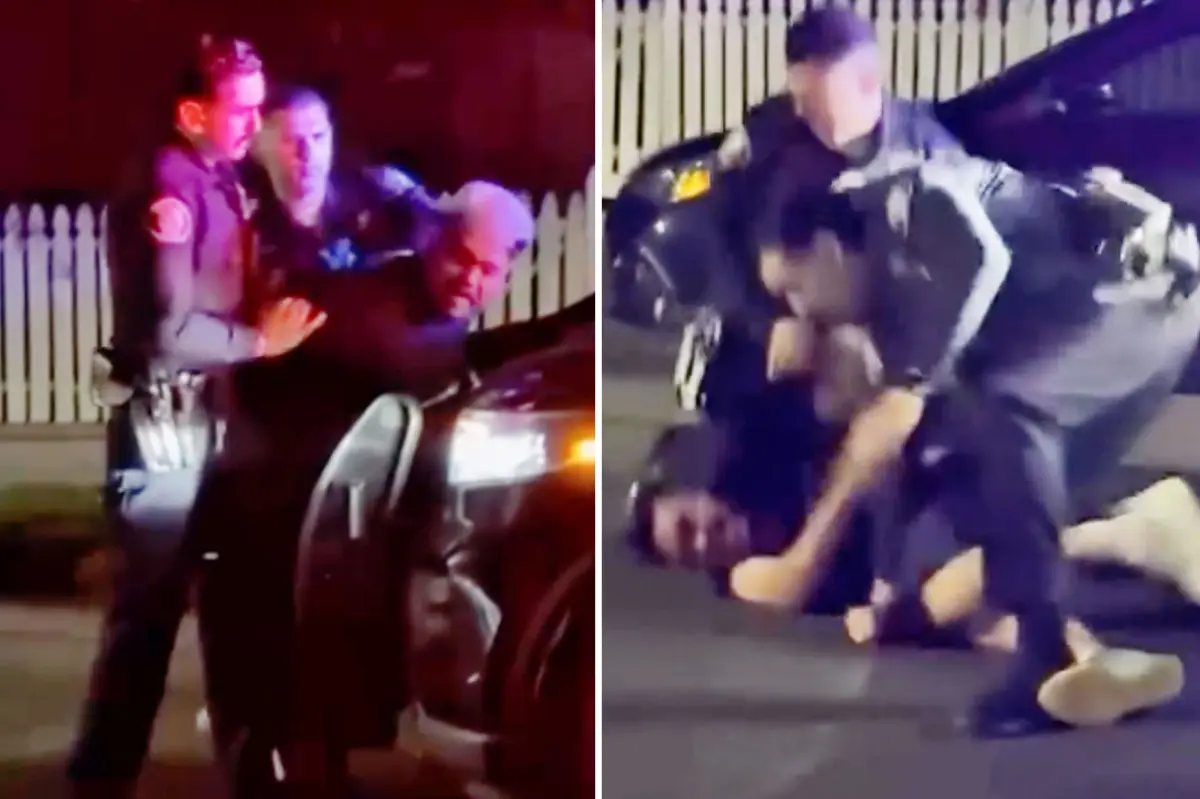
There is a moment in the Santa Ana police video that is hard to watch without feeling your stomach tighten. A man stands hunched against a police vehicle, his hands not yet cuffed, his words flying at the officers in front of him. Then one officer reaches out, pulls him to the ground, and punches him. A second officer strikes him too. The man is Florentino Lopez, a 28-year-old who, according to his attorney John Kremer, is a felon on probation and therefore subject to search and seizure. Those are legal facts, but they do not fully define what appears on screen. What we see is a human being being subdued with sudden, repeated violence. The footage begins in the middle of an exchange—words have been spoken back and forth—but no physical violence or resistance by Lopez has been shown in the video. Police officers are granted enormous authority, and with that authority comes the responsibility to use force only when necessary. The viral nature of this video reflects something more than morbid curiosity. It reflects concern, anger, and fear. This could be a brother, a son, a neighbor. Every person watching knows that an arrest can be stressful and that officers must make split-second decisions. But the sight of a man who is already leaning against a vehicle, seemingly standing there while officers talk, being yanked down and punched makes us question why the situation escalated so violently. Santa Ana police have not yet released all body-worn camera footage or explained what happened before the cellphone recording began. That missing context matters. Yet even without it, the video has opened a wound. The public wants to believe that law enforcement officers protect and serve, not that they use their fists in a street arrest when other options remain. For now, the image of Florentino Lopez being punched on the ground stands at the center of a difficult conversation about justice, power, and the value of every life.
According to Kremer, the encounter did not begin with a call about a violent crime or a dangerous situation. Lopez and a relative were smoking marijuana on their front lawn—a choice that, while legally complicated in California, is hardly the stuff of a police action scene. A police car drove by. The officers slowed down and motioned for Lopez to approach them in the street. He did. He complied, Kremer said. That image matters: a man walking from his own front lawn to speak with police, not running, not hiding, not fighting. Then, at some point, the conversation soured. Words were exchanged between the two officers and Lopez, but according to the attorney, there was no physical violence or resistance. It is possible that Lopez, frustrated by being singled out, used harsh language or raised his voice. People do that every day, sometimes with police, sometimes with strangers. Being rude is not a crime. Being a felon on probation can make a person a target, however, and Lopez was legally subject to search and seizure because of his status. That means officers had broader authority over him than over the average citizen. But legal authority to search does not equal a license to punch. The front lawn where Lopez had been moments before is a place where people should feel safe. The video, though, transforms it into a stage for a violent arrest. We might wonder what was going through Lopez’s mind as the officers motioned for him: Did he feel he had no choice? Did he know he was recognized? Did he think that cooperating would make things easier? The attorney’s account suggests he did exactly what was asked of him, and still ended up on the ground. That disconnect between compliance and punishment is why this story resonates. It reminds us that an ordinary afternoon can turn dangerous when the person being confronted has a criminal record and the officer has a quick trigger. Humanizing this moment means understanding that Lopez is not just a case number or a police report. He is someone with a history, with flaws, with a family who watched the video and felt their hearts drop.
Now Lopez finds himself charged with felony and misdemeanor counts of resisting an officer, along with accusations of walking in the roadway and using marijuana on school or daycare property. To his attorney, the charges are an attempt to justify what happened. Kremer believes the case should be thrown out, and many people watching the video might agree. Resisting arrest is a serious charge, but it is hard to prove when the video appears to show no physical struggle before the officer pulls Lopez to the ground. The other charges feel almost like footnotes, attempts to build a record around the central, painful image of a man being punched. The marijuana use, in a state where cannabis is legal for adults with certain restrictions, seems particularly minor. The school or daycare property allegation adds another layer, but it is worth remembering that Lopez was on his own front lawn, a place that can legally be near such facilities. Walking in the roadway is a minor infraction at most. Meanwhile, Lopez remained behind bars from Thursday, October 1, until his court appearance on Monday, when a judge set bail at $20,000. For many people, that would be an enormous sum, an amount that could keep a person locked up simply because he cannot afford freedom. Even if the charges are eventually dismissed, the time spent in jail is time that cannot be reclaimed. The system has already punished him, regardless of guilt or innocence. This is the human reality behind legal headlines: a man’s life disrupted, his liberty taken away, his face bruised or worse, his future uncertain. His attorney insists he complied. The video does not show him striking an officer or lunging. And yet he is the one facing prison time, while the officers involved remain on duty pending review. That imbalance weighs heavily on anyone who believes in fairness. We do not know every detail, and the investigation may reveal things that complicate the story. But the burden should be on the state to prove that this level of force was necessary, not on a frightened man to prove his innocence after being beaten in the street.
The official response has been cautious. Santa Ana Police Chief Robert Rodriguez said the department is conducting a thorough review of the incident, including body-worn camera footage, reports, and the circumstances surrounding the arrest. Natalie Garcia, a public information officer, added that as with all use-of-force incidents, the department takes these matters seriously and will let the facts guide review and conclusions. Mayor Valerie Amezcua said she will continue looking into the incident. These are the expected words from public officials, but for a community that has just watched a video of police punches, words are not enough. People want to see the body camera footage. They want to know who made the decision to use force, and why. They want to understand whether the officers involved have a history of complaints or excessive force. They want to know what training was available to them and why it was not used. The mayor’s promise to keep looking into the incident is reassuring only if it leads to real transparency. The department’s promise to let the facts guide the review is meaningful only if the facts are shared openly with the public. There is a trust deficit that cannot be healed with a press release. It is healed with actions, with accountability, with policies that prioritize de-escalation and protect human life. Every time such a video goes viral, the same patterns emerge: an arrest, a punch, a lawsuit, a settlement, a policy change. But for the person in the video, the damage is permanent. The family relives it. The community loses faith. The officers themselves may face discipline or trauma. We should not rush to judge the officers without all the facts, but we should also not rush to excuse them. The review must be independent enough to matter, thorough enough to reveal the truth, and transparent enough to satisfy a shaken public. Until then, the people of Santa Ana, and the country watching from afar, are left with a video and a question: Why did this happen, and what can be done to make sure it doesn’t happen again?
Beyond the legal arguments and official investigations, this video touches something deeper. It is about what it means to be a human being in a society where some people are considered disposable. Florentino Lopez has a felony record. He was on probation. He was smoking marijuana. None of these things make him a good person or a bad person; they simply make him human. But labels like “felon” can drain away empathy. When we see someone and think “criminal,” we may be less likely to question the violence used against them. Yet every person, regardless of their past, retains a basic right to be safe in their own body. That right does not disappear when an arrest happens. Officers are human too. They carry tension, fear, and pressure. Their job is difficult, and they often face people who are uncooperative, angry, or under the influence. We should not pretend that policing is easy or that every use of force is automatically wrong. But the video shows something that looks troubling: a man on the ground being punched, not in a moment of mortal danger, but in the middle of a street in broad daylight. The racial and social dimensions cannot be ignored. For generations, many communities have experienced policing as an occupying force rather than a public service. Moments like this reinforce those feelings. A young man, a front lawn, a police car, a few words, and suddenly fists are flying. It sounds like a story that has been told too many times. It should make us uncomfortable. It should make us demand better from our leaders and from ourselves. We must ask whether our communities have enough mental health resources, enough drug treatment options, enough social services to reduce the burden on police to solve every social problem through force. We must ask whether training, accountability, and culture in police departments are truly oriented toward preserving life. And we must remember that the man in the video is not a statistic. He has a heartbeat, a family, a story. His dignity might have been bruised by an officer’s fist, but it cannot be taken away entirely.
The video from Santa Ana will not be the last one. There will be other arrests, other phones recording, other moments when the gap between law and justice becomes visible. But each time it happens, we have an opportunity to change course. For Florentino Lopez, the immediate need is a fair legal process. His attorney is right to challenge the charges. A judge must now decide whether the case has merit, and the public must keep watching. For the Santa Ana Police Department, the need is thorough and honest accountability. The officers involved must know that their actions are being scrutinized, and the department must be willing to admit mistakes if that is what the evidence shows. For the mayor and city leaders, the need is to ensure that policies and training make incidents like this less likely in the future. That means investing in de-escalation, in community policing, in mental health teams, in any strategy that gives officers more tools than their fists. But perhaps most importantly, we need to humanize the people in these moments. We need to see Florentino Lopez not as a felon or a probationer or a charge number, but as a person who was standing on his front lawn, who was motioned over by police, who complied, who exchanged words, and who ended up on the ground being punched. He made choices, and he may have made mistakes, but he deserves to have those mistakes addressed with fairness, not with a beating. The officers, too, deserve a fair review, and if they acted improperly, they must face consequences. Healing will not come easily. The community must trust the police, and the police must earn that trust. That happens one incident at a time, one honest review at a time, one policy change at a time. Until then, the image of a man being pulled down to the pavement will linger. It should linger. It should remind us that the measure of a society is not how it treats its best citizens, but how it treats those who have fallen, those who are vulnerable, and those who, in a single moment, find themselves on the wrong side of power.