


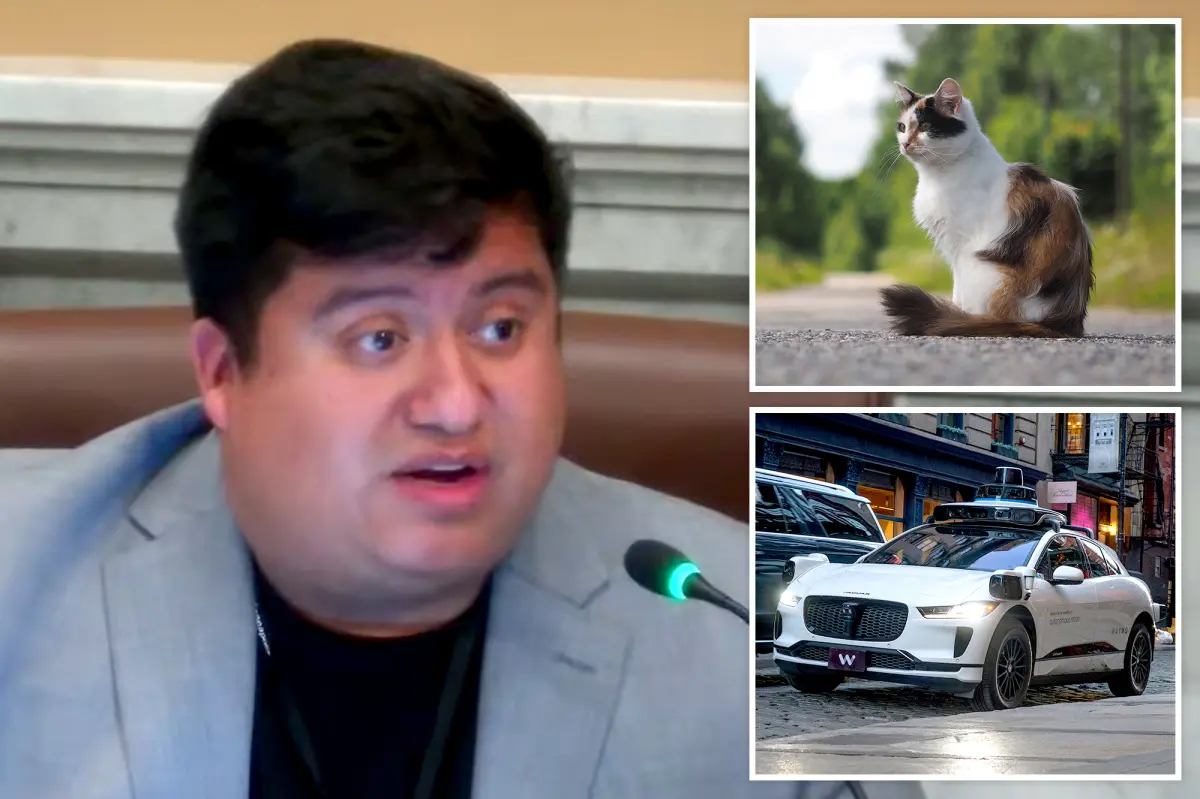
It started with a cat. Or, more precisely, with a city councilman’s heartfelt, if startling, declaration that robotic cars were waging a war on felines. Jason Chavez, a Minneapolis city council member, stood before his colleagues on Thursday and delivered an emotional appeal that would soon ricochet across the internet, turning a municipal transportation vote into a national spectacle. “I will say cats have been killed and cats have been killed by these autonomous vehicles,” Chavez said, his voice carrying the weight of a man who had just seen something disturbing. He told the chamber that he owns a cat and doesn’t want it to fall victim to a Waymo vehicle. Then he doubled down, insisting that those who love cats should know the truth: “These autonomous vehicles have killed cats and that’s unfair.” To drive his point home, he revealed that he had just watched a video from the dais—a video he described as genuinely hard to watch, a recording of cats, in his words, being “murdered by these vehicles.” It was a raw, visceral moment that mixed policy, personal pet ownership, and a tech company’s driverless fleet into a single emotional cocktail. For those in the chamber, it may have been a surprising interlude; for the rest of us watching from afar, it was the kind of moment that begs for context, humor, and a deeper look at what happens when grief over a cat collides with the future of transportation. Chavez’s plea was aimed at “cat lovers” everywhere, but it also touched on a real and growing anxiety about self-driving cars sharing the road with pedestrians, pets, and everything else that moves.
The immediate result of Chavez’s passionate appeal was a vote. The Minneapolis City Council narrowly passed an ordinance that would require a human operator behind the wheel of every autonomous vehicle operating in the city. It also mandated a special license for those operators, transforming the idea of a truly driverless taxi into something far more conventional and, to many, far less magical. For supporters like Chavez, the measure was a safety net—a way to ensure that machines don’t make irreversible, tragic decisions without a human hand ready to intervene. For opponents, it was something else entirely: a backdoor ban on autonomous vehicles, wrapped in the language of precaution and cat protection. The ordinance passed, but its future is far from certain. Mayor Jacob Frey quickly announced his intention to veto the proposal, telling multiple Minnesota outlets that it simply “doesn’t make sense.” Frey, who has positioned the city as a friend to innovation, said he would not support what he called a “backdoor ban” of the vehicles. He stressed that the city should continue to embrace “innovative technology,” including new transportation options, even as he acknowledged safety concerns. That puts the council in an awkward spot: a narrow victory that could be wiped away by mayoral veto, a public fight that has already drawn national attention, and a question lingering in the air—are self-driving cars actually killing cats, or is something else going on? The mayor’s stance suggests he believes the city can balance innovation and safety without resorting to mandates that effectively abolish driverless services. But the fact that this debate is happening at all, and happening with such fervor, shows just how emotionally charged the arrival of autonomous vehicles has become. It’s no longer just about engineering, mapping, or software updates; it’s about our pets, our streets, and our sense of control.
Beneath the cat jokes and the strong opinions, there is a genuine policy debate worth unpacking. As Waymo vehicles with rooftop sensors and empty seats become a more common sight in cities, they inspire both wonder and worry. Supporters of requiring a human operator argue that a driverless car is only as good as its programming, and that in a complex, unpredictable environment like a city street, a human hand on the wheel—or at least a human ready to take over—adds a crucial layer of accountability. They point to incidents, real or perceived, where vehicles made poor decisions, and they argue that technology isn’t yet ready to navigate the messy reality of urban life. Opponents counter that requiring a human operator would effectively kill autonomous taxi services as we know them. The entire business model relies on removing the driver, and adding a paid, specially licensed human to every vehicle would drive up fares, reduce accessibility, and stifle innovation. They also note that 2025 is a strange time to be so afraid of technology; ride-sharing apps, GPS navigation, and even autopilot features in planes have all faced similar skepticism and become part of everyday life. The debate is not just about cats—it’s about who gets to decide what “safe” means, and at what cost. It’s about the thousands of workers who could lose their jobs to automation, versus the thousands of riders who might benefit from cheaper, more efficient transportation. It’s about whether cities should lead the way in regulating new technology or wait for state and federal guidelines. And hiding underneath all of it is a very human fear: that we are losing control of our environment, one algorithm at a time.
Then came the internet, and the internet did what it does best. Social media users pounced on Chavez’s comments with glee, turning his heartfelt plea into a meme, a punchline, and a political weapon. Conservative commentator Dustin Grage posted on X, noting that Chavez earns a taxpayer-funded salary of $110,000 a year, and then kept the jokes coming. “They’re calling it the cat genocide,” Grage wrote, before adding, “Hide your cats. The Waymos are coming.” Gunther Eagleman, another conservative voice, mocked the council’s priorities with an all-caps laugh: “LOL! MINNEAPOLIS HAS FOUND ITS REAL CRISIS, AND IT’S ROBOT CARS ‘MURDERING’ CATS.” David Marcus, a Fox News Digital columnist, piled on with a reference to the movie “They Live”—or perhaps just a bit of absurdist humor—saying “They’re driving over the cats, they’re driving over the dogs!” The jokes were relentless, but some critics used the moment to raise more serious points. Eagleman argued that Minneapolis should be focusing on larger issues, like crime and fraud, and he referenced darker chapters in the city’s recent past: the burning of a police precinct during unrest and a $250 million fraud scheme that unfolded with, in his view, too little attention. “A council member in a city that let rioters burn down a police precinct and watched a $250 million fraud scheme happen under its nose now wants a human in every driverless car to protect the cats,” he wrote. “He’s pulling down $110,000 a year of taxpayer money to say this with a straight face. Minneapolis doesn’t have a driverless car problem. It has a leadership problem.” That kind of criticism stings, especially when it comes wrapped in a joke about cats. But it also reveals just how quickly a single emotional statement can overshadow years of policy work and open a city to national mockery.
The mockery wasn’t limited to political commentators, though. People in the tech world and even in civic life took their own shots. Three Rivers Park Commissioner Jennifer DeJournett pointed to the salary question, framing it as a matter of economic justice: “Why is a city council member making 110,000 when families and seniors are getting priced out of their homes in Minneapolis and taxes are sky rocking????? That’s absurd – where is the equality in that???” It’s a fair question, one that links the cat controversy to broader concerns about housing affordability and the cost of living in a city that has seen dramatic changes in recent years. Meanwhile, tech advocates and everyday drivers offered their own evidence from personal experience. Journalist Zaid Jilani wrote on X that he had been in a self-driving Tesla that stopped for cats crossing the road, adding that Waymo is “a lot more advanced.” Sean Stapleton, a tech CEO, chimed in: “My FSD Tesla avoids animals on the road. He is full of it.” That last comment, blunt as it was, points to a central tension in Chavez’s story. If autonomous vehicles are so dangerous that they’re murdering cats left and right, why do so many people have positive experiences with them? The videos of self-driving cars avoiding pedestrians, navigating tricky intersections, and yes, waiting patiently for animals to cross are easy to find. But so are the videos of incidents, of cars hesitating, or worse, of accidents. The truth is that autonomous vehicle technology is still evolving, and its track record is mixed. There have been real accidents, real injuries, and even real deaths involving autonomous vehicles in various testing phases. But the claim that they are systematically killing cats—so much so that human operators are necessary—remains unproven, and the lack of data behind Chavez’s assertion made his speech an easy target. Fox News Digital reached out to Chavez for comment, but at the time of this writing, there was no additional statement explaining the video he referenced or providing specifics on the feline fatalities he described.
So what does all of this mean in the end? On one level, the saga of the Minneapolis cat-killing Waymos is a classic internet story: a local politician says something odd, social media amplifies it, the mainstream media picks it up, and for a day or two, everyone gets to feel both superior and entertained. But underneath the laughter, there is a more nuanced story about public fear, technological trust, and the messy way we navigate change. When a new technology enters our lives, not everyone experiences it the same way. For some, a driverless car is a marvel of convenience, a safe, efficient ride that arrives without a driver and takes them exactly where they need to go. For others, it’s a threat—a machine that can’t fully understand the world, that might not see a child or a dog or a cat, that takes away jobs and replaces human judgment with cold code. Both perspectives have merit, and dismissing either one as foolish misses the point. Chavez’s comments, however flawed in their execution, tapped into a genuine unease many people feel about giving up control on public streets. The mockery he faced suggests that his delivery overshadowed his concern, and perhaps rightly so. Claiming that cats are being “murdered” by driverless cars, without presenting clear data or verification, undermined whatever safety concerns he was trying to raise. But the underlying question remains: how do we ensure that autonomous vehicles are safe enough for the communities they operate in? How do we balance innovation with accountability? And how do we have a conversation about these issues without reducing it to jokes about cats or dismissing people’s fears out of hand? Maybe the answer lies in better data, more careful communication, and a willingness to listen to both the technologists and the skeptics. Or maybe, as this episode suggests, we’re all just one city council speech away from a very strange week. For Minneapolis, the immediate road ahead is uncertain: a passed ordinance, a promised veto, and public debate that won’t be easily resolved. The cats, presumably, will keep doing what they do best—strolling through streets, oblivious to the fact that they have become unlikely symbols of our anxieties about the future. And the Waymos will keep humming along, carrying passengers with empty seats, waiting for the next neighborhood to decide whether they are a blessing, a menace, or just another part of a changing city.