





In the quiet, sun-drenched suburbs of St. Johns County, Florida, the illusion of peaceful domesticity was shattered earlier this year by a chilling revelation that has left a community grappling with fear, disbelief, and profound sadness. It began on a seemingly ordinary spring day, April 27, when a modern safety net worked exactly as intended. An anonymous tip was submitted through FortifyFL—a mobile security application created in the painful wake of the 2018 Marjory Stoneman Douglas High School massacre to help students report suspicious activity. This particular tip directed sheriff’s deputies to a series of deeply disturbing Telegram messages exchanged between two young boys, fourteen-year-old Julian Davis and his thirteen-year-old friend, both of whom were students at Switzerland Point Middle School. What started as a routine digital investigation quickly unraveled into a terrifying glimpse of youth radicalization and violent intent. The boys’ private messages, far from the typical banter of middle schoolers, detailed a cold, calculated plan to hold an individual at gunpoint and rob them. The digital breadcrumbs painted a surreal picture of children discussing the procurement of heavy-duty zip ties to bind their victim, alongside technical schematics for assembling functioning, crude firearms. The stark contrast between the innocent, everyday routine of middle school life and the dark, weaponized conspiracies brewing on their phone screens sent shockwaves through the local community, forcing neighbors to confront the unsettling reality of what can transpire behind closed bedroom doors in the digital age.
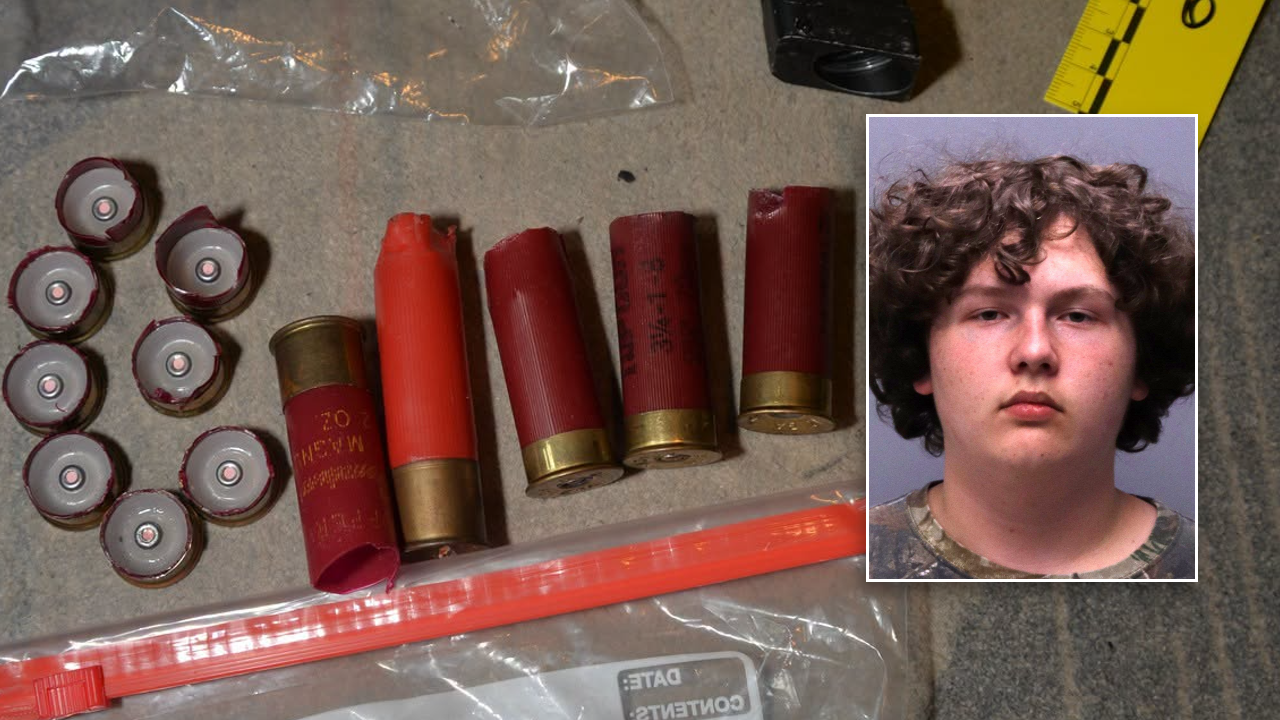
The subsequent investigation swiftly escalated from digital surveillance to physical intervention, culminating in a series of intense searches of Julian Davis’s family home conducted by sheriff’s deputies and federal agents between April 27 and April 30. Inside the teenage boy’s private sanctuary, investigators did not just find the typical debris of adolescence; instead, they uncovered a makeshift armory and a disturbing ideological shrine. Law enforcement seized three homemade firearms—rudimentary ghost guns including a custom-built shotgun and a musket—alongside live ammunition, volatile chemical components suspected of being intended for explosives, and crude, homemade handcuffs. Scattered among these physical threats were handwritten notebooks filled with meticulous diagrams detailing weapon construction, including a hand-drawn blueprint of a Molotov cocktail. Far more alarming than the physical weapons, however, was the dark psychological landscape revealed by Julian’s personal belongings. Agents discovered a tactical vest adorned with hand-drawn white supremacist symbols, stored alongside a printed copy of the manifesto written by Brenton Tarrant, the notorious white supremacist who slaughtered fifty-one innocent worshippers at two mosques in Christchurch, New Zealand, in 2019. The search also yielded well-worn copies of a U.S. Army improvised munitions handbook and “The Anarchist Cookbook”—a infamous 1971 counterculture manual containing recipes for weapons, explosives, and illicit drugs—revealing a child who had bypassed typical teenage curiosities to immerse himself in some of the most destructive literature of the modern era.
The gravity of the situation was laid bare in a somber press conference where St. Johns County Sheriff Robert Hardwick, flanked by federal investigators, addressed the public for the first time regarding the case. Hardwick argued passionately that the timely arrest of Julian Davis on April 30 was not merely a standard law enforcement action, but a critical intervention that likely averted a catastrophic mass casualty event at Switzerland Point Middle School or within the wider community. According to investigators, the young boys had been actively plotting to rob an individual identified in their messages only as “CJ,” a figure whose real identity remains a frustrating mystery to detectives. However, Sheriff Hardwick emphasized that the scope of Julian’s ambitions extended far beyond a simple street robbery. A deep forensic analysis of the fourteen-year-old’s personal electronic devices revealed a consuming, dark obsession with notorious school shooters and perpetrators of mass stabbings. Julian had spent countless hours researching high-profile mass killings, studying the tactics, psychological profiles, and outcomes of these tragedies with an intensity that investigators characterized as a desire to emulate them. While the school district’s deputy superintendent, Paul Abbatinozzi, later clarified that there was never a direct, explicit threat leveled against Switzerland Point Middle School itself, the chilling digital footprint left by Julian suggested a child standing on the precipice of extreme violence, driven by a dangerous mixture of ideological radicalization and a thirst for infamy.
In the eyes of the law, the sheer scale of the threat posed by Julian’s alleged activities prompted a severe and controversial judicial response: prosecutors made the heavy decision to charge the fourteen-year-old child as an adult. Charged with multiple severe firearm and explosive offenses, alongside conspiracy to commit armed robbery, Julian now faces the terrifying weight of the adult criminal justice system, a punitive apparatus designed for mature offenders rather than developing adolescent minds. He is currently being held in the adult population environment of the St. Johns County Jail on a staggering $240,000 bond, a financial hurdle far out of reach for a typical family, effectively ensuring his continued incarceration as his legal battle begins. He has entered a plea of not guilty to all charges, setting the stage for a dramatic and emotionally charged legal battle. Meanwhile, his thirteen-year-old co-conspirator, protected by his younger age, was processed entirely through the Florida Department of Juvenile Justice. After spending twenty-one days in a juvenile detention facility, the younger boy was released back to his family, highlighting a stark disparity in how the justice system treats children separated by only a single year of age. Regardless of their differing legal paths, the academic lives of both boys have been permanently derailed; school district officials confirmed that neither child will ever be permitted to return to Switzerland Point Middle School, leaving their educational futures in complete ruin.
Amid the mounting legal pressure and public condemnation, a deeply human and heartbreaking counter-narrative has emerged from Julian’s defense attorney, Jill Barger, who seeks to remind the public of the fragile child behind the monstrous headlines. Barger has raised urgent alarms regarding Julian’s mental and emotional state, paint a devastating portrait of a fourteen-year-old boy disintegrating under the harsh realities of adult incarceration. She revealed that Julian has spent nearly four months isolated in an “empty pod” inside the county jail—a sensory-deprived environment that has left the young teenager profoundly frightened, deeply depressed, and utterly traumatized. Barger has passionately accused the state of Florida of failing in its fundamental duty of care, arguing that they have locked a deeply troubled child away in a concrete box without providing him the essential psychological, educational, or developmental resources he desperately needs. Furthermore, the defense attorney fiercely criticized the St. Johns County Sheriff’s Office for orchestrating a sensationalized press conference, accusing law enforcement of conducting a public relations campaign designed to poison the local jury pool and secure a conviction before Julian ever sets foot in a courtroom. According to Barger, Julian is not a cold-blooded monster, but a confused, lonely boy who never truly harbored any intention of hurting anyone, arguing that the police acted with reckless cruelty by publicly framing a child’s online bravado and tragic curiosity as an imminent mass casualty event without any concrete evidence of a real-world plan.
The tragic saga of Julian Davis stands as a complex, cautionary tale for twenty-first-century society, highlighting the terrifying ease with which vulnerable young minds can be swept down dark, digital rabbit holes of hate and violence from the isolation of their bedrooms. It exposes the agonizing, delicate balance that modern communities and law enforcement must strike between the absolute necessity of preemptive public safety and the humane treatment of deeply troubled children. While the anonymous tip system of FortifyFL undoubtedly succeeded in preventing potential harm, the aftermath of the arrest leaves a trail of ruined lives, systemic questions, and community grief. As Julian awaits his next arraignment, his case forces us to look into a mirror and ask hard questions about how we protect our schools, how we monitor the digital spaces our children inhabit, and at what point a society decides to discard a troubled fourteen-year-old child to the unforgiving machinery of the adult prison system. It is a story with no easy answers, leaving a neighborhood haunted by what might have been, a defense attorney fighting for a terrified boy’s humanity, and a young life permanently fractured before it even had a chance to truly begin.