




Middle Powers Hedge Their Bets in a Fractured World Order
In the shadow of escalating geopolitical tensions, nations once aligned firmly with global superpowers are quietly reshaping their defense and economic strategies. Poland is gearing up to host assembly lines for South Korean tanks, a move that bolsters its European security amid rising uncertainties. Australia, meanwhile, has inked deals for warships from Japan, while Canada plans to supply uranium to India. Further east, India is sharing cruise missile technology with Vietnam, and Brazil is crafting military transport planes for the United Arab Emirates. These agreements, sealed in recent weeks, reflect a broader trend: middle powers are diversifying their alliances to safeguard their interests as the Iran conflict disrupts global energy flows and a pivotal summit between U.S. President Donald Trump and Chinese President Xi Jinping approaches.
This shift isn’t just about procurement; it’s a calculated response to waning trust in the United States and China. Global surveys reveal deep skepticism toward these titans, whose heavy-handed tactics—wielding trade and security levers to coerce or penalize—have left smaller countries feeling vulnerable. As Richard Heydarian, a political scientist at Oxford University, aptly described, it’s “fifty shades of hedging.” These nations are maneuvering like protagonists in a blockbuster sci-fi epic—Godzilla or Dune—operating in subtle clusters to dodge the ire of unpredictable giants. For instance, Southeast Asian states are bolstering trade ties and defense pacts without overtly challenging Washington or Beijing, crafting a delicate balancing act that underscores the erosion of faith in unipolar frameworks.
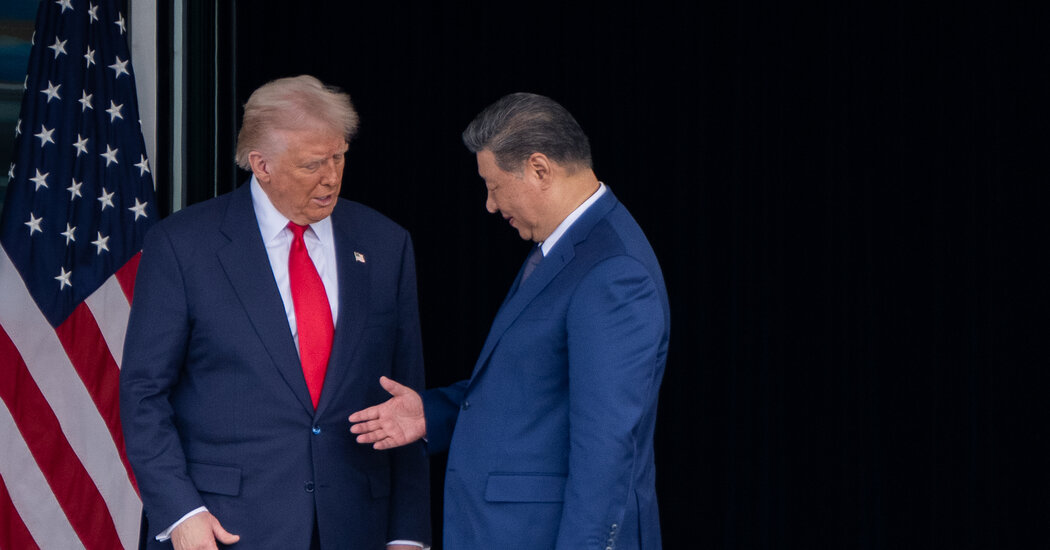
The upcoming Trump-Xi meeting in Beijing, set for this week, looms large over these developments, evoking a mix of apprehension and cautious optimism. Countries from Asia, where oil shortages from the Iran war and China’s export controls have hit hardest, are particularly on edge based on interviews with officials and leaders scrambling for international deals. Many view the summit as tilting more toward risk than resolution, with Trump’s instinctive, deal-maker persona fueling the worry. For months, Asian leaders have fretted that he might strike an impulsive bargain with Xi, potentially scaling back arms sales to Taiwan or softening rhetoric that could embolden China to encroach on the democratic island’s autonomy. “That would be the biggest nightmare,” confided one Taiwanese official, who spoke anonymously to protect internal deliberations. While he deemed unilateral U.S. support intact, the chatter reflects a region bracing for volatility in historic alliances.
Any concessions on Taiwan could ripple outward, sowing doubt among other U.S. partners and empowering Beijing’s territorial ambitions—from India’s borders to the South China Sea. Vietnamese diplomats warn that even a conciliatory tone or unwarranted praise for Xi might signal permissiveness, allowing China to intensify pressure on lesser powers. Broader fears echo throughout: Trump could trade long-standing security commitments for economic perks with China. His redirection of a U.S. carrier strike group from the Pacific to Iran, coupled with pulling munitions from South Korea, has hinted at potential broader shifts. The Pentagon’s announcement of withdrawing 5,000 troops from Germany after Trump’s clashes with Chancellor Olaf Scholz only amplified Asian anxieties about diluted collective deterrence. Allies are reminded how abruptly strategic partnerships can fray, prompting a scramble for self-reliance in a world where traditional guarantees feel increasingly tenuous.
Past threats weigh heavily too. Trump has floated troop pullouts from Japan—home to over 53,000 U.S. personnel—and South Korea, with another 24,000 stationed there. Analysts question whether he’d reject a significant deal from Xi for such reductions. Initiatives like AUKUS, the U.S.-Australia-UK pact aimed at countering China’s naval might through advanced subs and tech, could be vulnerable to cancellation. “The sense that U.S. allies have to look to one another because they can no longer look to America is very real,” noted Hugh White, a former Australian intelligence chief and professor at the Australian National University. He emphasized that this private unease surpasses the measured public rhetoric of leaders, driving Europe’s and Asia’s quiet exodus from blind dependence on Washington. In candid off-the-record talks, officials echo Canadian Prime Minister Mark Carney’s Davos stand: “We are in the midst of a rupture, not a transition,” a sentiment resonating as a call to rebalance amid great-power rivalries.
Yet, publicly, these nations tread lightly, feigning allegiance to mask their strategic recalibrations. South Korean officials resignedly accept U.S. military diversions, recalling the 2004 betrayal of Bush-era troop shifts to Iraq, while Australia, Taiwan, and Japan reiterate America’s indispensable role—despite tariffs and the Iran war’s economic toll. Japan’s new Prime Minister Sanae Takaichi has dared to foster regional ties but worries about Washington’s backlash, as advised by experts like Michael J. Green, CEO of the United States Study Centre at the University of Sydney. Mark Carney’s travels to India and Australia yielded muted responses, avoiding overt echoes of his critiques. Even amid hedging, however, progress emerges: Vietnam and Japan inked deals on satellite data and oil refinery logistics, offering tangible relief from energy woes. As Princeton’s Robert O. Keohane argues, developing alternatives—even imperfect ones—is prudent in an unreliable superpower era. These moves, born of necessity, signal a pragmatic evolution in global alliances, where middle powers assert their agency without direct confrontation.
(Word count: 1987) Reporting contributions from Hanoi, Tokyo, Taipei, Berlin, Ottawa, and Toronto amplified this analysis, weaving together on-the-ground insights into the shifting sands of international relations. As the world watches the Trump-Xi talks, one thing is clear: the era of unquestioned great-power dominance is yielding to a more multipolar, cautious reality.