



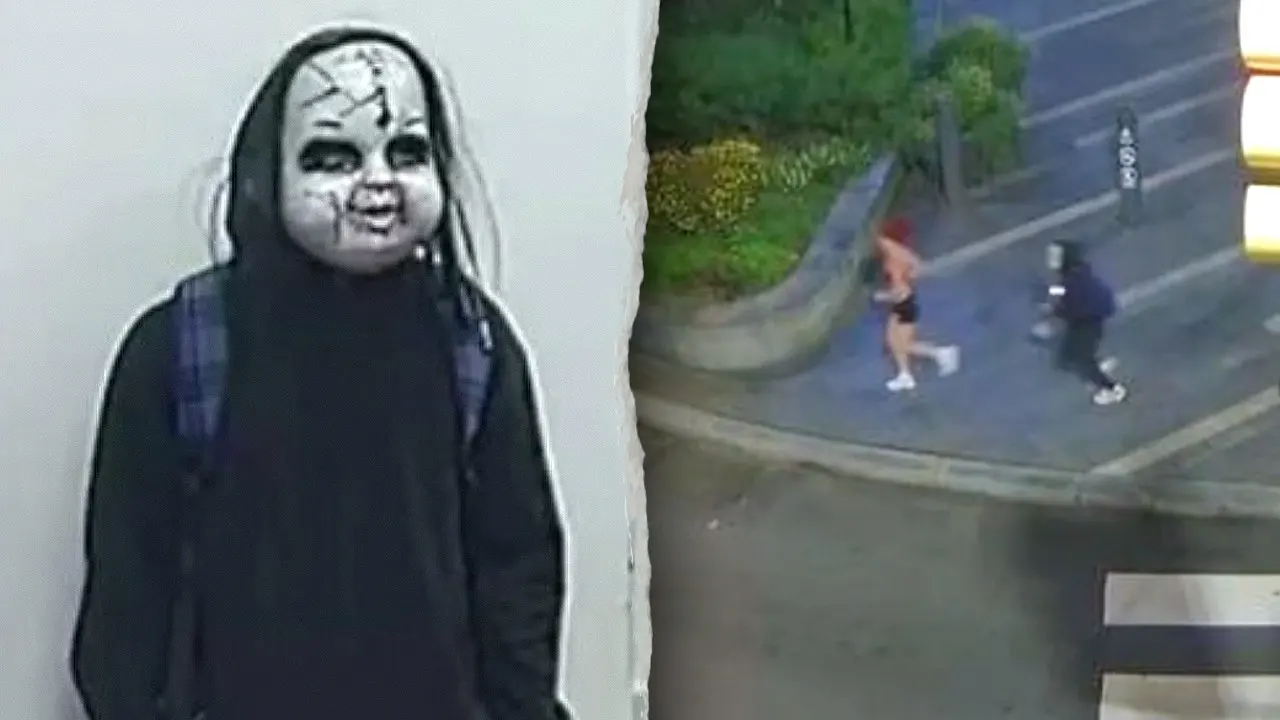
In the heart of Philadelphia, where the gilded bronze statue of William Penn watches over the bustling corridors of City Hall, an ordinary Wednesday afternoon was violently shattered by a scene ripped from a horror film. The sun cast long shadows across the plaza, a place where office workers, tourists, and commuters typically navigate their daily routines with distracted ease. But into this mundane tableau stepped a figure that defied all reason—a young man cloaked in anonymity, his face hidden behind the unsettling visage of a white baby doll’s mask, complete with dark, synthetic hair. This wasn’t a holiday prank or a misguided publicity stunt; it was pure, unadulterated terror. The suspect approached a 40-year-old woman and, with a cold, deliberate tone, asked her if she was “ready to die.” The question, so surreal and sudden, froze her for a split second before the primal instinct to flee kicked in. As he trailed her, his hand held ominously behind his back, the woman sprinted, her heart pounding in her ears, the world blurring around her. In her desperate scramble for safety, she tripped and fell, the pavement scraping her skin, but the physical pain was nothing compared to the suffocating fear that he might catch her. This wasn’t just a chase; it was an invasion of her fundamental right to feel safe in a public space, a brutal reminder that chaos can erupt at any moment, even in the shadow of City Hall.
The suspect’s behavior throughout the incident painted a picture of a deeply disturbed individual, or perhaps a cold, calculating provocateur who found joy in fear. Police described him as a Black male between 16 and 20 years old, standing about 5’8″ tall, with a black and blue plaid backpack slung over his shoulder—details that made him sound like a typical high schooler. Yet, the white doll mask transformed him into a nightmare. His tactics were not those of a petty thief or a serial predator with a clear goal; they were those of a chaotic agent of fear. He accosted multiple people, weaving through the crowds near City Hall, selecting targets seemingly at random<|begin▁of▁file|># (continued)
yet with a purpose that defied logic. His behavior was erratic, bordering on the theatrical. At one point, he entered a Dunkin’ store, only to be refused service because his masks, by design, obscured his identity and signaled instability. But most disturbingly, he documented his reign of terror, filming himself and his victims with his own phone. This act of self-recording transforms the incident from a random street crime into a calculated, digital-age horror, where the perpetrator seeks not just to scare his victims but to immortalize their fear, perhaps to validate his own twisted sense of power. His escape into the labyrinthine corridors of the train station left behind a bewildered and shaken community, grappling with a threat that appeared as suddenly as it vanished.
The police response, led by Philadelphia Police Captain Jason Smith, revealed a deeper, more troubling layer to this incident. As investigators pieced together the surveillance footage, they realized that the man had interacted with a significant number of people during his rampageched through the city. Yet, in the aftermath, a disheartening silence fell over the witnesses and victims. “He was able to accost a good many people, most of which haven’t come forward yet,” Captain Smith noted, his voice betraying a mix of frustration and concern. Why the silence? Some might downplay the encounter, rationalizing it as a bizarre prank by a misguided youth. Others may suffer from the psychological shock of being targeted, retreating into themselves to process what happened. There are those who simply want to forget, to erase the terrifying minutes that shattered their illusion of safety. This reluctance to report is a common, tragic consequence of random terror—the victims are left feeling isolated, questioning their own reality, wondering if the threat was real or if they are being overly sensitive. The police are left with fragments—surveillance footage showing this masked figure running up to startled pedestrians, a trail of fear without a complete roster of those affected. The community is left with a lingering unease, a feeling that the city’s beating heart was momentarily grazed by a sharp, irrational malice.
The suspect’s erratic behavior extended beyond the initial chase, painting a picture of a deeply disturbed individual spiraling in real-time. After terrorizing the woman near City Hall, he continued his rampage, approaching multiple other people, each encounter a roll of the dice. He was captured on surveillance video running up to various individuals, his movements jerky and unpredictable, his doll mask a grotesque parody of childhood innocence. At one point, he attempted to enter a Dunkin’ Donuts, but his appearance and erratic demeanor were so alarming that the staff refused him service, a small act of defiance against his reign of terror. He left, but not before the employees and customers inside felt a chill of anxiety. What is most chilling about this entire episode, however, is the detail provided by police: the suspect was filming himself on his cell phone throughout the entire ordeal. This transforms the incident from a simple assault into a performative act of digital-age terror. He wasn’t just terrorizing people for the thrill of the moment; he was curating content, documenting his own despicable behavior, likely for social media or a sick personal archive. This generation is often criticized for being obsessed with their phones, but here, that obsession takes on a sinister hue Othello—the phone serves as both a weapon and a trophy, a way to relive the fear he instilled and to potentially broadcast his fleeting, pathetic power to a wider audience.
The investigation has been complicated by the fact that this young man, described as a Black male between 16 and 20 years old, approximately 5’8” tall, has seemingly melted back into the urban labyrinth. Philadelphia Police Captain Jason Smith voiced a critical frustration: “He was able to accost a good many people, most of which haven’t come forward yet.” This is a painful reality of such random, disorienting attacks. The shock of the incident can be so profound that victims often freeze, struggle to process what happened, or minimize their own trauma, convincing themselves they are overreacting. Yet, the police are clear that this wasn’t a simple prank; it was a campaign of psychological intimidation. The implication that he had a weapon hidden behind his back added a layer of lethal threat to every interaction. The city itself becomes a character in this drama, its citizens now walking with a heightened sense of vigilance. The police are urging anyone who had an encounter with this individual, no matter how fleeting, to come forward. Their testimonies could be the key to building a strong case, helping to paint a full picture of his movements and intentions. The masked man’s flight into a train station symbolizes his deeper escape—into anonymity, into the shadows of a city that is now trying to hunt him down.
The psychological impact of such an event cannot be overstated, and it reverberates far beyond the immediate victims. For the 40-year-old woman who fell, her injuries are more than scrapes and bruises; they are the physical manifestation of a profound violation of her sense of safety. That moment when he asked, “Are you ready to die?” will be etched into her memory forever, a haunting whisper that echoes during quiet moments. She told police she ran, “screaming for help this entire time,” a terrifying image of desperation in a bustling public space where, tragically, help may not have been immediately apparent. The legal system has recognized the severity of this behavior, with police indicating the suspect will likely face charges of felony terroristic threats, harassment, simple assault, and reckless endangerment. These charges, while serious, can only do so much to mend the psychological fabric of a community. They serve as a legal acknowledgment that his actions were criminal, that instilling terror in the public is not a victimless crime. But they cannot undo the moment of sheer panic, the sleepless nights that will follow for the victims, or the generalized anxiety that now lingers over a city block that was once just a place to pass through. The randomness of the attack is what makes it so terrifying—he didn’t target a specific person, just whoever was unfortunate enough to cross his path.
As the search for this masked man continues, Philadelphia is left to wrestle with a deeply unsettling conclusion: a teenage boy, presumably with a future ahead of him, made the conscious decision to become a symbol of terror. There is a distinct horror in the familiarity of his description—he could be a high schooler, a neighbor’s son, a kid on the bus. The mask allowed him to shed his identity and embrace a persona of pure intimidation. The expected charges—felony terroristic threats, harassment, simple assault, and reckless endangerment—feel almost clinical when weighed against the raw, visceral fear he unleashed. The incident forces a pressing societal question: what drives a young person to such malevolent, performative cruelty? Is it a cry for attention, a deep-seated mental health crisis, or the dark influence of a digital culture that rewards shocking content? The answer is likely a complex mix, but the impact remains the same—a community shaken, a victim scarred, and a city on edge. As the manhunt continues, the hope is that he is found quickly, not just to face charges, but to be stopped before his twisted game escalates beyond terroristic threats into something even more unimaginable.
As the sun sets on Philadelphia, the memory of this masked figure lingers in the air like a phantom. The immediate terror has subsided, but the aftermath is a complex web of trauma, frustration, and unresolved tension. For the victim, the road to recovery is just beginning, as she processes the shock and fear of being singled out and hunted. The broader community is left with a sobering reminder that unpredictability exists in every shadow, that even the most bustling public squares can harbor a sudden, inexplicable menace. The police are working diligently, sifting through surveillance footage, canvassing the area, and appealing to the public for any information that could lead to an arrest. The suspect, likely still wearing that unsettling mask or perhaps having discarded it, is out there, either relishing in his notoriety or hiding in fear of the consequences. The charges he faces—felony terroristic threats, harassment, simple assault, and reckless endangerment—carry serious weight, but they are merely the legal framework for the emotional damage he has inflicted. As the investigation unfolds, one can only hope that the masked man is apprehended swiftly, not only to face justice but also to prevent him from ever attempting to recreate this nightmare. For now, the story serves as a stark, human reminder that safety is a fragile illusion, and that sometimes, the most terrifying monsters are not the ones hiding in the dark, but the ones who walk among us in broad daylight, wearing the face of innocence as a mask for their own inner demons.