


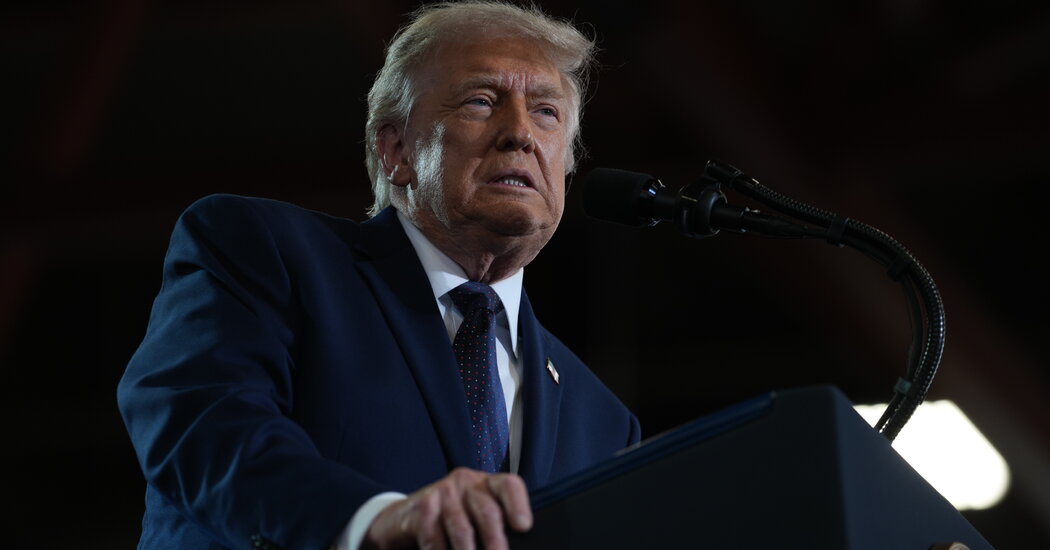
Eleven weeks ago, the digital landscape was set ablaze by the uncompromising, high-stakes bravado of President Donald J. Trump, who boldly declared on social media that the only acceptable resolution to the escalating conflict with Iran would be nothing short of “UNCONDITIONAL SURRENDER!” This fierce, uncompromising rhetoric, designed to project absolute American dominance and capture the imagination of a deeply anxious global public, was quickly followed by a flurry of administrative damage control. White House officials scrambled to issue clarifying statements, explaining that even if the leadership in Tehran did not sign a formal, humiliating instrument of defeat, the President himself would unilaterally decide when the Islamic Republic had been sufficiently humbled—or, in Trump’s characteristically raw, colloquial phrasing, when they had finally cried “uncle.” Fast-forward to the present, and the rigid, black-and-white certainties of wartime posturing have dissolved into the murky, compromise-laden gray zones of backroom international diplomacy. The sudden shift from demanding absolute submission to announcing a tentative memorandum of understanding on Truth Social highlights the age-old tension between bravado-driven political theater and the pragmatic, often humbling realities of global statecraft. For a leader who has long built his political brand on the mythos of the aggressive, unyielding dealmaker, this transition reveals the intense, human weight of the presidency, where the catastrophic potential of a prolonged war must eventually be balanced against the quiet, painstaking work of diplomatic compromise. Behind the scenes, the terrifying potential of an endless conflict has forced a stark reevaluation of what victory actually looks like. While the public is fed a steady diet of triumphant online proclamations about reopening the vital Strait of Hormuz, the reality is a deeply complex, fragile negotiation that bears little resemblance to the total, unconditional defeat originally promised, leaving everyday citizens, military families, and global markets to navigate a confusing mix of relief and profound skepticism.
At the heart of this unfolding diplomatic drama lies a profound fog of information, where the actual terms of the agreement remain dangerously opaque and fiercely disputed by the very people tasked with implementing them. President Trump’s recent assertions that the vital Strait of Hormuz would soon reopen under a new memorandum of understanding have done little to quiet the deep-seated anxieties of global shipping networks, merchant mariners, and international observers. According to two U.S. officials speaking on the condition of anonymity, Iran has agreed in principle to surrender its prized stockpile of highly enriched uranium. However, this monumental concession has yet to be publicly confirmed by the government in Tehran, highlighting the incredibly delicate dance of political survival and national pride that both regimes must perform before their respective domestic audiences. This tentative breakthrough inevitably recalls the historic 2015 nuclear agreement negotiated under the Obama administration, during which Iran successfully shipped approximately ninety-seven percent of its enriched uranium stockpile to Russia without a single shot being fired. The stark contrast between that peaceful, detail-oriented multilateral diplomacy and the current environment of high-friction military pressure raises profound questions about the true cost of human conflict and the efficacy of modern warfare. Today, many of the reported details of the current memorandum are pieced together from a fragmented web of American and Middle Eastern sources, few of whom seem to share the exact same understanding of what has actually been committed to paper, or if the parameters of the deal are even officially finalized. This lack of clarity creates a volatile global vacuum where hope and dread coexist, leaving career diplomats to work exhausting, sleepless hours in an effort to translate vague executive promises into verifiable, concrete commitments that can prevent a catastrophic return to active hostility.
Even before the physical ink of this potential agreement could dry, a ferocious civil war erupted within the American foreign policy establishment, exposing the deep ideological rifts and raw, personal animosities of those in the corridors of power. For many conservative foreign policy hawks, any talk of a temporary truce is viewed not as a diplomatic triumph, but as a spineless betrayal of the immense human and material sacrifices made during the recent military campaign. Senator Roger Wicker, the influential chairman of the Senate Armed Services Committee, took to social media to passionately denounce the rumored sixty-day ceasefire, warning that relying on Iran to act in good faith would be an unmitigated disaster that would render the entire military campaign, codenamed Operation Epic Fury, completely in vain. This hardline view was quickly echoed by Mike Pompeo, Trump’s former secretary of state, who dismissed the diplomatic overtures with characteristic disdain. This public dissent from a former close ally triggered an astonishingly vulgar and aggressive backlash from the White House, with top communications official Steven Cheung firing back on social media, telling Pompeo to shut his mouth and leave the serious work of global diplomacy to the professionals. This extraordinary public spat, marked by raw expletives and personal insults, humanizes the terrifyingly high-stress, cutthroat nature of modern Washington politics, where foreign policy is argued not in the sober, dignified tones of historical statecraft, but in the chaotic, unfiltered arena of digital street fights. For the military personnel who risked their lives in the skies and waters of the Persian Gulf under Operation Epic Fury, this public bickering serves as a sobering, painful reminder of how easily their real-world sacrifices can become rhetorical weapons in a domestic political war, where legacies and future presidential ambitions are fiercely defended at the expense of national unity and coherent strategy.
As the dust begins to settle on this public brawl, the international community is left to grapple with several critical, unresolved questions that will ultimately determine whether this agreement brings genuine stability or merely a brief pause in a catastrophic cycle of violence. Chief among these concerns is the physical and economic reality of the Strait of Hormuz, a vital maritime artery that was fully open on the fateful day in late February when the joint American and Israeli offensive commenced. The international community must now look closely at whether this new agreement ensures a truly permanent, unrestricted reopening of the waterway, or if it tacitly grants Iran the authority to police the strait under the guise of enforcing newly established tolls on commercial shipping. Furthermore, the human cost of the conflict’s economic dimension hangs in the balance: will the United States agree to permanently lift its crippling naval blockade on ships traveling to and from Iranian ports? For the thousands of ordinary merchant sailors who navigate these highly volatile waters under the shadow of heavy naval artillery, and for the global consumers who feel the immediate shockwaves of disrupted supply chains in the price of food, fuel, and daily essentials, these are not abstract legal issues, but matters of immediate physical safety and economic survival. The psychological toll of sailing through a militarized choke point, wondering if the next cargo ship will be targeted by a missile or boarded by hostile commandos, highlights the human stakes of this diplomatic deadlock. A failure to clearly resolve these intricate maritime logistics could quickly lead to renewed naval skirmishes, proving that a peace treaty is only as strong as its ability to secure the physical pathways of global commerce from the constant threat of sudden seizure and military aggression.
Beyond the maritime shipping lanes, a high-stakes game of financial and nuclear accounting is playing out behind closed doors, forcing President Trump to confront his own historical political rhetoric and the complex, unforgiving mathematics of atomic diplomacy. Under the terms of the proposed memorandum, Iran is demanding the release of twenty-five billion dollars in frozen assets—a staggering sum of money that presents a profound political and moral dilemma for the President. Over the years, Trump has relentlessly criticized former President Barack Obama for releasing a much smaller sum of one point seven billion dollars as part of the 2015 nuclear pact, making any financial concessions to Tehran a highly sensitive domestic issue that his hardline political opponents will eagerly exploit as a sign of weakness and hypocrisy. At the same time, the physical reality of Iran’s nuclear capabilities introduces a terrifying level of technical complexity to the negotiations. The world is waiting with immense anxiety to see if Iran will actually agree to surrender its nine hundred and seventy pounds of near-bomb-grade uranium, or if it will merely blend it down to a less threatening form, while leaving the status of its remaining eleven tons of lower-enriched uranium highly uncertain. The sheer scale of these radioactive materials, painstakingly documented by inspectors of the International Atomic Energy Agency, represents a constant, existential threat that cannot be easily swept under the rug of a superficial executive agreement. For the millions of families living across the Middle East and the Western world, who carry the heavy psychological burden of a potential nuclear arms race, these scientific numbers are not mere bureaucratic data points, but represent the fine line between global security and an unimaginable humanitarian catastrophe that could reshape human history for generations to come.
Ultimately, the true measure of this potential agreement will not be found in the triumphant boasts of politician’s social media posts, but in its ability to address the long-term, systemic sources of hostility that have fueled this decades-long conflict. Even if the immediate nuclear stockpile is temporarily neutralized, the critical question of Iran’s future enrichment rights remains a massive point of contention, with Trump recently suggesting to reporters aboard Air Force One that a twenty-year suspension of enrichment might be acceptable—a dramatic departure from his previous uncompromising insistence that the country must abandon its nuclear ambitions entirely. Furthermore, the complete, unsettling silence surrounding Iran’s formidable ballistic missile program casts a dark, ominous shadow over the entire diplomatic effort. For the citizens of Israel and other regional allies who live within the direct flight path of these highly destructive weapons, the absence of strict missile limitations in the current talks is not an academic oversight, but an existential vulnerability that could trigger a preemptive war at any moment. As vulnerable communities transition from the terrifying realities of active military operations to the uncertain promises of a fragile peace, the human hunger for lasting stability is palpable, yet deeply tempered by bitter historical experience. Whether this memorandum of understanding represents a courageous, historic step toward a durable Middle East peace or simply a temporary, face-saving pause in an inevitable march toward a far larger, more devastating war is a question that remains unwritten, reminding us that true safety is never built on hollow words, but on the painstaking, honest labor of building trust across a chasm of deep-seated fear, historical trauma, and ideological animosity.