

Tragedy in the Southern Philippines: Devastating 7.8 Magnitude Earthquake Leaves Communities Shattered and Families Left Waiting in the Ruins
A Scenic Coastline Shattered by Seismic Terror
The pristine morning light over the southern Philippines was violently shattered on Monday when a massive 7.8-magnitude earthquake—the most powerful seismic convulsion to strike the archipelago in decades—ripped through the region, leaving a widening trail of devastation, grief, and desperate search operations. By Tuesday afternoon, official reports confirmed that the death toll had climbed to 38 individuals, while emergency medical teams scrambled to treat nearly 500 injured citizens inundating local clinics, and more than 20,000 displaced residents sought whatever refuge they could find in makeshift camps. The disaster, which originated deep within the tectonic fault lines that crisscross the Mindanao region, unleashed violently prolonged tremors that violently destabilized mountainsides, collapsed modern commercial concrete structures, and left hundreds of families waiting in agonizing suspense for news of loved ones still buried deep beneath the rubble. Located on the volatile Pacific “Ring of Fire,” the Philippines is no stranger to volcanic eruptions and earthquakes, yet the scale of this particular disaster has overwhelmed local municipalities, triggering a massive national emergency response as first responders race against a ticking clock to locate survivors trapped in the pockets of pancaked buildings and beneath massive landslides that have rewritten the local geography.
The Empty Shoreline: A Family’s Sudden Disappearance Beneath the Landslide
Landslices transport massive boulders and debris onto a residential community on Balut Islands, burying a multi-generational family.
For the survivors, the structural statistics of this catastrophe translate into unbearable personal nightmares, nowhere more visible than on the remote Balut Islands where 23-year-old Randy Bacag stands vigil near a mountainside that simply swallowed his family whole. On that fateful Monday morning, his 42-year-old mother, Amie Bagan Bacag, was engaged in the comforting routines of daily life, washing the family’s laundry, when the ground suddenly began to pitch and roll with a violent, deafening roar that sent terror throughout the coastal village. Running out into the open to escape her collapsing home at the base of the cliffs, Amie made a split-second decision that would seal her fate; remembering that her young granddaughter was playing in the neighboring house, she turned back into the danger zone to rescue her. In that fleeting moment of maternal bravery, a massive torrent of boulders and loosened earth cascaded down the unstable mountainside, completely burying their home and leaving those inside—including six-year-old Tresia Dalaman, her six-year-old cousin Brian John Mangayao, and their 62-year-old great-grandmother, Pilar Singcag—entombed under tons of debris. More than 24 hours after the landslide, rescue crews have been unable to penetrate the thick wall of rock, leaving Randy to confront the grim reality that all four of his relatives are gone, unable to even recover their bodies to hold a traditional wake, while his traumatized father, who witnessed the entire event unfold while fleeing to safety, has been left emotionally shattered, seemingly transformed into a silent stranger by the sheer horror of the sudden loss.
Urban Devastation in General Santos: Schools and Commerce in Ruins
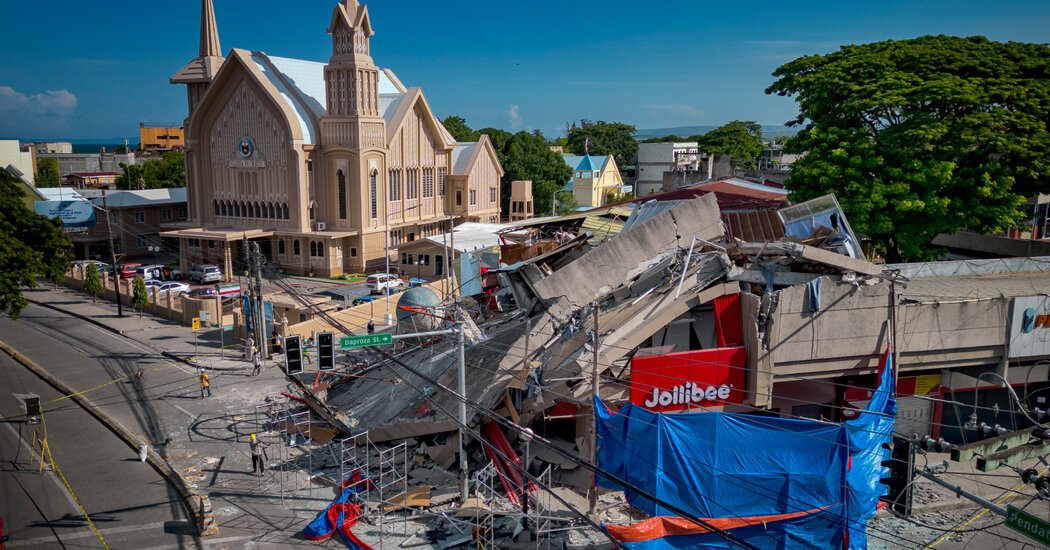
Emergency personnel and local citizens inspect the extensive structural damage in downtown General Santos, the tuna capital of the region.
While the landslide-scarred coastlines of the outlying islands tell a story of natural forces colliding with rural isolation, the urban center of General Santos, a sprawling metropolis of 700,000 residents famed globally for its multi-million dollar tuna export industry, presents a picture of structural failure and civilian panic. The earthquake struck on a morning that should have been filled with hope and excitement, marking the very first day of the new school term, which sent thousands of children into the streets in absolute terror as their classrooms began to sway listlessly. Romdel Catolico, a local disaster management official, detailed the extensive damage that has crippled the city’s vital infrastructure, noting that bridges have cracked, arterial roads have buckled, civil service buildings have been rendered unsafe, and five local schools have suffered severe structural compromises. The economic heartbeat of the city has been effectively paused as businesses, municipal offices, and local marketplaces remain closed for safety inspections, casting a long shadow over the region’s financial stability and raising urgent questions among engineering experts about the implementation of building codes in a zone known for high seismic vulnerability.
A Population Displaced: Terror of Aftershocks and the Fight for Shelter
Displaced residents set up temporary shelters and tents in open fields as continuous aftershocks prevent them from returning home.
As the dust began to settle over the ruined streets of General Santos, a second humanitarian crisis quickly materialized in the form of widespread displacement, with thousands of terrified families fleeing their cracked homes to find safety in 44 hastily assembled municipal evacuation centers across the region. Harold Cabreros, the regional administrator of the Office of Civil Defense, explained that many of these displaced citizens spent a sleepless night in open fields, parking lots, and parks, refusing to sleep under any ceiling due to the relentless and terrifying succession of aftershocks that continued to rattle the region every few hours. These frequent tremors serve as a psychological torment for the survivors, keeping adrenaline levels high, preventing emergency workers from entering unstable structures, and discouraging citizens from returning home to salvage their meager possessions. The government and local non-profits are struggling to supply these crowded evacuation camps with basic necessities such as clean drinking water, sleeping mats, ready-to-eat food packets, and psychological support services for children who remain deeply traumatized by the sudden destruction of their community.
Flicking Embers of Hope: The Desperate Search for Signs of Life in Collapsed Ruins
Search and recovery teams use specialized equipment to detect signs of life within the pancaked structure of the Savemore Supermarket.
Amidst the prevailing atmosphere of grief, there are still pockets of desperate hope where families refuse to give up, gathered in anxious vigil outside collapsed commercial buildings like the Savemore supermarket in General Santos, where search and rescue teams are working around the clock under the glare of industrial lights. Among those waiting is 66-year-old Allan Angcad, whose 28-year-old daughter, Babylyn Angcad, had only recently achieved a professional milestone by being appointed as a manager at the retail outlet just one week before the disaster. Babylyn is one of two employees currently reported missing beneath the pancaked concrete slabs of the supermarket, and though her frantic siblings have tried calling her mobile phone a hundred times only to hear it ring out into a void of silence, Allan clings to the belief that she is still breathing. That hope was preserved by rescue workers who reported detecting vague “signs of life” deep within the structural cavity of the collapsed supermarket, prompting specialized extraction teams to use delicate hand tools, thermal imaging, and acoustic listening devices to map out a safe path through the unstable concrete debris in an effort to reach those trapped before dehydration or shifting debris claims them.
The Tyranny of Distance: Logistical Nightmares and Isolated Islands Cut Off from Aid
A damaged harbor on Balut Islands limits access for heavy machinery, complicating rescue and excavation efforts in remote areas.
The geography of the southern Philippines, with its beautiful but isolated islands and rugged volcanic terrain, has emerged as one of the greatest obstacles to the disaster recovery effort, creating logistical nightmares that local officials are struggling to overcome. On the Balut Islands, home to approximately 700 rural families, local government representative Vivian Bulabos described a dire situation where the community’s main seaport was severely damaged by the initial quake, rendering it unusable for standard cargo vessels and forcing rescue agencies to airlift critically injured patients to the mainland via military helicopters. The island’s municipal workers are attempting to dig through landslide debris with nothing more than shovels and their bare hands, hindered by a total lack of heavy construction equipment such as backhoes, which cannot be transported to the island without functional port installations. Complicating matters further is the near-total collapse of communication systems; with power lines down and cellular towers damaged, this community of hundreds of families is currently dependent on a single, fragile satellite internet connection to coordinate medical evacuations, request food aid, and send word to anxious relatives across the sea, illustrating the deep digital and logistical divide that leaves the country’s most vulnerable populations exposed when natural disasters strike.