



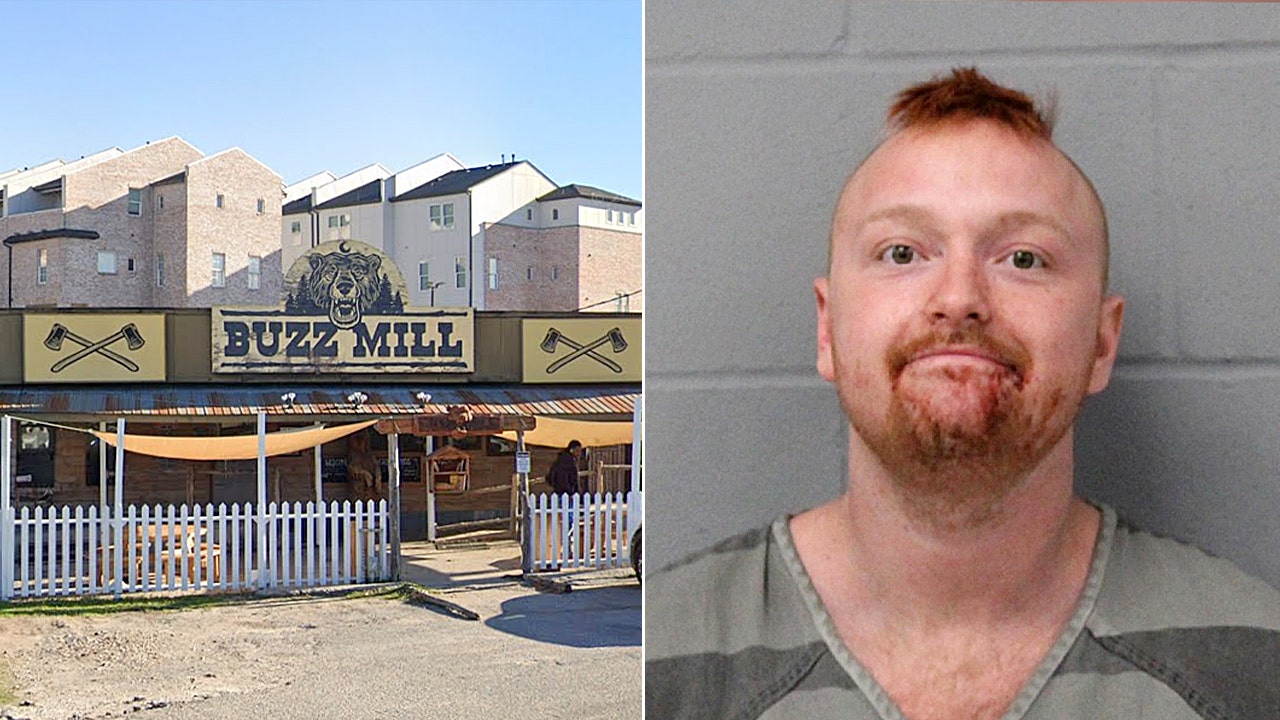
On a Wednesday evening in Austin, Texas, the neighborhood around The Buzz Mill was settling into its familiar rhythm. The coffee shop and bar, a local institution known for its welcoming patio, live music, and community events, was preparing to host a comedy show. Patrons had ordered their drinks, found their seats, and settled in for a night of laughter. Outside, the cool autumn air carried the playful spirit of Halloween, a season when people across the city slip into costumes and become someone else for a few hours. Then, without warning, that spirit curdled into something dark. According to the Austin Police Department, a young man later identified as 20-year-old Shankar Temple Grace entered The Buzz Mill wearing a Halloween costume. A witness told police that he was dressed as a zombie, his face covered in makeup. At first, he may have seemed like just another attendee, perhaps even a performer warming up for the show. But within moments, the evening unraveled. Police were summoned to the business after receiving what they classified as a “disturbance hot shot”—a term reserved for a rapidly escalating altercation involving an immediate threat to life or serious physical harm. That designation tells a story of its own: this was not a minor scuffle or a verbal disagreement, but a situation that demanded an urgent, high-priority response. When officers arrived, they found the aftermath of a knife attack, with two people wounded and the suspect already gone. The victims’ names were not immediately released, and details were slow to emerge. But the bare facts were enough to leave a city on edge: a man in a zombie costume, a coffee shop full of people, and two innocent victims caught in the middle of a nightmare.
The immediate aftermath of the stabbing was a blur of sirens, shouting, and confusion. Austin Police Department officers converged on The Buzz Mill, where the comedy show had been scheduled to begin. Inside, the mood had shifted from anticipation to terror. Some patrons had seen the attack happen directly in front of them; others had heard screams and scrambled to get out of the way. The first responders who pushed through the doors were met with a scene that no amount of training can fully prepare anyone for. One victim was lying with life-threatening injuries, the kind that make every second count. Another was hurt but in a less critical condition, their wounds painful but not immediately deadly. Paramedics worked quickly to stabilize both patients before rushing them to area hospitals. For the people who witnessed the chaos, the minutes felt like hours. For the families of the victims, the wait for news must have been agonizing. The first official update brought a measure of relief: both victims were reported to be in stable condition. That word, stable, suddenly carried enormous weight. It meant that despite the horror of the attack, there was hope. It meant that two people who had simply been in the wrong place at the wrong time had survived. It also meant that the investigation could move forward, focusing on finding the person responsible and understanding how such a violent act could occur in a place where people gather to relax and enjoy themselves.
While paramedics tended to the victims, the search for the attacker was already underway. The suspect, still wearing his zombie costume, had fled the scene in a pickup truck. In his haste to escape, he crashed into an unoccupied autonomous vehicle—one of those self-driving cars that have become a common sight in Austin and other technology-forward cities. The collision was a strange and almost surreal detail in an already terrifying story. Fortunately, no one was inside the driverless vehicle, so the crash added property damage to the list of consequences rather than another casualty. But it also showed how reckless the suspect was in his effort to get away. He was not thinking clearly; he was simply trying to disappear. Police launched a search that stretched for miles, with officers scanning streets, alleys, and public spaces. The fact that he was wearing a costume made the search both easier and harder. It made him stand out, but it also meant that witnesses might not be sure what they had seen. After a tense period of searching, officers located Grace on a walking trail roughly three miles from the scene of the stabbing. He was taken into custody without further incident. The distance he had covered on foot, after crashing his truck, suggested that he had been trying to put as much space as possible between himself and the violence he had left behind. For the officers who made the arrest, it was the end of a frantic manhunt. For the community, it was the first step toward accountability.
When Grace was finally in custody, investigators began to piece together the events leading up to the stabbing. According to a witness, the man had been dressed as a zombie, with makeup covering his face, at the time of the attack. But that was not the only notable detail. People at The Buzz Mill told police that Grace had caused a disturbance at the bar earlier in the evening, before the violence erupted. It is unclear from initial reports what that disturbance was, or how it was handled. The revelation adds a troubling dimension to the case: if there were early signs of trouble, why was the man still inside the establishment? That question is likely to be examined as the investigation continues. For now, the suspect is being held in connection with the attack, and the legal process is beginning to move forward. The Austin Police Department’s investigation will involve interviews with witnesses, a review of any surveillance footage, and a careful reconstruction of the timeline. The motive for the attack remains unknown, and authorities have not offered any public explanation. What is clear is that a random night at a coffee shop became a life-altering event for the victims, the witnesses, and even the suspect himself. There is something deeply unsettling about the image of a person hiding behind zombie makeup while committing such an act. It blurs the line between costume and reality, between the playful spookiness of Halloween and the genuine horror of violence. In a city that prides itself on creativity and self-expression, that blurring makes the incident even harder to process.
Grace was booked into the Travis County Jail and charged with two counts of aggravated assault with a deadly weapon, a second-degree felony under Texas law. The charge is a serious one, reflecting both the use of a knife and the severity of the injuries inflicted. In Texas, aggravated assault with a deadly weapon can be punished by a prison sentence of two to twenty years, along with a fine of up to ten thousand dollars, if a conviction is obtained. The decision to charge Grace with two counts underscores that both victims were present and that both are considered to have been targeted in the same violent episode. As with any criminal case, the suspect is presumed innocent until proven guilty in a court of law. His attorney, if he has one, will have the opportunity to challenge the evidence, examine the circumstances, and present a defense. The legal proceedings are likely to draw attention not only because of the nature of the crime, but also because of the unusual element of the Halloween costume. The image of a zombie mask hiding a face of violence is deeply unsettling, and it will likely follow the case through every hearing and every court appearance. For now, the criminal justice system will do its work, slowly and deliberately, in an effort to provide some measure of justice for the victims and their families. It will not erase what happened, but it will determine the consequences.
In the days after the stabbing, The Buzz Mill is likely to feel different. The comedy show that was about to begin will be rescheduled or forgotten; the laughter that once filled the room will be replaced by a heavier silence. The community that gathers there will have to process the trauma in its own way, perhaps through conversations over coffee, perhaps through a renewed appreciation for the simple act of going out at night. The victims, both now stable, face a long road to recovery—physically and emotionally. The witnesses, too, will carry the memory of what they saw. For the city of Austin, the incident serves as a sobering reminder that violence can erupt anywhere, even in the most familiar and comfortable spaces. There are no easy answers, no obvious lessons, only the quiet resilience of a community that refuses to be defined by one terrible night. The case now moves through the criminal justice system, where a young man who was once just another face in a Halloween crowd will have to answer for his alleged actions. In the meantime, the rest of us are left to wonder: what could have been done, what should have been done, and what will be done to make sure such a night never happens again. It is a question that has no quick solution, but it is one that deserves to be asked, in Austin and everywhere else, every time a night of ordinary fun is shattered by extraordinary violence.