



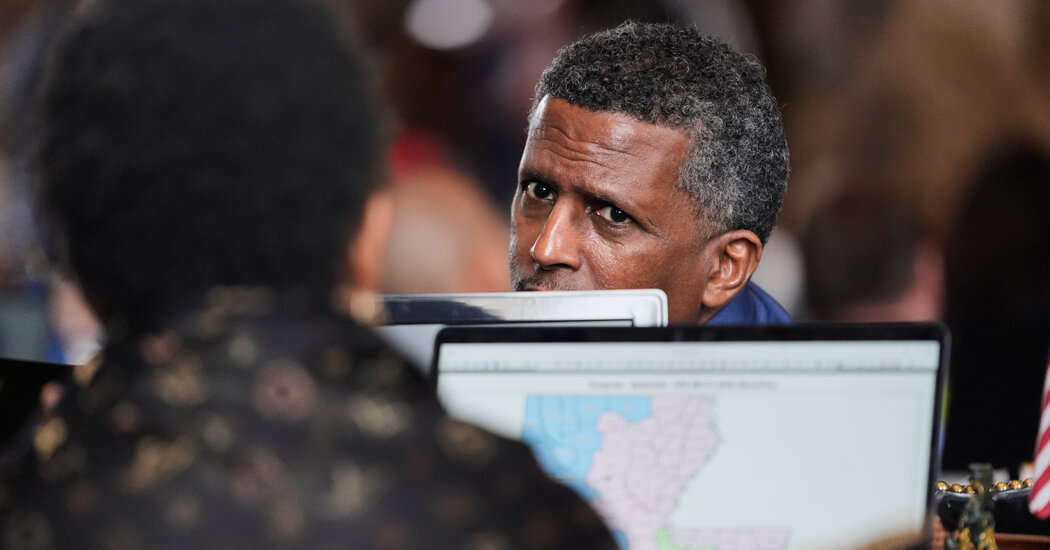
The air inside the Louisiana State Capitol in Baton Rouge on Friday was thick with the weight of a history that many in the chamber felt was being actively rewritten, or perhaps worse, forgotten. With a final, decisive vote, Louisiana lawmakers officially approved a sweeping new congressional map that dismantles one of the state’s only two majority-Black districts. In doing so, Louisiana became the second Southern state to aggressively carve up such a district since the U.S. Supreme Court weakened the landmark Voting Rights Act last month. For the state’s Black residents, who make up roughly one-third of the total population, the legislative maneuver felt less like a routine administrative adjustment and more like a profound betrayal of their democratic representation. The Republican-dominated Legislature constructed the map to secure a partisan advantage ahead of the high-stakes November midterms, leaving a community that has spent generations fighting for basic political visibility feeling sidelined once again by the cold mechanics of gerrymandering.
This dramatic redrawing of Louisiana’s political landscape is the direct fallout from a complex legal saga that began when the Supreme Court rejected the state’s previous congressional map, labeling it an unconstitutional racial gerrymander. Paradoxically, while the nation’s highest court struck down that map, its broader ruling simultaneously raised the legal bar for voters of color to bring forward discrimination claims under the historic 1965 Voting Rights Act—a crown jewel of the Civil Rights movement designed to prevent Southern states from diluting the power of minority voters. Armed with this new, more lenient legal standard, conservative legislatures across the American South quickly seized the opportunity to debate and dismantle majority-Black districts that had long been protected under federal law. In Louisiana, the legislative response was swift and uncompromising; lawmakers pushed through the changes after weeks of intense backroom negotiations, waiting only for the signature of Republican Governor Jeff Landry, which is widely considered a certainty.
At the very heart of this political storm is Congressman Cleo Fields, a prominent Black Democrat whose newly dissolved district has now been reshaped to heavily favor its new conservative electorate. Fields, a veteran politician whose career has been defined by advocacy for underrepresented communities, now faces an uncertain future, leaving his constituents wondering who will speak for them in the halls of Congress. The sudden disruption has cast a heavy shadow of confusion over the state’s electorate, especially because the primaries for Louisiana’s six House seats have been abruptly rescheduled to November 3—nearly half a year later than the state’s other primary contests. For the average voter, navigating these changing dates and disrupted boundaries feels like a direct assault on their agency. State Representative Kyle M. Green Jr., chairman of the House Democratic caucus, lay bare the emotional reality of the debate on the House floor, asserting that using dry, technical terms like “communities of interest” and “district boundaries” was merely a polite way of masking a deliberate effort to diminish Black political power. Green implored his colleagues to remember that asking Louisiana to be “colorblind” in its politics requires an intellectual amnesia that ignores centuries of systemic segregation and racial struggle.
On the other side of the aisle, Republicans fiercely defended the new boundaries, insisting that their motives were purely political rather than racial, framed entirely around securing their party’s dominance in state and national politics. Beau Beaullieu, the Republican State Representative who championed the map on the House floor, even went so far as to claim that he instructed his staff to turn off the computer feature displaying racial demographic data to ensure the drafting process remained strictly objective. Despite these claims of impartiality, the final map tellingly safeguards the districts of powerful Republican incumbents, including House Speaker Mike Johnson and House Majority Leader Steve Scalise, while systematically neutralizing the competitive edge Democrats gained when Fields flipped the Sixth Congressional District in 2024. The newly squeezed district, which once stretched across the state to connect diverse communities, is now a compact sliver confined strictly to the southern region. This rapid, insular redrawing of the lines even drew sharp criticism from within the Republican party itself; Congressman Clay Higgins, an outspoken conservative representing the Gulf Coast, publicly decried the map on social media, calling it a “Frankenstein” creation drawn by a select few in a secret room and urging his followers to reject what he deemed an “insanely bad” piece of legislation.
Even as the state legislature celebrates its victory, the shadow of imminent and endless litigation hangs heavily over Louisiana’s political horizon. Both sides of the aisle acknowledge that the new map is far from a final resolution, with State Senator Jay Morris pragmatically noting that in the polarized landscape of modern redistricting, passing any map without triggering a flurry of opposing lawsuits is an impossibility. In a fascinating and complex twist, the very coalition of voters who successfully sued to overthrow the state’s previous map as a racial gerrymander has refused to accept this new compromise, which leaves only a single majority-Black district intact in New Orleans. In a court filing submitted just before the legislative session closed, these advocates argued that the new map continues to violate the Equal Protection Clause of the Constitution by keeping the New Orleans district isolated, illustrating how deeply contested the definition of fair representation remains in a state still healing from its past.
As Louisianans prepare for a delayed and highly contentious election season this November, the human cost of this legislative battle stretches far beyond the borders of any single congressional district. For the millions of citizens who call the state home, the redrawn map represents a fundamental question about whose voices carry weight in the American democratic experiment and whose are deemed expendable in the pursuit of partisan power. The shifting lines on Louisiana’s political map do not just determine which party controls a seat in Washington; they draft the daily reality of communities relying on federal representation for resources, civil rights protections, and economic investment. While lawmakers safely ensconced in the state capitol look ahead to strategic midterm victories, the people of Louisiana are left to navigate a fractured political landscape, waiting to see if the courts will once again intervene, or if the music of their collective voice has been permanently quieted.