


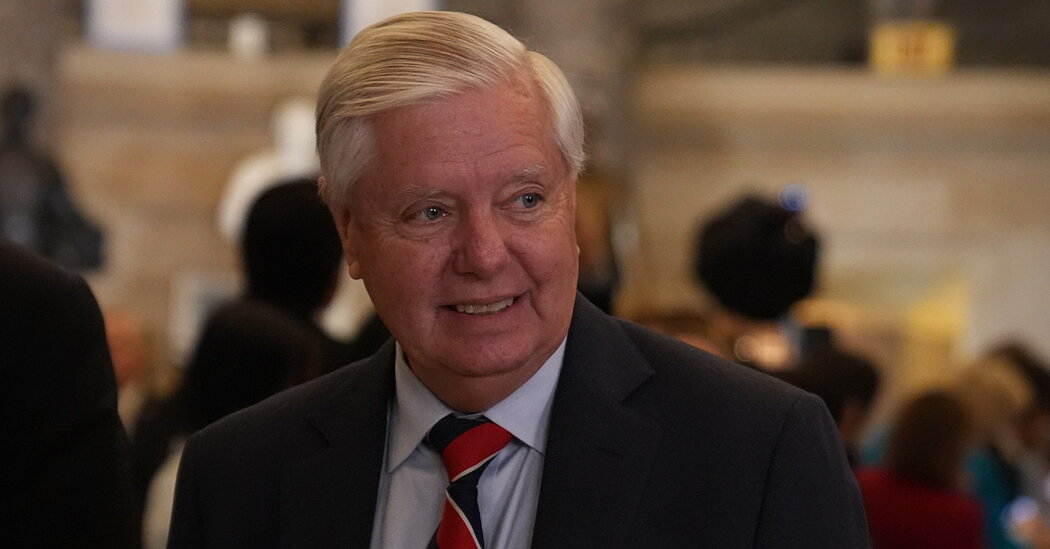
The humid evening air of South Carolina on Tuesday carried a heavy weight of suspense for Senator Lindsey Graham, a man who has spent more than two decades walking the tightest of tightropes in modern American politics. As voters filed out of polling stations across the Palmetto State, the veteran four-term incumbent faced the very real and potentially humiliating prospect of being forced into a primary runoff election—a messy, prolonged battle that would have signaled deep vulnerability and dissatisfaction in his beloved home state. Yet, as the final ballots were carefully counted and the Associated Press officially called the race in his favor, Graham and his exhausted campaign team finally breathed a collective, deeply felt sigh of relief. By securing an outright victory against a crowded and aggressive field of five eager Republican challengers, he managed to bypass the dreaded fifty-percent threshold hurdle, entirely avoiding a grueling extra month of head-to-head campaigning that would have tested his political survival skills to their absolute limit. This was not merely another routine primary victory for a seasoned lawmaker; it was a deeply personal validation of Graham’s unique, often controversial brand of political resilience. The victory party, filled with weary staffers and loyal allies who had spent months in the trenches, marked the successful end of a highly stressful chapter, proving once again that despite the constant shifting of the political sands beneath his feet, Graham still possesses a remarkably sharp instinct for self-preservation. To truly understand the gravity of this victory is to appreciate the immense psychological pressure of modern political primaries, where a single miscalculation or public misstep can instantly erase decades of public service and leave even the most established political giants vulnerable to the fury of an increasingly restless, change-hungry electorate. For Graham, Tuesday night was a stark, humbling reminder that while the cost of maintaining power has skyrocketed, his ability to read the room and execute a defensive strategy remains one of his most formidable assets in a volatile landscape.
The primary threat to the senator’s long-standing reign came in the formidable shape of Mark Lynch, a wealthy, energetic, and highly ambitious businessman hailing from the bustling, conservative hub of Greenville. Lynch did not just challenge Graham; he launched a full-scale, multi-million-dollar assault on the veteran politician’s entire record, utilizing his own personal fortune to fund a relentless campaign that painted the incumbent as an outdated, compromised relic of a bygone Washington era. This was a classic battle of ideologies and resources, with Lynch portraying Graham as insufficiently dedicated to the foundational tenets of the “Make America Great Again” movement. The challenger focused much of his fire on Graham’s traditionalist, hawkish foreign policy stances, specifically lighting into the senator’s vocal defense of military action in Iran, which Graham has long championed as an absolute necessity for ensuring the national security underpinnings of Israel. This narrative of a disconnect between an elite Washington insider and the grassroots populist base gained enough traction to terrify Graham’s campaign apparatus, sparking fears of a catastrophic runoff. In response to the looming danger, Graham’s team and his allied political action committees unleashed an unprecedented and astonishing financial counteroffensive designed to flood the airwaves and drown out Lynch’s message. According to detailed data compiled by the media tracking firm AdImpact, the pro-Graham forces poured a staggering $18 million into political advertisements starting in early January 2025 alone. This massive, saturated media blitz highlights the sheer desperation and the immense monetary cost currently required to shield an incumbent from a well-funded, populist challenger who is capable of tapping into deep-seated voter frustration and isolationist sentiments.
To completely understand how Graham managed to withstand such a fierce, well-funded populist surge, one must examine the towering, omnipresent shadow of Donald J. Trump, whose influence over the modern Republican Party remains absolute and highly unpredictable. The former president’s endorsement has become the ultimate currency in primary politics, capable of elevating political newcomers or instantly destroying the careers of seasoned veterans. This dynamic was vividly demonstrated earlier in the year in Texas, where Senator John Cornyn was forced into a grueling and politically damaging Republican runoff that he ultimately lost to Ken Paxton—a devastating defeat that was heavily accelerated by the fact that Paxton, rather than the long-serving senator, had secured Trump’s highly coveted blessing. However, in the politically crucial state of South Carolina, the former president made the calculated decision to stand passionately and firmly behind Graham. Trump’s defense of the incumbent was characteristically loud and unsparing; in an abrasive social media post in April, he publicly labeled Lynch a “LUNATIC” and pointedly aligned him with Representative Thomas Massie of Kentucky, a frequent and highly vocal Trump skeptic whom the former president had personally helped defeat in a bitter primary election just a month prior. This aggressive intervention by Trump effectively acted as a protective shield for Graham, blunting Lynch’s populist attacks and sending a clear signal to the MAGA faithful that, despite any lingering personal doubts they might harbor, the leader of their movement still considered the veteran senator to be a vital and trusted ally in his broader political coalition.
Yet, for Graham, maintaining his standing within this populist movement represents one of the most intellectually fascinating and emotionally exhausting tightrope walks in contemporary American history. He is a truly rare political actor: a traditional, old-school Republican who once fiercely criticized Trump during the highly contentious 2016 primary, only to transform himself into one of the former president’s most loyal defenders, advisory voices, and personal golfing partners. This dramatic evolution has earned him the deep-seated suspicion of a large, vocal segment of the populist grassroots base, who view his conversion with intense skepticism. It is a striking, deeply human paradox that while Graham holds the official, written endorsement of Donald Trump, he is still routinely greeted with a chorus of loud, echoing boos whenever he appears on stage at massive Trump rallies in his own home state. Standing before thousands of his own constituents, feeling the undeniable sting of their public rejection, and yet choosing to smile, press forward, and deliver his speech is a testament to Graham’s extraordinary political pragmatism and thick skin. These moments of public friction lay bare the complex reality of his existence; he is a politician caught between two worlds, constantly forced to prove his populist credentials to a base that fundamentally distrusts his traditionalist foreign policy views, all while relying on the top-down authority of a single leader to keep his career alive.
With the exhausting and politically bruising primary finally behind him, Graham can now lift his gaze toward the general election in November, where he enters the fray as the overwhelming favorite to retain his seat in a state that has not elected a Democrat to the Senate in decades. Standing in his path is the Democratic nominee, Dr. Annie Andrews, a highly respected pediatrician whose background in healthcare offers a stark, compassionate contrast to the hyper-partisan, multi-million-dollar combat of the Republican primary. Andrews’ campaign is rooted in a lifetime of caring for children and families, presenting a narrative centered on local community well-being, public health, and social stability—a sharp divergence from Graham’s grand, global sweep of foreign policy debates and Washington power struggles. While the political mathematics of deep-red South Carolina make a Democratic victory an incredibly steep, almost insurmountable mountain to climb, Andrews’ presence on the ballot ensures that Graham cannot simply take his re-election for granted. Her campaign will force him to engage with the real-world, everyday anxieties of ordinary South Carolinians who are grappling with maternal care crises, childhood health concerns, and economic instability. This upcoming contest will set up a compelling debate between Graham’s long legacy of Washington influence and global strategy, and Andrews’ local, care-focused perspective, reminding voters that politics eventually has to come home to the people it supposedly serves.
Ultimately, Lindsey Graham’s dramatic triumph in Tuesday’s primary serves as a vivid, sobering window into the tireless and often ruthless machinery of modern American democracy. The sheer velocity of the campaign, coupled with the astronomical $18 million spent on television and digital advertisements, underscores a system where political longevity is never truly permanent and must be constantly repurchased at an eye-watering cost. As Graham prepares to transition his focus toward the November general election, he does so having once again defied his critics, demonstrating an uncanny ability to adapt, survive, and outmaneuver his opponents in a party that has rapidly evolved around him. Yet, the physical and emotional scars left by this primary are undeniable, offering a constant reminder of how precarious political power has become in an era defined by deep division, populist outrage, and fluctuating personal loyalties. Graham has secured his immediate political future, but the lingering echoes of the boos at the rallies and the multi-million-dollar challenge from his own right flank suggest that the deeper struggle over the soul of the Republican Party is far from resolved. For now, the veteran senator can claim victory, but he knows all too well that in the modern political arena, survival is a daily battle, and the peace he bought on Tuesday night is only temporary. (Reporting contributed by Matt Zdun)