


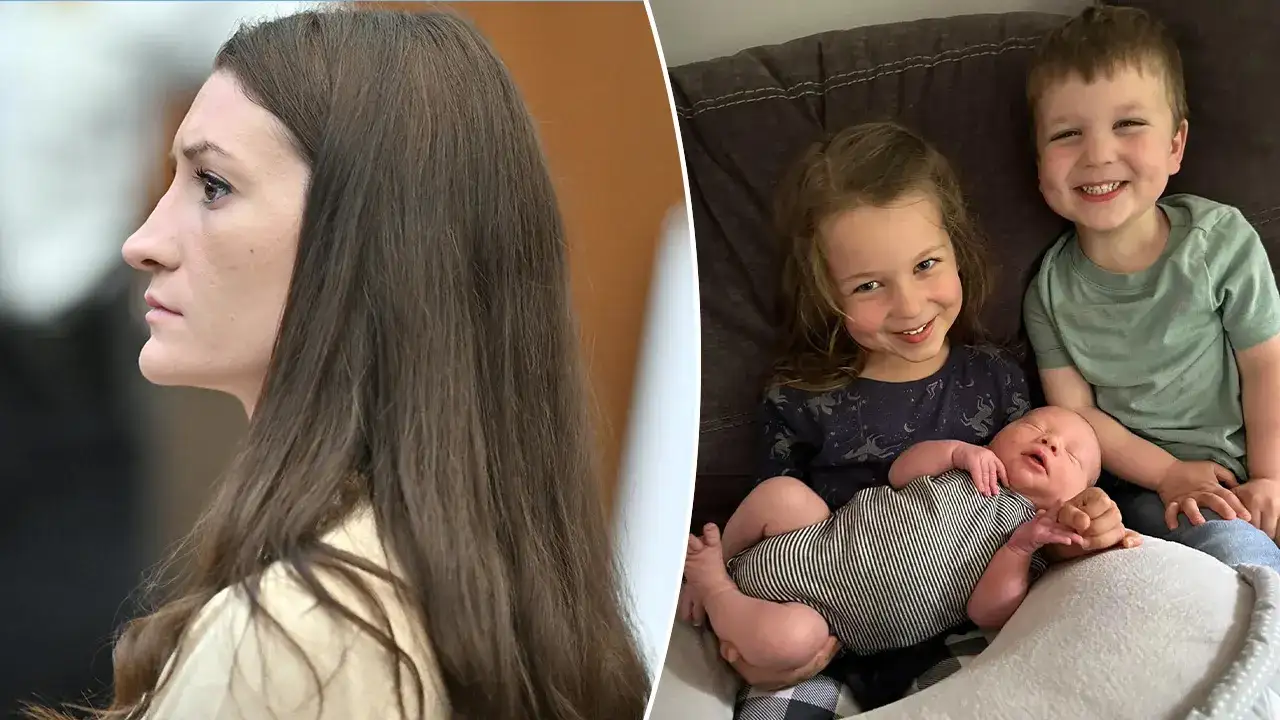
In a Massachusetts courtroom, the trial of Lindsay Clancy ended not with a verdict but with a fractured jury and a mistrial, leaving a grieving family, a divided public, and a legal system grappling with one of the most heartbreaking questions a jury can face: what happens when a mother kills her own children, and her mind is so broken that she cannot be held criminally responsible? Lindsay Clancy, a 65-year-old former nurse and mother of three, stood accused of strangling her children—Cora, 5, Dawson, 3, and eight-month-old Callan—with exercise bands in their home. Her defense never denied that she committed the act. Instead, her lawyers argued that she was in the grip of postpartum psychosis, a severe mental health crisis that rendered her incapable of understanding right from wrong. The prosecution argued that she planned the killings and should be held accountable for first-degree murder. After weeks of testimony, the jury emerged deadlocked, 11 to 1, with the majority favoring a finding of not criminally responsible. The lone holdout, the only Black person on the jury, refused to convict but also refused to accept the insanity defense, and the judge had no choice but to declare a mistrial. The case was always going to be a lightning rod, but the aftermath has revealed something even more troubling: the jury itself may have been thinking not about the law, but about the future of women and families everywhere.
One of the jurors, Paula Devlin, has since spoken publicly about what happened inside the deliberation room, and her words have stirred both sympathy and alarm. Devlin told CBS Saturday Morning that the jury understood the weight of the moment, not just for Lindsay Clancy, but for society. “Even though we didn’t know what was going on outside of our little bubble that we were in, we knew that this was a turning point, and this would be something that could change something to make it better for other women in the future, for other families,” she said. She added, “You know, justice for those children is this never happening again.” For Devlin, the verdict was never just about one woman or one family. It was about preventing future tragedies, about sending a message that the system must do more to protect mothers and children from the devastating effects of untreated or unrecognized postpartum mental illness. She described the jury’s evolution: at one point, eight jurors were firmly in favor of finding Clancy not criminally responsible, two were undecided, and the holdout plus one other juror were leaning toward guilt. The deliberation was long and emotional, with jurors poring over evidence, listening to expert testimony, and trying to make sense of a case that seemed to defy ordinary moral categories. But Devlin’s framing—that the jury saw itself as making a difference for other women—has raised eyebrows among legal experts, who worry that the jury may have overstepped its role.
Neama Rahmani, a Los Angeles-based trial attorney and legal analyst who has followed the case closely, called Devlin’s statement “problematic.” In his view, a jury’s job is not to change the world, but to decide the facts of a specific case. “Jurors are supposed to decide cases solely based on the facts of that case,” Rahmani said. “In the Clancy case, they were to decide whether she was criminally responsible.” He emphasized that the jury’s role is to apply the law, not to make law, and that considering the broader social impact of a verdict is inappropriate. “It is not appropriate for the jurors to consider the impact of their decision on other women, children or cases,” he told Fox News Digital. Rahmani acknowledged that there is little that can be done about it now. The judge has already declared a mistrial, and the law generally prohibits inquiry into juror deliberations. There is an exception for outside influences that may prejudice the jury, but that would require an additional inquiry into whether jurors considered information from traditional or social media, or whether Devlin’s comments were simply her own interpretation of the case’s importance. Still, the concern remains: if jurors are deciding cases based on what they hope will happen in the future, rather than what the evidence shows in the present, the entire foundation of the justice system is shaken. The law is supposed to be blind, and juries are supposed to be the embodiment of that principle—neutral, impartial, and focused solely on the evidence before them.
The holdout juror, who has not spoken publicly, has become a figure of intense curiosity and, in some circles, sympathy. Several jurors and Clancy’s defense attorney, Kevin Reddington, have claimed that the holdout did not show his fellow jurors the evidence that he believed pointed toward guilt beyond a reasonable doubt. Devlin told CBS, “If he had shown us some evidence, then we all would have been OK with that.” The implication is that the holdout may have had reasons for his position that he never fully articulated, leaving the other jurors frustrated and confused. The holdout has not responded to Fox News Digital’s attempts to reach him, and as of Monday, he had not spoken publicly about the case. In the meantime, a GiveSendGo fundraiser has been launched to benefit him, and it has already raised over $115,000. According to the organizer, the money is meant to cover “security, lawyers [and] lost work.” The fact that a juror would need security and legal representation after a mistrial speaks to the intense public scrutiny and potential backlash that comes with being the lone holdout in a case involving the deaths of three children. It also raises uncomfortable questions about whether jurors can truly deliberate freely when they know that their decisions will be dissected by the media, criticized by the public, and possibly even used as a fundraising cause. The holdout’s silence leaves a void, and into that void have rushed speculation, anger, and a growing sense that the justice system may have failed not only the Clancy children, but also the very idea of a fair trial.
Amid all of this, the children’s father, Patrick Clancy, has been trying to move forward with his life in a way that has also drawn public attention. Over the weekend, he was photographed vacationing in the Hamptons with his new wife, Rachel Danis, at the Milk Pail farm stand on Montauk Highway in Water Mill. The image, obtained by TMZ, shows a man who has lost three children and a wife to a tragedy that would break almost anyone, now appearing to enjoy a sunny weekend with a new partner. For some, this is a sign of resilience and the human capacity to heal. For others, it is jarring, even painful, to see a father who lost so much smiling at a farm stand while the legal case surrounding his children’s deaths remains unresolved. Patrick Clancy has not spoken publicly about the vacation, and it is not fair to judge a grieving father for how he copes with unimaginable loss. But the image is a reminder that the aftermath of this case is not just about legal arguments and juror deliberations. It is about real people, real lives, and the messy, complicated ways that people survive tragedy. Patrick has also been a central figure in the case itself, testifying about his wife’s mental health struggles and the events leading up to the killings. He has said that he forgives Lindsay, and he has spoken about the importance of mental health awareness. His presence in the Hamptons, with a new wife, suggests that he is trying to rebuild a life that was shattered, even as the world continues to debate what should happen to the woman who killed his children.
The Clancy case is far from over, and its implications extend well beyond the courtroom. Lindsay Clancy still faces three counts of first-degree murder, and her defense team has indicated that it plans to file a new motion to dismiss after the jurors spoke out about the mistrial. The legal battle will continue, and the question of whether she will be retried, or whether the charges will be dropped, remains unanswered. But the case has already ignited a national conversation about postpartum psychosis, the criminal justice system’s treatment of mental illness, and the role of juries in cases that touch on deeply emotional social issues. Devlin’s comments, however well-intentioned, have exposed a troubling reality: juries are made up of human beings, and human beings bring their hopes, fears, and desires for a better world into the deliberation room. The law asks them to set those aside, to focus only on the evidence and the instructions given by the judge. But in a case like this, where the facts are horrific and the mental health issues are so complex, it is almost impossible to separate the legal question from the moral and social one. Was Lindsay Clancy a murderer, or was she a victim of a disease that stole her mind? The jury could not agree, and the mistrial means that the question remains open. For the children, there is no justice that can bring them back. For the mother, there is no verdict that can undo what she did. And for the rest of us, there is only the uncomfortable truth that sometimes the law is not enough to heal the wounds that tragedy leaves behind. The case has become a turning point, as Devlin said, but not necessarily in the way she hoped. It has turned a spotlight on the cracks in the system, the limits of the law, and the profound difficulty of finding justice in a world where some acts are so terrible that no verdict can ever feel right.