

On a quiet Sunday morning off the coast of Malibu, what should have been a peaceful fishing trip turned suddenly into a terrifying fight for survival. Just after dawn, with the ocean still calm and the morning light soft over the water, a kayaker was out near the popular café at Paradise Cove, doing something that has been done along that coastline for generations. He was alone with the sea, likely hoping for a good catch and an hour of solitude before the weekend crowds arrived. The water looked inviting, almost tranquil, and nothing about the scene suggested danger. But at around 8:30 a.m., that delicate stillness was shattered. In a flash, a shark struck the kayak and bit the man on the lower part of his body, delivering at least two bites before the ordeal was over. The first attack was so sudden and violent that it knocked him from his kayak and into the water. What followed must have been a blur of pain, adrenaline, and disbelief — the kind of moment that moves in slow motion and yet is over before the mind can make sense of it. The ocean, which had been a place of peace and recreation, had become something wild and unfamiliar, and the kayaker was no longer a fisherman but a victim, struggling to stay afloat and survive.
The details of the attack, as reported early on, describe a scene that was both chaotic and frighteningly direct. Preliminary reports suggested the shark was a small mako, a species known for its speed and aggressive nature. A mako may not carry the cultural weight of a great white, but in the water, it is a powerful and fast predator, more than capable of doing real damage to a person. According to witnesses, the shark bit the man the first time, causing him to fall into the oceanched. Then, instead of swimming away, the shark circled back and struck a second time. That additional bite is what makes this attack so particularly terrifying — the animal wasn’t just acting on a confused instinct; it was returning to finish its intentions concern. For the man in the water, that moment between the first strike and the second must have been absolutely crushing. He had no weapon, no shield, no way to defend himself other than the instinct to survive. He was exposed in open water, vulnerable to a creature that was faster and stronger, and yet he kept fighting. The sheer will to live, to get back to the surface, to stay conscious and aware, is something that cannot be measured in news reports. Every second in that water was a second of uncertainty, and every movement he made could have been his last.
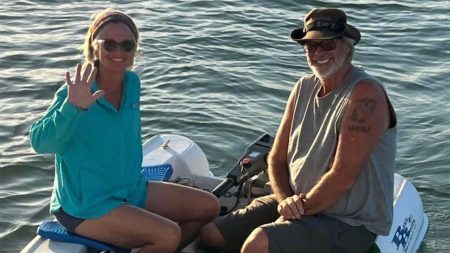
Help, though, was closer than he might have realized. A nearby fisherman had seen the attack unfold and didn’t think twice. In the kind of split-second decision that defines heroism, he moved his boat toward the victim, reached into the water, and pulled the injured man from the ocean. There is something profoundly human about that rescue — not because it was dramatic or extraordinary, but because it was simply what needed to be done. A complete stranger saw another person in danger and acted without hesitation. He didn’t stop to think about the danger of an injured man, or the possibility that the shark was still nearby, or the risk to his own safety. He just went. Once the victim was safely on board, the immediate danger had passed, but the crisis was far from over. The man called his girlfriend, a retired lifeguard, and in that incredible phone call, the story took on a new layer of resilience. She received the news that no partner ever wants to hear, but instead of collapsing into panic, she tapped into everything she had learned over years of training and experience. She contacted 911 immediately, setting into motion a rescue response that would bring Los Angeles County lifeguards to the scene. It is impossible to know what was said in that call, but the outcome speaks to her composure and quick thinking. She was the calm in the middle of a storm, the voice on the other end of the line that helped connect a bleeding man in a boat to the help he desperately needed.
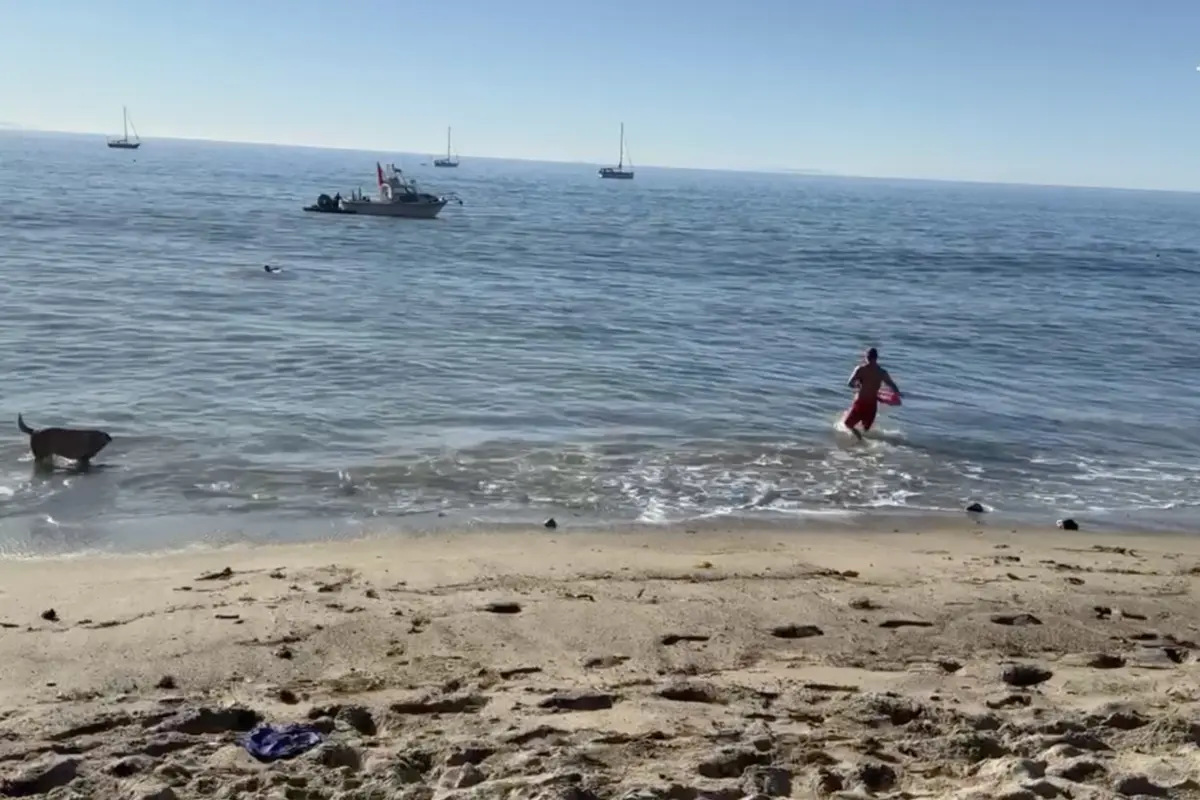
The arrival of the lifeguards marked the beginning of the transition from survival to recovery, but the scene remained tense and uncertain. Los Angeles County lifeguards responded to the area and worked to bring the victim safely back to shore, where an ambulance was waiting to transport him for treatment. Video from the scene shows a lifeguard rushing through the water, pushing through the surf, part of a larger effort to get the injured man out of the ocean and onto stable ground. The footage reveals surprisingly calm conditions along the Malibu coastline, with a small boat nearby and a man seen swimming toward it at one point, though it remains unclear whether that man is the kayaker who had been attacked. What is striking about the footage is that it shows no obvious signs of danger; the water looks like it would on any ordinary Sunday morning, clear and invitingcasual. There is no great shadow circling beneath the surface, no dramatic splashing, no visible evidence of the violence that had just occurred. That contrast — between the chaos of the attack and the serenity of the footage — makes the incident even harder to process. Officials have not yet publicly confirmed the shark species, and additional details about the victim’s injuries have not been released. The circumstances surrounding the encounter remain under investigation. For now, the public is left with fragments: a funny fisherman, a man bitten and bleeding, a woman on the phone, lifeguards in the water, and an animal that may never be identified with certainty. In the absence of official answers, the story becomes a collection of human moments stretched across an unresolved event, and the waiting itself is a kind of anxious uncertainty that many people in the community feel along with the victim.
This attack also serves as a reminder that the ocean is never entirely under human control, and in Southern California, shark encounters are part of the natural landscape, even if they are rare. Sharks venture into shallow coastal waters for a variety of reasons, most often driven by the search for food. Warm water, shifting tides, and concentrations of baitfish all work together to bring prey closer to shore, and sharks naturally follow. Along the Southern California coastline, sharks can be found relatively close to shore throughout the year, and their activity tends to increase during the warmer months when more people are in the water option. Some species use these shallow areas as nursery grounds, particularly when juvenile sharks are present. That means sharks are not invading or behaving strangely by swimming near beaches — they are simply being sharks, responding to the same environmental cues that have guided them for millions of years. The timing of this attack, in the morning hours near dawn, also overlaps with periods of increased shark activity, when lower light and the movement of prey create more favorable feeding conditions. For beachgoers and lifeguards, the incident is a sobering reminder to stay aware, to respect the water as a wild environment, and to understand that encounters, while uncommon, are possible. But it is also a reminder that the ocean does not have to be feared in order to be respected. The shark in this story may not be an evil monster, but simply an animal doing what hungry animals do in a habitat that humans have chosen to share. That understanding doesn’t diminish the seriousness of the attack or the suffering of the victim, but it does ground the event in a broader context.
In the end, this is a story about vulnerability and connection. A kayaker set out on the water that morning just as thousands of other people will set out this weekend, never imagining that within a matter of seconds his life would be changed. He was attacked, injured, and thrown into the water, and yet he survived because a stranger decided to help, because a retired lifeguard knew how to respond to an emergency, and because trained professionals raced to the scene to bring him home. The shark, whether a mako or something else, will likely never be found or identified, and the exact details of the attack may never be fully known. What is known is that a human being was hurt and frightened, and other human beings responded without hesitation. As the investigation continues)Skip, the focus should remain on the victim’s recovery and the quiet courage of everyone involved. The ocean off Malibu will still be beautiful tomorrow. The kayakers will still paddle out at dawn, and the fishermen will still cast their lines. But for one man, that stretch of water will never feel the same. What happened off Paradise Cove is a reminder of how quickly life can change, and of how, even in the most terrifying moments, we are never entirely alone. That is the real human story in this incident — not the fear, not the violence, but the way ordinary people rise to meet extraordinary moments. And in that, there is something worth holding onto.